After writing about why you don’t need to feel sore to get stronger , there is one question that keeps coming up:
I understand why people think that.
For years, fitness has been sold as:
Sweat more.
Burn more.
Push harder.
Rest less.
Leave exhausted.
If you walk out of the gym feeling reasonably good, it almost feels like you cheated.
“Was that really enough?”
I hear versions of this all the time.
“That felt pretty easy.”
“I wasn’t sore after the last session.”
“I thought I’d be sweating more.”
“I feel like I could have done more.”
And somehow that gets translated into:
“The training must not be working.”
No.
That is simply the wrong way to judge a workout.
Being sore does not prove the session worked.
Being exhausted does not prove the session worked.
Sweating more does not prove the session worked.
Harder is not automatically better.
Better is better.
The “No Pain, No Gain” Trap
Somewhere along the way, we started judging workouts by how much they hurt.
If you’re sweating everywhere, your legs are shaking and you can barely walk down the stairs afterwards?
Great session.
If you finish feeling like you probably could have done a little more?
Must have been too easy.
I think that is a terrible way to judge training.
Because making someone tired is easy.
Making someone sore is easy.
Give me enough burpees, lunges, jump squats and high-rep exercises they haven’t done for a while and I can probably make almost anyone sore.
That doesn’t automatically make it good training.
The purpose of training is to create an adaptation.
Get stronger.
Build fitness.
Move better.
Improve what your body can handle.
Then recover and come back to do it again.
“But It Felt Too Easy”
Good.
Maybe it was supposed to.
Not every session should feel like a test.
Sometimes you are learning a new movement.
Sometimes we are gradually building the weight.
Sometimes we deliberately leave a little in reserve.
Sometimes you are returning from illness, injury or time away.
Sometimes we want to see how your body responds before asking for more.
And sometimes the session feels easier because you are getting fitter and stronger.
That last one seems to surprise people.
Something that used to feel hard starts feeling easier.
The kettlebell that once felt heavy doesn’t anymore.
You recover quicker between sets.
You finish the session with more energy.
That may be evidence that you are.
Soreness Tells Me You’re Sore
DOMS stands for Delayed Onset Muscle Soreness.
It often appears 24–72 hours after training, particularly when you do something unfamiliar, increase the amount of work you are doing or perform movements your body isn’t accustomed to.
It can happen after a good session.
It can also happen after a badly programmed session.
Soreness is a response to training. It is not a score for training quality.
You can become considerably stronger without spending every week limping around the office.
Muscle soreness and muscle damage are not requirements for getting stronger or building muscle.
Sometimes you will be sore.
That’s fine.
We just don’t chase it.
How We Prefer to Train
A lot of the strength training we use at Adaptive Strength is built around a fairly simple philosophy:
Lower reps. Heavier weights.
Longer rest periods.
Precision and control over speed and chaos.
That doesn’t mean every exercise is heavy.
And it doesn’t mean there is no conditioning.
But when we are trying to build strength, we want you performing good-quality repetitions with appropriate resistance.
Then resting enough to do another good-quality set.
Not turning every strength session into cardio because apparently you need to be gasping for air for the exercise to count.
Sometimes strength training looks surprisingly calm from the outside.
Then pick up the kettlebell.
We Train. We Don’t Try to Destroy You.
At Adaptive Strength, I want you to train hard enough to create change.
But I also want you to recover.
I want you to be able to come back.
I want the next session to be productive too.
I want you training next month.
Next year.
And years from now.
That doesn’t mean training is always easy.
Some sessions should be hard.
Some exercises should challenge you.
Some sets should make you work.
But hard is a tool.
It is not the objective.
What About Weight Loss?
This is where people really struggle with the idea.
If the workout didn’t leave you dripping with sweat, surely you didn’t burn enough calories?
But losing body fat is not a competition to see how many calories you can destroy in a 45-minute session.
What you eat matters.
Your overall activity matters.
Your training matters.
And doing those things consistently matters enormously.
Strength training is particularly useful when weight loss is the goal because I don’t just want the number on the scales to go down.
I don’t want you becoming a smaller, weaker version of yourself.
I want you losing body fat while keeping — and ideally building — muscle and strength.
That is what helps create the leaner, firmer, more “toned” look most people are actually chasing.
Less body fat. More muscle. More strength.
Not just less body weight.
I want you becoming lighter and stronger.
Leaner and more capable.
If weight loss is the goal, I don’t just want less of you.
You do not need endless HIIT.
You do not need every workout to turn into a cardio circuit.
You do not need to crawl out of the gym for weight loss to happen.
You need to train effectively and keep doing it.
Sweat Is Not a Fat-Loss Score
Sweating feels productive.
You can see it.
You can feel it.
Your shirt is soaked, your heart rate is high and the session feels hard.
So it is easy to think:
“I must have burned heaps of fat.”
But sweat is primarily your body trying to cool itself.
It is not a report card telling you whether your weight-loss plan is working.
A hard cardio session can absolutely be useful.
So can walking.
So can strength training.
So can improving what you eat.
The mistake is believing the session that feels the most brutal must automatically be producing the best result.
Recovery Is Part of the Program
Here is something I think people forget:
You have work.
Kids.
Sport.
Gardening.
Walking.
Sleep.
Stress.
And hopefully another training session coming up.
If every workout leaves you so sore and exhausted that you can barely move for three days, I don’t automatically see that as evidence of a great program.
Sometimes I see it as evidence that we did too much.
If your legs are destroyed for four days, you may walk less.
You may skip your next session.
You may feel tired and flat.
You may stop enjoying training.
And eventually, you may stop altogether.
The goal isn’t to win today’s workout.
The goal is to keep progressing over time.
That is why recovery matters.
So How Do I Know If It’s Working?
Progress should be measured by progress.
Are you lifting more than you were three months ago?
Can you do more repetitions with the same weight?
Are you moving through a range you couldn’t before?
Is your balance better?
Does the same session now take less effort?
Can you walk further?
Are everyday things easier?
Are your clothes fitting differently if weight loss is a goal?
Are you actually training consistently?
Those are things I care about.
How sore you are on Wednesday morning?
Much less.
Stop Judging Your Training by How Much It Hurts
I genuinely want people to stop doing this.
“I wasn’t sore, so it didn’t work.”
“I wasn’t exhausted, so I didn’t train hard enough.”
“I didn’t sweat enough, so I couldn’t possibly lose weight.”
That is not how I judge a good training program.
That’s the question.
Are you stronger?
Moving better?
Fitter?
More capable?
Recovering well?
Turning up consistently?
Then the training is doing its job.
You don’t need every workout to remind you for the next three days that you went to the gym.
You need your body, six months from now, to show you that the training worked.
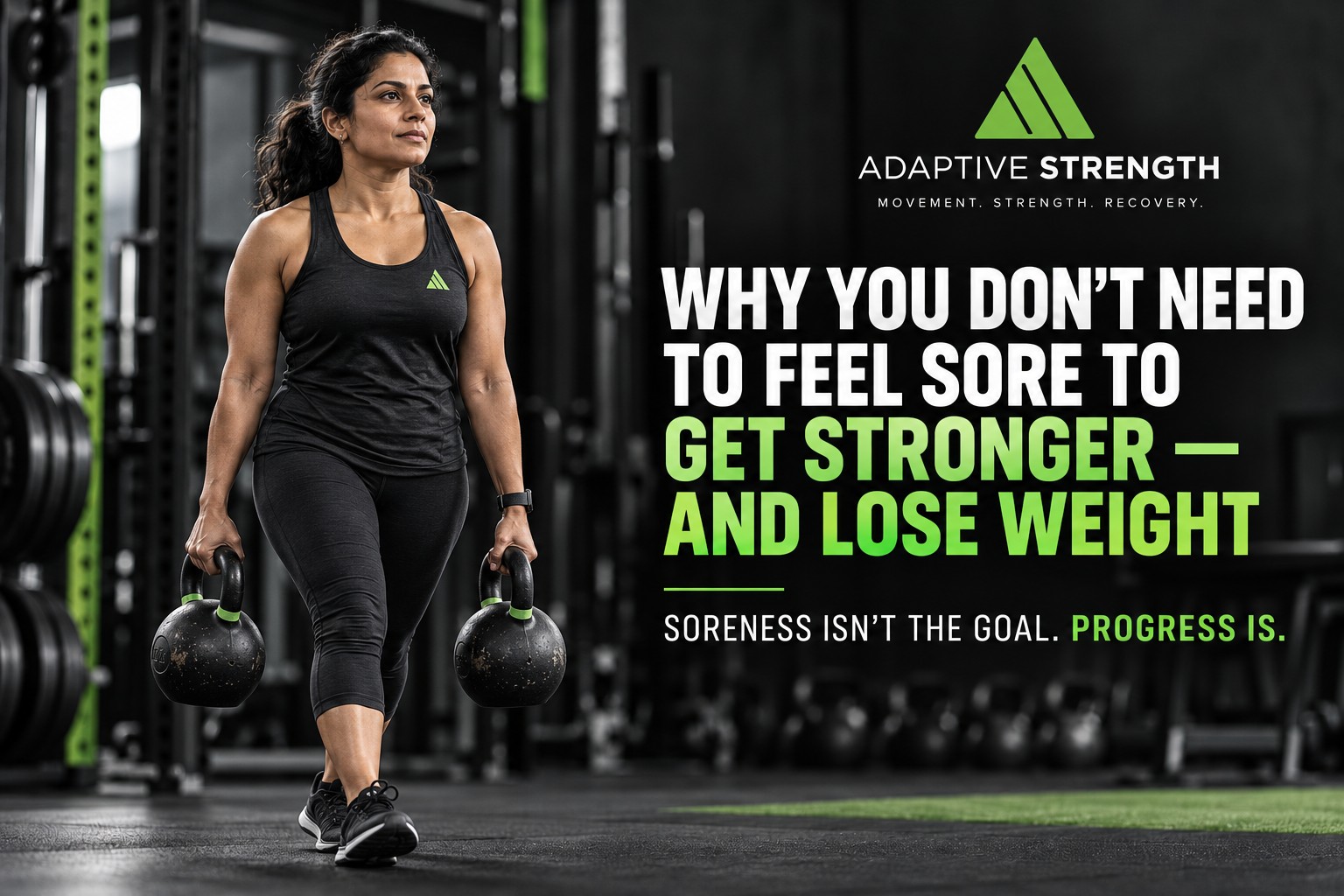
Soreness is not the goal.
Progress is.
Want to Get Stronger and Lose Weight Without Trying to Destroy Yourself?
If you want an individual strength program that helps you get stronger, improve your fitness and work towards losing weight without feeling like every session needs to punish you, we can help.
At Adaptive Strength in Booragoon, we build your training around your current ability, goals and what your body can realistically recover from.
If you’d like to know more, you can book a quick call with me, Kurt, Head Coach at Adaptive Strength.
We can have a chat about what you’re trying to achieve and whether Adaptive might be the right fit for you.
Book a Quick Call With Kurt