At Adaptive Strength in Booragoon, we often hear this concern:
It’s a common belief that if you’re not hobbling out of the gym or wincing as you sit down the next day, then your workout must not have been effective.
But here’s the truth:
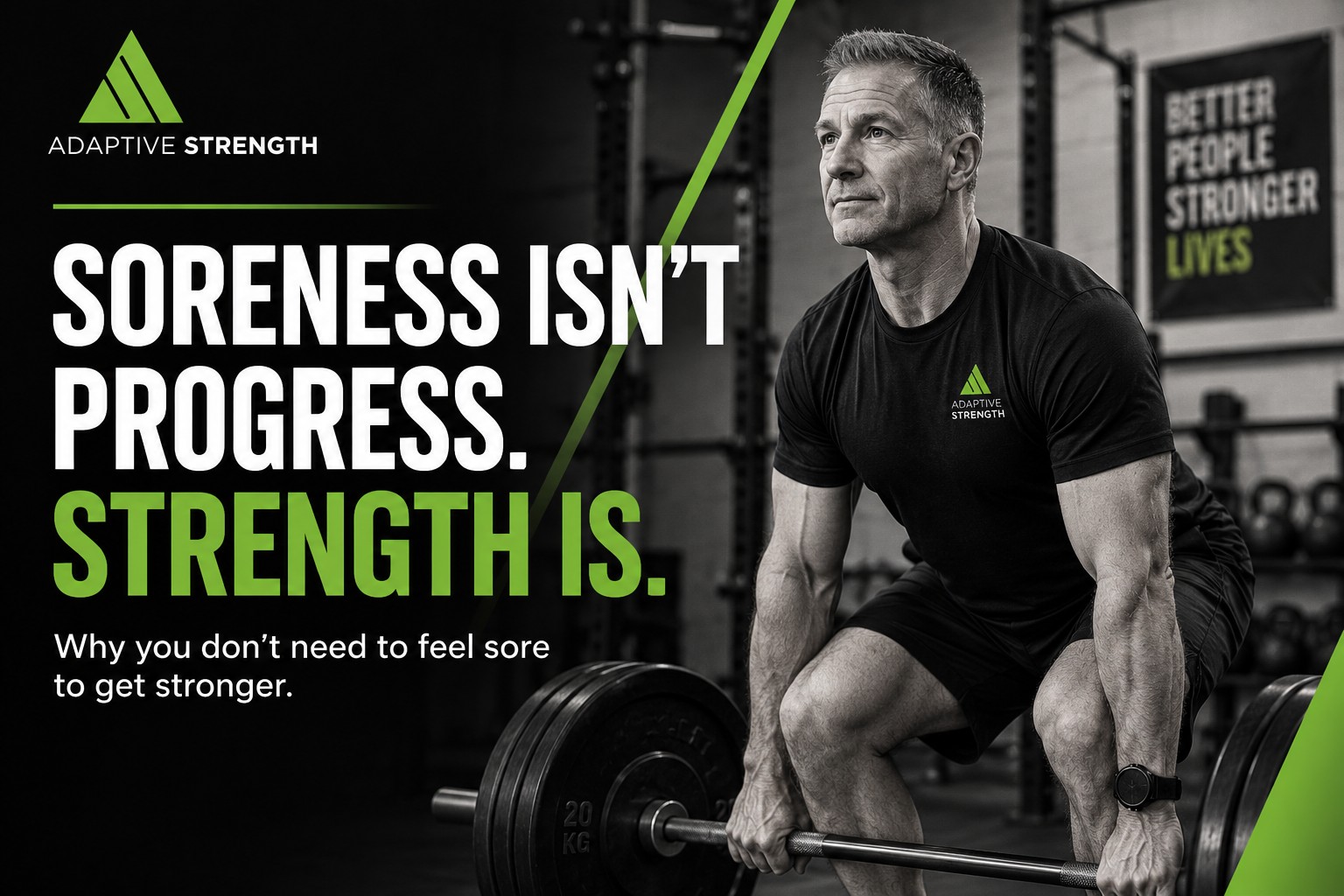
Strength is.
We had one client — let’s call her Sarah — who trained consistently, lifted heavy and made impressive progress. But she admitted:
“I’m not used to leaving a session without feeling sore. It makes me question if I’m doing enough.”
Her reaction is completely normal.
Many people have been conditioned to think DOMS (Delayed Onset Muscle Soreness) equals progress.
In reality, smart training — like the kind we deliver here at Adaptive Strength — often leads to results without the soreness.
Let’s break down why.
What Is DOMS — And What It Isn’t
DOMS stands for Delayed Onset Muscle Soreness.
It usually kicks in 24–72 hours after a workout and is that stiff, achy feeling you get after doing something your body isn’t used to — like a high-rep squat session or trying a new movement.
DOMS is commonly associated with:
- New exercises or new movement patterns
- High-repetition sets
- Large increases in training volume
- Eccentric loading — where the muscle is working while lengthening
But here’s the key:
You can feel sore and make very little progress.
You can feel great and get stronger.
Train, Don’t Drain
At Adaptive Strength, we believe in a simple principle:
Train, Don’t Drain.
We focus on:
- Low to moderate reps with appropriately heavy weights
- Quality over quantity
- Power, control and technical excellence
You won’t find random high-rep circuits just to leave you exhausted.
Instead, we use strategic loading, intentional rest and movement mastery to build strength that lasts.
That’s by design.
You trained smart, not just hard.
That doesn’t mean training is easy.
There will be heavy sets. There will be difficult sessions. And sometimes you will be sore.
But making you sore isn’t the goal. Making you stronger is.
Why No Soreness Can Be a Good Thing
When you’re no longer sore after every workout, that doesn’t mean the training has stopped working.
Quite often, your body has simply adapted to what you’re asking it to do.
In fact:
- You can train more frequently and consistently when you’re not constantly sore.
- You’re building capacity and resilience, not just fatigue.
- Better-managed training allows you to recover and come back ready to train again.
On the flip side, constantly chasing soreness can:
- Make recovery harder
- Affect the quality of your next training session
- Make it harder to train consistently
- Leave you unnecessarily tired and sore for the rest of your week
That’s not smart training.
Signs Your Training Is Working (Besides DOMS)
So how do you know your training is effective if you’re not sore?
Look for these signs:
Your numbers are going up. That’s strength in action.
Improved technique, mobility, balance and body awareness.
Carrying groceries, climbing stairs, getting off the floor — your strength carries over into real life.
You’re no longer wrecked for days after a session. That’s a good thing.
More weight, more reps, more work or movements that you couldn’t do before.
And consistency beats constantly smashing yourself and then needing days to recover.
This is also where Movement. Strength. Recovery. comes into the way we look at progress at Adaptive.
Are you moving better and more freely?
Are you getting stronger?
And are you recovering well enough to keep training and progressing?
Those things tell me far more than how sore you are the next morning.
When Soreness Might Be Useful — And When It’s Not
We’re not saying soreness is bad.
It can be a normal response to a new or more demanding training stimulus — maybe a new movement, an increase in training volume or returning to something you haven’t done for a while.
Occasional DOMS is normal.
But constant soreness?
That’s usually a sign we should look more closely at what you’re doing.
It might be:
- Too much training volume
- Too much intensity too often
- Poor recovery
- Not enough sleep
- A sudden increase in training load
Training should challenge you, yes.
Redefining What “Hard” Means
This is something I think the fitness industry gets wrong.
A hard workout doesn’t have to mean lying on the floor afterwards or struggling to walk the next day.
Hard might mean lifting a genuinely heavy weight for five quality repetitions.
It might mean producing another strong set after taking enough rest to recover properly.
It might mean maintaining good technique when the weight gets challenging.
It might mean progressing from a 20kg kettlebell to a 24kg kettlebell because you’ve earned the progression.
At Adaptive Strength, we believe training should leave you better, not battered.
Stronger, not sorer.
More capable, not simply more tired.
The strongest people in the gym aren’t necessarily the ones limping out of it.
They’re the ones showing up week after week, steadily building strength, improving movement, recovering and continuing to progress.
So the next time you leave your session feeling fresh, don’t assume you didn’t work hard enough.
Look at what you actually achieved.
FAQ
“But I Used to Feel Sore All the Time at Bootcamp — Wasn’t That Effective?”
It may have been effective for some things.
But soreness itself doesn’t tell us that.
You can get very sore from high-rep circuits and unfamiliar exercises.
The better questions are:
- Were you getting stronger?
- Were you moving better?
- Was your fitness improving?
- Were you progressing?
- Were you able to keep training consistently?
There’s nothing wrong with circuits or high-repetition training when there’s a reason for them.
But fatigue and progress are not the same thing.
“Does Soreness Mean I’m Building More Muscle?”
Not necessarily.
Building muscle comes from providing an appropriate training stimulus, progressively challenging the muscles over time, eating appropriately and recovering.
You might experience soreness as part of that process.
But soreness itself is not the measure of whether you’re building muscle.
“If I’m Not Sore, Should I Lift Heavier Next Time?”
Not simply because you’re not sore.
Soreness shouldn’t dictate your training load.
You increase the weight when you’re ready for the next progression.
Your technique is good.
You’re completing the required work.
The weight is moving well.
And the current load is becoming easier.
The Bottom Line
You don’t need to feel broken to make progress.
At Adaptive Strength, we believe training should leave you better, not battered.
Stronger, not sorer.
More capable, not more exhausted.
The strongest people in the gym aren’t always the ones limping out of it.
They’re the ones showing up week after week, steadily building capacity, improving movement, getting stronger and recovering well enough to do it again.
So the next time you leave your session feeling good, remember:
Want Training That Builds You Rather Than Just Beats You Up?
If you’re tired of judging a workout by how exhausted or sore it makes you, we can show you a different approach.
At Adaptive Strength in Booragoon, we build individual strength programs around your goals, current ability, movement, injuries or limitations and your ability to recover.
You still train hard.
But there’s a reason behind what you’re doing and a plan for where we’re trying to take you.
If you'd like to know more, you can book a quick call with me, Kurt, Head Coach at Adaptive Strength.
We can have a chat about what you're trying to achieve, what your training has looked like in the past and whether Adaptive might be the right fit for you.
Book a Quick Call With Kurt