I’m going to say something that will upset many strength coaches.
There.
I said it.
The back squat is a good exercise.
If you're a powerlifter, it is obviously an important exercise.
If you love doing it, move well doing it and it helps you achieve your goals, keep doing it.
But somewhere along the way, the fitness industry turned the back squat from an exercise into the exercise.
The “king of exercises.”
“How much do you squat?”
As though the answer tells us whether someone is actually strong.
I don't buy it.
For the majority of people we coach at Adaptive Strength, I can build strong legs, strong hips, a strong trunk and a very capable body without ever putting a barbell on their back.
That doesn't make the training easier.
It doesn't mean we are afraid of heavy weights.
It means I think the exercise should suit the person.
Not the person being forced to suit the exercise.
The Back Squat Has Become Bigger Than the Goal
So why does the back squat still dominate so many strength programs?
Partly tradition.
“This is what strong people do.”
Partly ego.
Let’s be honest — putting more plates on a bar and talking about your squat number feels good.
And sometimes it is simply coach bias.
The coach likes back squatting.
The coach became strong through back squatting.
So everyone they train back squats.
But the program is supposed to be about the person being coached.
Not the coach.
We shouldn’t back squat because gym culture decided decades ago that strong people back squat.
We should choose the exercise that best helps the individual in front of us become stronger.
I Don’t Care How Much You Back Squat
Unless your sport is powerlifting, the number itself means very little to me.
I care whether you are getting stronger.
Whether you move well.
Whether your training supports the things you actually want to do.
And whether you can keep training consistently without constantly being beaten up by your program.
If someone has strong legs, moves well, can hike, run, play sport, carry things, get off the floor, train hard and do everything they want to do…
I’m not particularly concerned that they don’t have a back-squat number.
The exercise is a means to an end.
It is not the end.
What’s the Problem With Automatically Back Squatting?
The problem is not that the back squat is inherently bad.
The problem is automatically deciding that everybody needs to do it.
The back squat has relatively high technical, mobility and loading demands.
You need enough ankle and hip movement.
You need to be comfortable getting your shoulders into the bar position.
You need to control your trunk under a substantial load.
You need a squat technique that works with your proportions.
And then you need to progressively add weight while maintaining all of that.
For some people, that works beautifully.
For others?
It is a lot of effort to force one particular exercise when I have several other ways to build extremely strong legs.
Injury Potential Still Matters
Heavy lifting has risk.
That is not unique to the back squat.
But heavy spinal loading, poor technique and years of “just getting the reps done” can add up.
So I think it is reasonable to ask:
Why would I automatically choose an exercise with relatively high technical, mobility and loading demands when I have other ways to achieve the same strength goal?
If the back squat is clearly the right exercise, great.
Use it.
If it isn’t?
Choose something else.
That is coaching.
People Are Built Differently
This is another part of the conversation that gets overlooked.
People are built differently.
Different femur lengths.
Different torso lengths.
Different ankle mobility.
Different hip structures.
Different shoulder mobility.
Yet somehow the fitness industry decided they should all put the same bar in the same place and perform the same lift.
Some people look beautiful when they back squat.
Others have long femurs and naturally lean much further forward.
Some have limited ankle mobility.
Some have had previous knee or back problems.
And I have coached people whose shoulder external rotation is so limited that they can barely get their hands around the bar.
They end up holding it with their fingertips, twisting themselves into position and compensating somewhere else just to perform an exercise they supposedly “need” to do.
There are plenty of other options.
Front-Loaded Squats Make a Lot of Sense
For many of the people we coach, I prefer front-loaded squat variations.
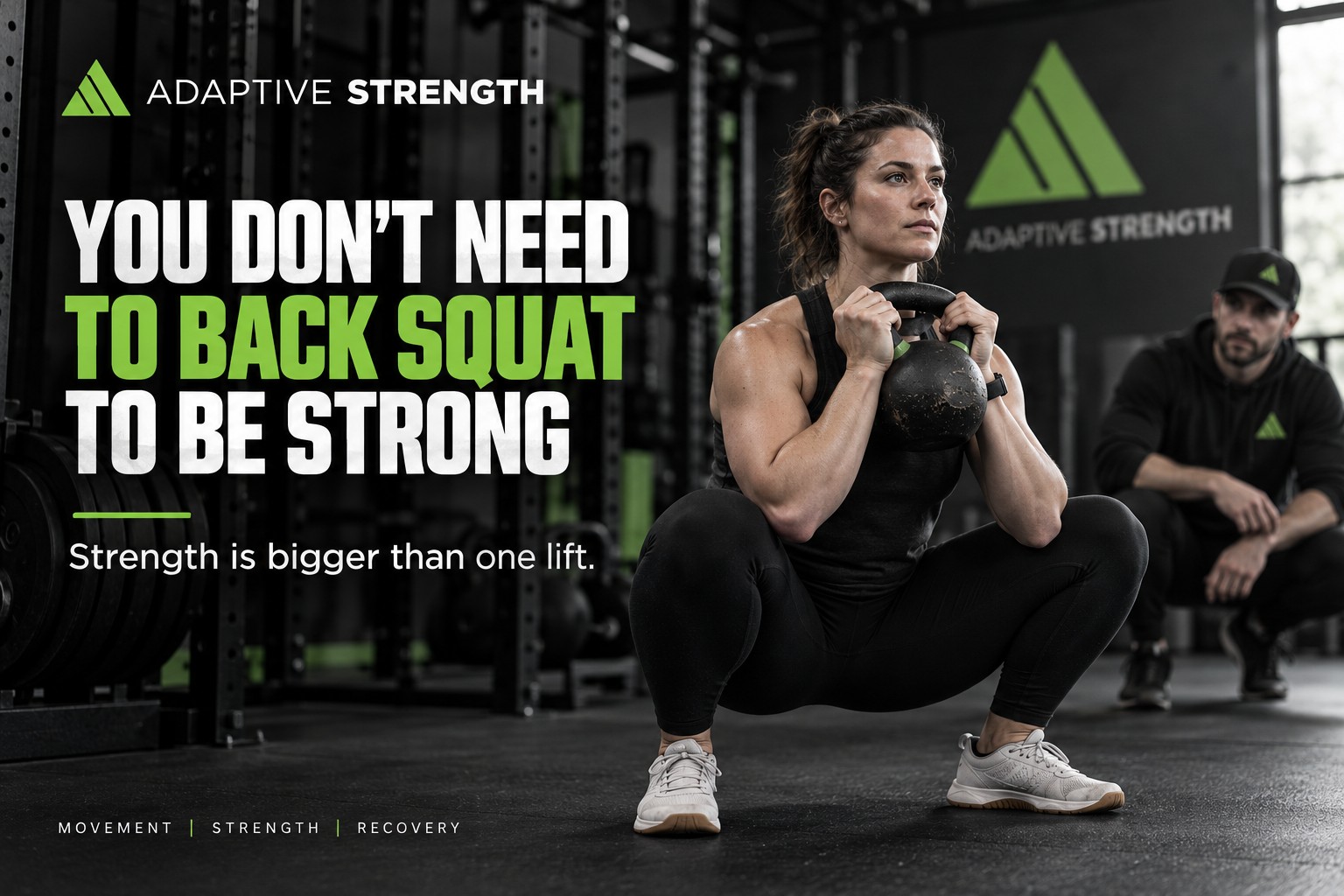
The Goblet Squat is one of our favourites.
It is relatively simple to teach.
The load is in front of the body.
It encourages a more upright torso.
It challenges the trunk.
And it gives us plenty of room to work on squat strength and movement without needing to place a bar across someone’s shoulders.
Then we can progress to a Double Kettlebell Front Squat.
Now we can load the legs heavily.
Challenge the trunk.
Build strength.
And still avoid many of the positioning demands of the back squat.
Can you eventually reach a point where loading these exercises becomes harder?
Of course.
But for the vast majority of normal people, we have a lot of strength to build before that becomes a serious problem.
Being Strong in More Than One Position Matters
I also think a lower-body program built almost entirely around the back squat is incomplete.
Life doesn't only happen with both feet perfectly planted underneath you.
Neither does sport.
We step.
Lunge.
Run.
Change direction.
Climb.
Carry things.
Catch ourselves.
Move from uneven positions.
That is why we use:
Split squats
Step-ups
Rear-foot-elevated split squats
Single-leg deadlifts
Lunges
Carries
Other single-leg or split-stance exercises
Not because bilateral strength is useless.
We use bilateral exercises too.
Because being strong in more than one position matters.
If We Want to Lift Heavy, We Have Other Options
There is also this idea that if you remove the back squat, you somehow remove heavy strength training.
You don't.
We can use:
Trap-bar deadlifts
Heavy kettlebell deadlifts
Front squats
Loaded carries
Split squats
Step-ups
Single-leg work
And plenty of other exercises that become very challenging when programmed properly.
You can train incredibly hard without ever putting a barbell across your back.
The Goal Decides the Exercise
This is the part that matters most.
If you are a powerlifter, back squat.
Your sport literally asks you to back squat.
If you love back squatting, move well doing it, tolerate it well and want to get better at it — back squat.
I have no problem with that.
But if you're a 52-year-old who wants stronger legs, better balance, fewer aches and the ability to keep hiking, travelling and playing sport?
I don't need you to back squat.If you're a 68-year-old who wants to stay strong and independent?
I don't need you to back squat.If you're a tennis player who needs strong legs, hips, trunk and good single-leg strength?
I don't need you to back squat.There are dozens of ways I can make you very strong.
Strength Is Bigger Than One Lift
At Adaptive Strength, we are not trying to turn everyone into powerlifters.
We are trying to build people who are strong, capable and physically resilient.
For some people, that may include a barbell.
For others, it might be kettlebells, dumbbells, trap bars, carries, split squats and a dozen other exercises.
The important thing is not whether the exercise looks impressive.
It is whether it is helping the person in front of us.
That is what individualised programming should actually mean.
Not:
“Everyone does the same exercises, but we'll change your weight.”
It means the exercises themselves can change.
Because the person is different.
Their body is different.
Their history is different.
And their goals are different.
You Don’t Need to Back Squat to Be Strong
I know some strength coaches will disagree with me.
That's fine.
I'm not trying to win an argument about which squat variation deserves a crown.
I'm trying to help people become stronger.
And after coaching people for years, I have never looked at someone who was strong, capable, moving well and doing everything they wanted to do and thought:
“Shame they can't back squat.”
You don't need to back squat to be strong.
You need a program that makes you stronger.
There is a difference.
Want to Train Differently?
If you want a strength program built around your body, your goals and what you actually want to be able to do, you can book a quick call with me.
I’m Kurt, Head Coach at Adaptive Strength in Booragoon.
Book a Quick Call With Kurt