The 20-Minute Strength-Endurance Challenge
Some workouts test how much weight you can lift for a few repetitions.
Others test how quickly you can move.
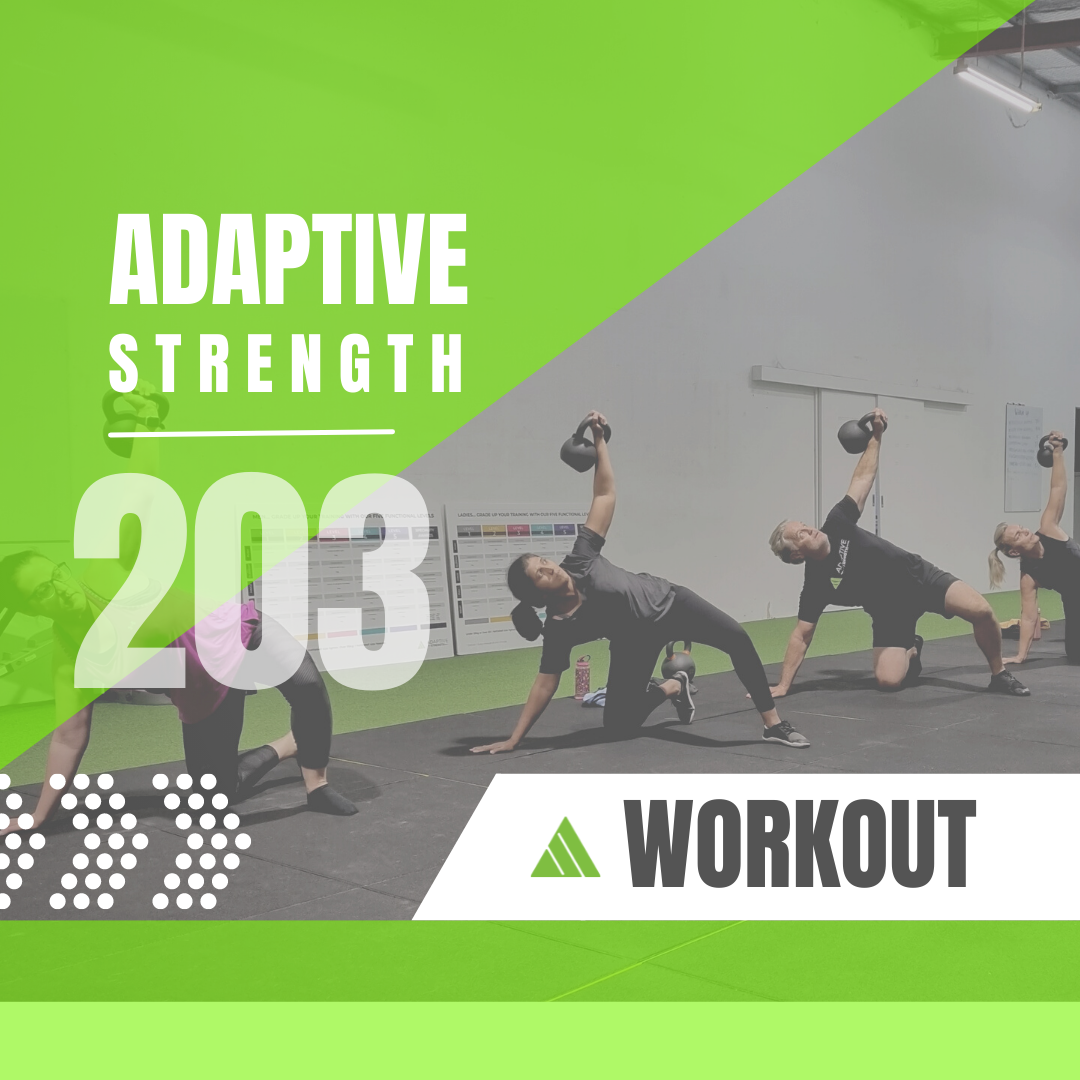
Workout 203 sits somewhere in between.
It combines controlled strength exercises with loaded carries, explosive kettlebell swings and a short cardiovascular effort. You repeat the circuit for 20 minutes, accumulating as much good-quality work as your current ability allows.
The exercises are:
- Turkish get-ups
- Wall sits
- Kettlebell swings
- Single-arm rack carries
- SkiErg
Each movement challenges you differently.
The Turkish get-up requires patience and whole-body control. The wall sit creates sustained tension through the legs. The swing asks you to produce repeated force through the hips. The rack carry challenges your grip and trunk under an uneven load, while the SkiErg raises your breathing rate before the next round begins.
This creates an important challenge:
Can you maintain your movement quality while several different types of fatigue begin to accumulate?
That is the real purpose of the workout.
Workout 203 at a Glance
Set a timer for 20 minutes.
Complete as many quality rounds as you can of:
- Turkish get-up: 2 repetitions on each side
- Wall sit: 30 seconds
- Kettlebell swing: 15 repetitions
- Single-arm rack carry: 1 lap with each arm
- SkiErg: 10 calories
Continue repeating the circuit until the 20-minute timer finishes.
Rest whenever needed.
The original workout refers to this as an AMRAP, meaning as many rounds as possible.
For this particular workout, it is more useful to think of it as:
As many technically consistent rounds as you can complete within 20 minutes.
The round count matters less than the quality of the work used to achieve it.
This Is Not a Sprint Workout
Many AMRAP workouts encourage people to move quickly from the beginning.
That approach is unlikely to work well here.
Every round contains four Turkish get-ups—two on the left and two on the right. Get-ups are deliberate, multi-stage exercises that should not be rushed.
You then move through a wall sit, 15 explosive swings, two loaded carries and a SkiErg effort.
A round may take several minutes when performed properly. You are therefore unlikely to accumulate a very high number of rounds.
That is not a problem.
The workout is testing strength endurance, not just speed.
Strength endurance is your ability to continue producing useful muscular effort over time. It requires enough strength to complete each movement, but also enough control and work capacity to repeat that movement as fatigue builds.
A good result may be:
- Completing each get-up without rushing
- Maintaining the same wall-sit position
- Producing consistent kettlebell swings
- Carrying the weight without leaning
- Keeping a steady SkiErg rhythm
- Finishing the workout with similar technique to the first round
Those outcomes are more meaningful than simply adding another rushed round.
The Five Demands of Workout 203
One reason this session is challenging is that the exercises do not all create the same type of fatigue.
Each station adds something different.
1. Turkish Get-Ups: Control Before Speed
Complete two repetitions on each side.
The Turkish get-up involves moving from lying on the floor to standing while controlling a weight above one shoulder. You then reverse the sequence and return to the floor.
A full repetition may include:
- Rolling onto one elbow
- Moving from the elbow to the hand
- Raising the hips
- Moving the leg underneath the body
- Establishing a kneeling position
- Standing
- Reversing each stage back to the floor
It is one of the most technically involved exercises in the workout.
The get-up can help develop:
- Shoulder stability
- Core and trunk control
- Whole-body coordination
- Hip mobility
- Balance
- Lower-body strength
- Confidence moving between the floor and standing
The value comes from controlling each transition rather than treating the movement as one hurried action.
Why the Get-Up Comes First
Beginning each round with Turkish get-ups sets the tone for the session.
You must slow down, establish your positions and demonstrate control before reaching the faster exercises later in the circuit.
The get-up may also reveal whether you are recovering adequately between rounds.
If your shoulder becomes less stable, your transitions become rushed or you begin forgetting parts of the sequence, it is a sign to slow down or reduce the difficulty.
Get-Up Options
The full prescription is two repetitions on each side, but that is substantial within a repeated circuit.
Possible modifications include:
- One get-up on each side
- A partial get-up
- An unloaded get-up
- A half get-up to the tall-seated position
- Practising the floor-to-kneeling section
- A supported floor-to-standing movement
Someone who has not learned the Turkish get-up should not attempt to teach themselves the complete movement during a timed workout.
Learn the positions first. Add the AMRAP format later.
2. Wall Sit: Staying Strong Without Moving
Hold the wall sit for 30 seconds.
The wall sit is an isometric exercise. This means the muscles are working while the body remains relatively still.
You position your back against a wall, lower into a squat-like position and maintain the hold.
The exercise primarily challenges:
- Quadriceps endurance
- Glute contribution
- Lower-body muscular endurance
- Tolerance to sustained tension
- Awareness of lower-body position
The wall sit feels very different from the exercises around it.
The Turkish get-up is a slow sequence of changing positions. The kettlebell swing is fast and explosive. The wall sit asks you to stay still and tolerate the increasing effort through your legs.
Finding the Right Position
You do not need to create a perfect 90-degree angle at the hips and knees.
Use a depth that allows you to:
- Keep your back supported
- Keep your feet firmly planted
- Maintain a comfortable knee position
- Breathe throughout the hold
- Complete the intended time without sliding down the wall
Moving your hips slightly higher generally makes the exercise more manageable.
You could also begin with a 15–20-second hold and gradually build towards 30 seconds.
3. Kettlebell Swings: Producing Power While Fatigued
Complete 15 repetitions.
The kettlebell swing is an explosive hip-hinge exercise.
Your hips create the force that moves the kettlebell. The arms guide the weight but should not perform most of the lifting.
Swings can help develop:
- Glute and hamstring strength
- Hip power
- Hip-hinge technique
- Grip strength
- Trunk stability
- Whole-body coordination
- Muscular and cardiovascular conditioning
The challenge in this workout is not simply completing 15 swings.
It is producing good swings after the Turkish get-ups and wall sit have already created fatigue.
Avoid Turning the Swing Into an Arm Exercise
As fatigue builds, people often begin lifting the kettlebell with their shoulders rather than driving it through the hips.
Focus on:
- Pushing your hips backwards
- Keeping the kettlebell close during the backswing
- Driving forcefully through the hips
- Allowing the kettlebell to float
- Keeping your arms relatively relaxed
- Finishing tall without leaning backwards
- Controlling the final repetition back to the floor
The swing should remain powerful and organised.
When it becomes slow, squat-like or dominated by the arms, reduce the weight or repetitions.
Swing Alternatives
Someone who has not yet developed a confident kettlebell swing can use:
- Kettlebell deadlifts
- Romanian deadlifts
- Cable pull-throughs
- Glute bridges
- Hip thrusts
These exercises preserve the hip-strength emphasis without requiring an explosive movement.
4. Rack Carries: Strength on One Side at a Time
Complete one lap with the weight held on each side.
A single-arm rack carry involves holding a kettlebell close to the shoulder and walking while the load remains on one side of the body.
Unlike holding a weight down by your side, the rack position places the kettlebell closer to the chest and shoulder.
This can challenge:
- Grip strength
- Shoulder stability
- Upper-back strength
- Core and trunk stability
- Walking control
- Posture under an uneven load
- The ability to resist sideways bending and rotation
The weight attempts to pull or rotate your body towards one side.
Your trunk must remain active while your hips and legs continue to produce controlled steps.
Practical Carryover
Many daily tasks involve uneven loads, including:
- Carrying shopping
- Holding a child
- Moving tools
- Carrying luggage
- Transporting work equipment
- Holding an object against the chest
- Walking while one side supports more weight
The rack carry does not duplicate every one of these tasks, but it develops the general grip, shoulder and trunk strength required to manage uneven loads.
Rack-Carry Coaching Notes
Focus on:
- Holding the kettlebell securely
- Keeping the wrist controlled
- Allowing the weight to rest comfortably in the rack position
- Standing tall without leaning away from the kettlebell
- Keeping the ribs and pelvis organised
- Taking natural, measured steps
- Turning carefully
- Returning the weight safely to the floor
The original workout does not define the distance of one lap.
Use the established carry route in your training environment. The distance should challenge you without causing your posture or walking pattern to deteriorate.
5. SkiErg: Raise the Heart Rate Without Losing the Rhythm
Complete 10 calories.
The SkiErg adds a short whole-body conditioning effort at the end of each round.
The movement primarily involves pulling the handles down while coordinating the arms, trunk, hips and legs.
It can help develop:
- Cardiovascular fitness
- Upper-body pulling endurance
- Trunk control
- Lat and triceps endurance
- Coordination
- Whole-body work capacity
Ten calories may be completed quickly by a highly conditioned person, but it can take considerably longer for someone with less SkiErg experience.
The calorie target should therefore be adjusted when needed.
Possible alternatives include:
- Six to eight calories
- A 20–30-second interval
- A fixed distance
- A controlled effort on another cardiovascular machine
Do Not Empty the Tank
The SkiErg is the final exercise in each round, but the workout is not over.
You must return to the Turkish get-up immediately afterwards.
An all-out SkiErg sprint may leave you too breathless to control the next set of get-ups.
Use a strong but repeatable pace.
You should be able to finish the calories, transition to the floor and regain enough control to begin the next round safely.
How to Pace the 20-Minute AMRAP
A useful pacing strategy is to treat the first round as your reference round.
Do not make it your fastest round.
During the first round:
- Move deliberately through the get-ups
- Use a wall-sit depth you can repeat
- Keep the swings powerful but relaxed
- Walk the carries at a controlled pace
- Use a sustainable SkiErg effort
After the first round, ask:
- Could I repeat that technique?
- Was the kettlebell weight appropriate?
- Did I recover sufficiently before the next get-up?
- Did one station feel disproportionately difficult?
- Do I need to change anything now rather than later?
Small early adjustments can prevent a major decline in later rounds.
Use Natural Rest Opportunities
You do not need to schedule a formal rest after every exercise, but there are several natural opportunities to recover:
- While safely changing sides during get-ups
- After standing from the wall sit
- Before picking up the swing weight
- While changing arms during the carry
- Before beginning the next round
A few controlled breaths can make the next exercise substantially better.
Rest is not separate from the workout. It is one of the tools that allows you to maintain the intended quality.
Three Ways to Approach Workout 203
Technique-First Version
This version suits someone learning the movements or returning to structured training.
Complete 12–15 minutes of:
- One Turkish get-up or partial get-up on each side
- A 15–20-second wall sit
- Eight to 10 kettlebell deadlifts or swings
- A shorter rack carry on each side
- Six SkiErg calories or 20 seconds
Take breaks whenever needed.
The aim is to finish each round feeling organised rather than overwhelmed.
General Strength and Fitness Version
Complete 15–20 minutes of:
- One get-up on each side
- A 30-second wall sit
- 10–15 swings
- One rack-carry lap on each side
- Eight to 10 SkiErg calories
Choose loads that are challenging but repeatable.
This version retains the full character of the workout while reducing the large get-up volume.
Full Strength-Endurance Challenge
Complete the original 20-minute AMRAP:
- Two Turkish get-ups on each side
- A 30-second wall sit
- 15 swings
- One rack-carry lap with each arm
- 10 SkiErg calories
This version is best suited to someone who:
- Is confident with Turkish get-ups
- Has an established kettlebell swing
- Can maintain a stable rack position
- Is familiar with the SkiErg
- Has experience pacing mixed strength-and-conditioning workouts
The full version should feel demanding, but it should not turn into 20 minutes of deteriorating movement.
Coach’s Notes
The Get-Ups Will Control Your Round Count
Four get-ups per round take time.
Do not compare your result with a faster AMRAP containing simpler exercises. This session is deliberately slower and more technical.
Use More Than One Kettlebell
The ideal weight for Turkish get-ups may be different from the best weight for swings or rack carries.
There is no prize for using one kettlebell for the entire workout.
Keep the Swing Crisp
Fifteen strong swings are the goal.
Stop before the movement becomes an arm-dominant front raise or a poorly controlled squat.
Walk Normally During the Carry
The carry should challenge your trunk without making you lean, shuffle or rush.
Reduce the weight if your walking pattern changes significantly.
Leave Something for the Next Round
The SkiErg should raise your breathing rate, not make the next Turkish get-up impossible.
What Does a Good Result Look Like?
A good result is not necessarily the highest round count.
Look for:
- Similar get-up control on both sides
- A repeatable wall-sit position
- Consistent swing technique
- Stable rack carries
- A sustainable SkiErg pace
- Sensible transitions
- No major technical collapse in the final minutes
You may record the number of rounds and additional exercises completed when the timer finishes.
For example:
Three rounds plus two Turkish get-ups.
That score can provide a useful reference if you repeat the workout later.
However, progress may also mean:
- Using slightly more weight
- Performing a fuller get-up
- Using less assistance
- Maintaining better control
- Completing the same work with less fatigue
- Producing a steadier SkiErg pace
- Feeling more confident throughout the session
Do not assume that improving the workout always means completing more rounds.
Where This Workout Fits
Workout 203 combines:
- Floor-to-standing movement
- Isometric leg endurance
- Explosive hip work
- Loaded carrying
- Cardiovascular conditioning
That gives it a broad whole-body strength-endurance focus.
However, it contains little direct upper-body pressing and no substantial upper-body row or chin-up movement. It also does not include a traditional squat through a repeated range of movement.
Those qualities could be trained during other sessions in the week.
The workout’s suitability would also depend on:
- Your goals
- Your training experience
- Your injury history
- What you trained earlier in the week
- How much kettlebell work you currently tolerate
- Your ability to recover
- Your sport and other physical activities
A challenging workout can be useful.
A series of challenging workouts selected without an overall plan is less likely to produce consistent progress.
Individualised Strength Training in Booragoon
Finding a workout online is easy.
The harder questions are:
- Is this the right workout for you?
- Should you perform the full Turkish get-up?
- How heavy should the kettlebell be?
- How many rounds should you attempt?
- What should you train during your next session?
- When should the workout become more challenging?
- What needs to change if you have an injury or limitation?
At Adaptive Strength in Booragoon, each member follows an individualised strength-training program within a supervised small-group environment.
You do not simply arrive and complete the same workout as everyone else.
Your program is built around your:
- Goals
- Current strength and fitness
- Training experience
- Injury and medical history
- Movement ability
- Weekly schedule
- Sporting and recreational activities
One member may practise partial get-ups, kettlebell deadlifts and short carries.
Another may complete loaded get-ups, powerful swings and a more demanding SkiErg target.
Both can train in the same supportive environment while following programs appropriate for their individual needs.
Our strength coaches, physiotherapists and Exercise Physiologist supervise your training, help you select suitable exercises and progress your program over time.
The value is not simply being given a list of exercises.
It is having a program designed for you, coached properly and progressed over time.
The first step is an initial consultation and movement assessment.
Book a quick chat with Adaptive Strength to find out whether our approach is right for you.