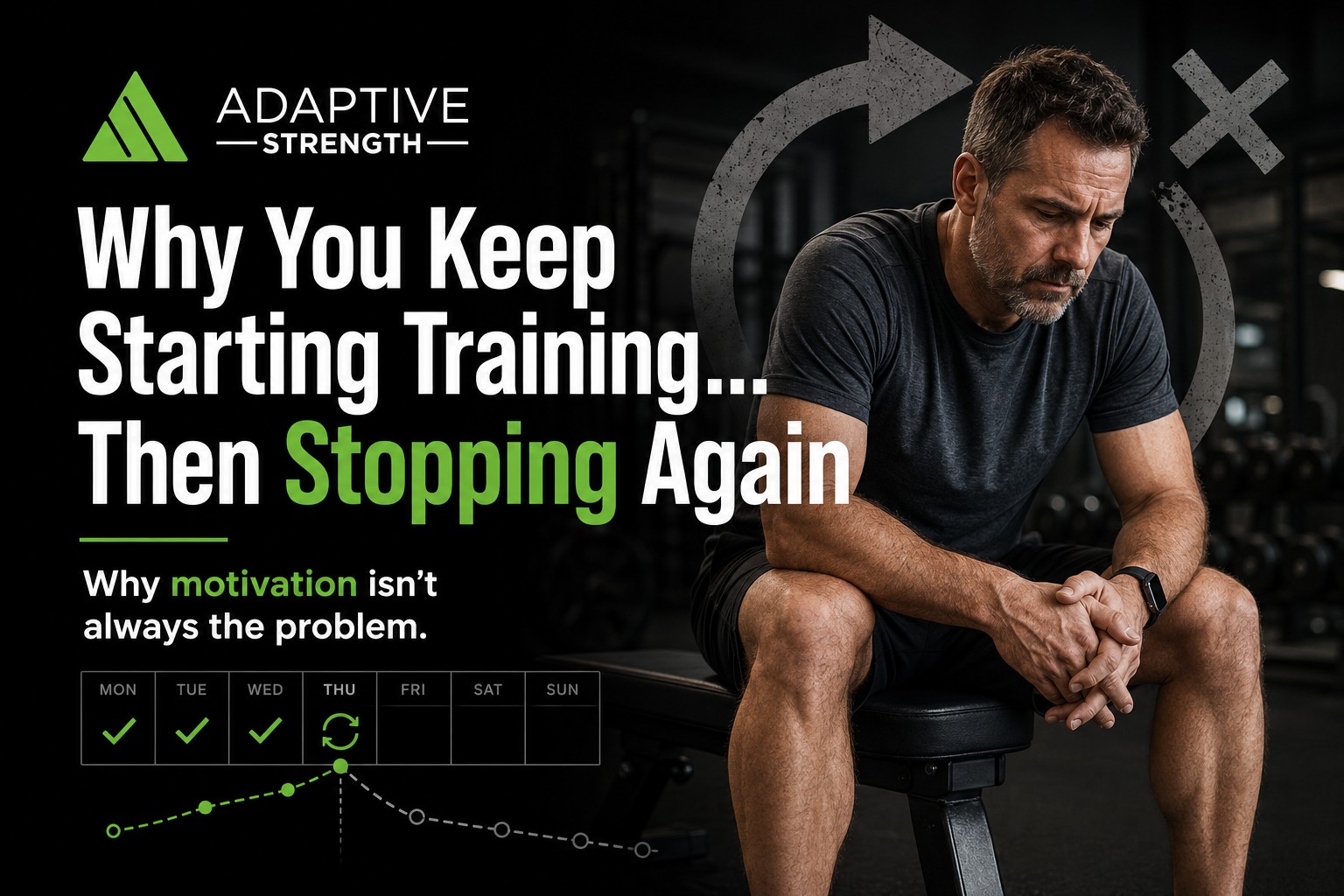
You know that feeling when you’re fired up to get back into training?
The excitement builds.
You plan out your week.
You might even dust off those old workout clothes.
This time feels different.
But then — three or four weeks later — you’re right back where you started.
Life gets busy.
Your body feels sore.
You miss a couple of sessions.
Motivation disappears.
Sound familiar?
I hear versions of this story all the time from people when they first come to Adaptive Strength.
They've often tried to get back into training before.
Sometimes several times.
And usually they think the problem is pretty simple:
Or:
“I need to be more disciplined.”
Sometimes that might be part of it.
But after coaching people for many years, I don't think that's usually the whole story.
Quite often, the problem starts much earlier.
It starts with what you're trying to build your training on.
The Real Reason Training Never Sticks
Most people jump straight into the what:
- What exercises should I do?
- What program should I follow?
- How many sets and reps?
- How many days per week?
But they often skip over the things that actually determine whether that program is going to work for them.
Things like:
- What training have you actually been doing recently?
- What can your body tolerate right now?
- Are there old injuries or limitations we need to work around?
- How much time do you realistically have each week?
- How well are you recovering?
- And what are you expecting yourself to be able to do because you used to be able to do it?
That is the foundation.
And when I think about that foundation, a lot of it comes back to three things we focus on at Adaptive:
You don't need to be perfect in all three areas before you start training. Far from it.
But if one is being completely ignored, it can eventually catch up with you.
You can have the best strength program in the world on paper, but if the exercises aren't appropriate for you, you're constantly aggravating an old problem, or every session leaves you wrecked for four days, it probably isn't going to last.
You can start with plenty of enthusiasm.
But if the plan doesn't match the person doing it, eventually something gives.
The Biggest Mistake Keeping You Stuck
One of the biggest things I see when people try and do it by themselves is this:
And honestly, I understand it.
Your mind remembers:
- The weights you used to lift
- How often you used to train
- The pace you used to maintain
- How quickly you used to recover
So when you decide to start again, that's often where your expectations go.
The problem is, you may not have trained consistently for six months, two years or even ten years.
Your life may also look very different now.
You might be working longer hours.
You might have kids.
You might not sleep as well.
You might have a shoulder, knee or back that needs a little more consideration than it did twenty years ago.
That doesn't mean you can't train hard.
It doesn't mean you need to be treated as fragile.
And it certainly doesn't mean getting older automatically means doing easy exercise forever.
It just means your starting point needs to reflect where you are now, not where you remember being.
Because this is where I hear the same pattern again and again.
You start hard.
You try to do too much too quickly.
You're sore for days.
Something starts niggling.
You miss a session.
Then another.
You lose momentum.
And eventually training disappears again.
A few months later, you get motivated and start the whole process over.
The Solution Isn’t Lower Standards — It’s Smarter Training
This is the part I think people sometimes misunderstand.
Starting at an appropriate level does not mean lowering your expectations.
You can still want to become:
- Stronger
- Fitter
- Leaner
- More athletic
- More capable
You can still have ambitious goals in your 40s, 50s, 60s and beyond.
But you don't have to prove what you're capable of in your first two weeks back.
If your goal is eventually to train four times per week, perhaps you start with two.
If you haven't lifted properly for years, perhaps your first few weeks aren't about seeing how close you can get to your old numbers.
If your knee doesn't like a particular squat variation, that doesn't necessarily mean you stop squatting.
We might change the range.
Change the load.
Change the exercise.
Work on the movement.
Build some strength and capacity.
Give it enough recovery.
Then progress from there.
That is something we do a lot at Adaptive.
How Do You Know Where to Start?
This is where a lot of people get stuck.
They know they probably shouldn't train like they did twenty years ago.
But they also don't want to feel like they're being wrapped in cotton wool.
So where do you start?
I think a better approach is to forget about old PBs for a moment and look honestly at what you're doing now.
What have I actually done over the last few months?
Not what you used to do.
What have you been doing recently?
If you've trained twice in the last three months, your starting point should probably reflect that.
How many days can I realistically train?
Not during the perfect week.
During your normal week.
There is very little point writing yourself a five-day program if you know you're going to struggle to get there twice.
Start with something you can actually do.
You can always build from there.
How do I feel after training?
Some soreness is completely normal, particularly when you're returning after a break.
But if every session leaves you so sore or exhausted that you can't train again for four or five days, we probably don't need to celebrate how hard the workout was.
We probably need to adjust the workout.
If you can't recover from what you're doing, eventually it affects how consistently you can do it.
Are old injuries changing how you train?
Having a previous injury doesn't automatically mean you shouldn't strength train.
Quite often it means we need to be a little smarter about exercise selection, load, range of movement or progression.
Sometimes we need to improve the way you perform a particular movement.
Sometimes we need to build more strength around it.
And sometimes we need to get the problem assessed properly rather than repeatedly stopping training every time it flares up.
None of these things are failures.
They're information.
And the more accurate that information is, the easier it is to build a program that actually works.
More Isn’t Always Better
When people are motivated, they often want to do everything at once.
Training five days a week.
Extra cardio.
More steps.
A completely new diet.
Early mornings.
No alcohol.
The whole lot.
And for a short period, they can often do it.
The question I care more about is:
Because I'd much rather see someone training two or three times every week for the next year than training six times a week for three weeks and then doing nothing for the next three months.
You don't build strength in three weeks.
You don't build fitness in three weeks.
And you certainly don't build long-term consistency in three weeks.
What This Looks Like at Adaptive Strength
A lot of the way we train people at Adaptive Strength has come from hearing these stories.
People come to us after trying gyms.
Trying group fitness.
Trying programs they found online.
Trying to go back to what they used to do.
And often the problem wasn't that they weren't willing to work hard.
The problem was that the training wasn't built around them.
That is why we don't simply give everyone the same workout.
When someone starts with us, we want to know:
- What are you trying to achieve?
- What training have you done before?
- What are you doing now?
- Have you had previous injuries?
- Is anything currently painful or restricted?
- How well do you move?
- What can you realistically commit to each week?
Then we build the training around that person.
Someone returning after a two-year break shouldn't necessarily be doing the same thing as someone who has trained consistently for the last ten years.
Someone with a history of shoulder problems might need a different pressing progression.
Someone who can only realistically train twice each week needs those two sessions to work for them.
And someone who has finished rehabilitation but still doesn't feel confident training independently may need more supervision and a more gradual progression back into strength work.
At Adaptive, members follow an individual program rather than everybody doing the same workout.
There is a coach on the floor supervising training, helping with technique and adjusting exercises when needed.
And if something is beyond the scope of normal coaching — perhaps an injury needs assessing or there is a more complex rehabilitation issue — we have physiotherapists and an exercise physiologist working within the same facility.
This is really what Movement. Strength. Recovery. means to me.
They aren't three completely separate things.
They work together.
Movement is about helping you move well, building exercise competency and giving you confidence in what your body can do.
Strength is about progressively building your capacity — muscle, strength, bone health, resilience and the ability to do more.
Recovery is about helping you keep going — whether that's managing training load, modifying around an injury, physiotherapy, massage, or simply recognising when the program needs to change.
And where you need the most focus isn't necessarily going to stay the same.
Sometimes you need more work on movement.
Sometimes you need to get stronger.
Sometimes you're going through an injury or a stressful period and recovery needs a little more attention.
But ultimately, all three are there for the same reason:
To help you keep moving forward.
Why Strength Training Is Still the Answer
None of this means I think people should avoid hard training as they get older.
Quite the opposite.
I think strength training becomes incredibly important as we age.
We want to maintain and build:
- Muscle
- Strength
- Bone health
- Balance
- Physical capacity
- Confidence in what our body can do
But to get those benefits, you need to keep training.
And that is the point.
The best program isn't the one that looks the hardest on paper.
It isn't the one that destroys you in week one.
The Bottom Line
If you've been stuck in the start-stop cycle, don't immediately assume you lack discipline.
Have a look at what you've actually been asking yourself to do.
Were you starting where your body actually is now?
Or where you remember being?
Were you choosing a training schedule that fits your life?
Or one that only works during a perfect week?
Were you gradually building your strength and capacity?
Were you paying attention to how you move and how you recover?
Or were you trying to get everything back in the first month?
Your goals don't need to become smaller.
You just need a sensible place to start.
Not Sure Where Your Starting Point Should Be?
If you've decided you want to get back into strength training but you're not quite sure what you should be doing — especially if you've had injuries, a long break from training or a few false starts before — that is something we can help you work through.
At Adaptive Strength in Booragoon, we start with an initial consultation and movement assessment.
We talk through your goals, training history, previous injuries, current ability and what you realistically want training to look like in your life.
Then we work out the right place to start.
Because you don't need to be fit before you come to us.
Finding the right starting point is part of what we do.
If you'd like to know a little more about how we could help, you can book a quick call with me, Kurt, Head Coach at Adaptive Strength.
We can have a chat about what you're looking to achieve, where you're at now, and whether Adaptive might be the right fit for you.
Book a Quick Call With Kurt