Whether you’re recovering from an injury, surgery or a health problem, rehabilitation has one main purpose:
Back to work. Back to training. Back to running, sport, gardening, lifting, or simply getting through everyday life without constantly thinking about the injury.
Early in rehabilitation, the focus may be relatively simple. Reduce pain. Restore movement. Get the injured area working again. Start gradually asking it to do more.
But as recovery progresses, the question changes:
At some point, feeling better is not enough. Your body needs the strength and physical capability to handle the things you actually want to get back to doing.
Your body has to be prepared for what comes next.
That is why strength training is such an important part of rehabilitation.
Used appropriately, strength training can help make the recovery process faster — helping you rebuild strength, function, confidence and physical capability so you can get back to the things that matter to you sooner.
Strength Training as Part of Rehabilitation
Strength training during rehabilitation starts with where you are now.
That starting point will be different for everyone. It depends on the injury or surgery, how you are moving, what you can currently do comfortably, how well you are recovering and what you eventually want to return to.
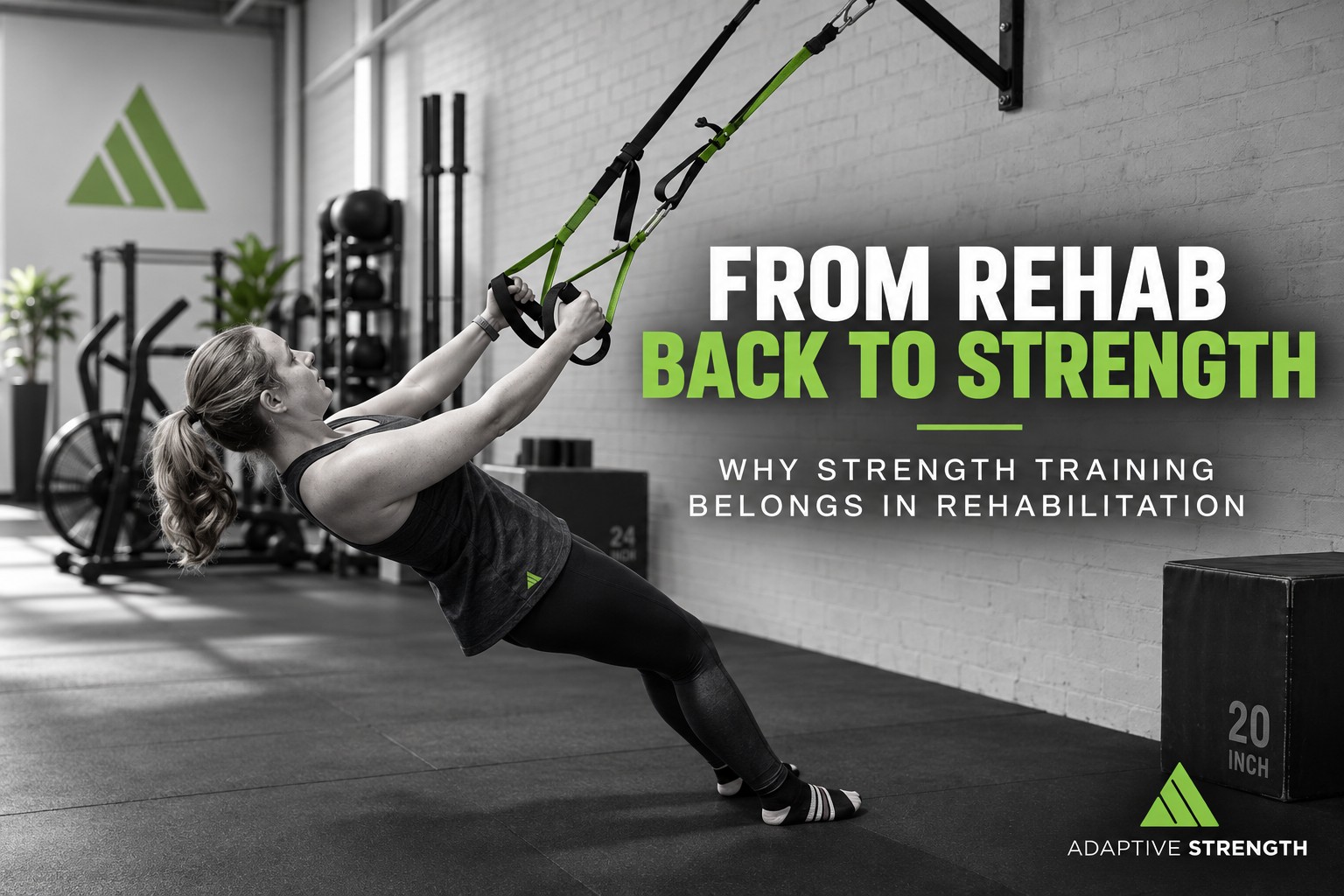
Early strength work may be quite simple. It might be a supported squat, a controlled step-up, a light kettlebell deadlift, a carry, a pushing or pulling exercise, or something more specific for an area that has become weaker.
Then, as your body improves, we gradually ask it to do more.
That might mean increasing the range of movement, adding a little more weight, doing more repetitions, using a more challenging exercise or increasing how much work you can do.
The important part is that the exercise changes because you are becoming more capable.
Progression does not mean making everything harder every week simply for the sake of it. Sometimes progress is more weight. Sometimes it is better control. Sometimes it is being able to move through a greater range. Sometimes it is doing the same exercise for another week because that is still the right level.
And sometimes we reduce the challenge for a while because your body needs more time to recover.
What Are We Actually Trying to Rebuild?
Strength training in rehabilitation is about much more than simply rebuilding muscle.
We are trying to rebuild the physical qualities you need to get back to your life.
Strength
Strength matters because your body needs to be able to handle more. That might mean standing from a chair more easily, carrying groceries, lifting something from the floor or eventually returning to heavy strength training.
Movement
Movement matters because you need to be able to get into the positions your everyday life, work or sport requires.
Control
Control matters because it is one thing to move through a position slowly and another to control that movement when more weight, speed or fatigue is involved.
Confidence
Confidence matters too.
After an injury, sometimes the body improves before the confidence does. You remember what hurt. You hesitate. You wonder whether the knee will give way again, whether the back will flare or whether the shoulder can handle the weight.
Progressively doing more — and discovering that your body can handle it — can be a powerful part of rebuilding that confidence.
Capacity
Doing something once is different from being able to keep doing it.
Walking for five minutes is different from walking for two hours. A few step-ups are different from a long hike. Lifting something once is different from lifting and carrying repeatedly through a workday.
Over time, we want to build a body that is not only stronger, but also more physically resilient — better prepared for the demands of work, training, sport and normal everyday life.
Your Body Has to Be Prepared for What Comes Next
One of the most important questions in rehabilitation is:
What are you actually trying to get back to?
If you want to walk around the shops without your knee or back becoming sore, carry the groceries from the car, get up and down from the floor, walk the dog or do the gardening, your body needs enough strength and capacity to handle those everyday tasks.
If you want to return to hiking, your legs may need to handle hills, uneven ground, repeated steps, hours on your feet and perhaps a backpack.
If you’re returning to a physical job, you may need to bend, lift, carry, push and pull repeatedly throughout the day.
If you’re returning to sport, eventually you may need speed, power, change of direction and the ability to keep performing when tired.
The demands are different, but the principle is the same.
Rehabilitation needs to prepare your body for the things you actually want and need to do.
That is where strength training becomes especially valuable.
The Diagnosis Matters. So Does the Person.
Two people can have the same injury and need very different rehabilitation programs.
One person may need more mobility. Another may already move well but needs much more strength.
One may be nervous about using the injured area again. Another may be trying to do too much too quickly.
And their goals may be completely different.
Someone recovering from knee surgery who wants to walk comfortably around the shops does not need exactly the same rehabilitation program as someone with the same surgery who wants to return to competitive sport.
That is why rehabilitation and strength training need to be individualised.
The starting point should reflect what your body can do now, and the program should continue changing as your strength, movement, confidence and goals change.
Sometimes the Exercise Is the Rehab
This is something I think people sometimes misunderstand about rehabilitation.
A rehab exercise does not always have to look like a rehab exercise forever.
Early on, you might be doing a light squat, a controlled hinge, a step-up, a carry or a specific shoulder exercise.
As you become stronger and more confident, that exercise can gradually become more demanding.
A light kettlebell deadlift can become a heavier deadlift.
A supported squat can become a goblet squat and eventually a more demanding squat variation.
A simple carry can become heavier or longer.
At some point, what started as rehabilitation simply begins to look like normal strength training.
There does not always need to be a clear line where rehabilitation finishes one day and strength training suddenly begins the next.
They can progressively blend together.
At Adaptive, the Rehab Professional Can Also Be Your Strength Coach
This is an important part of how we work at Adaptive Strength.
Our physiotherapists and exercise physiologists don’t just work clinically.
They also coach strength training on the gym floor.
That means the person assessing and helping manage your injury may also be one of the people supervising your strength training as your capability returns.
They can see how you are moving, modify exercises when needed, progress them when you are ready and continue adjusting your program as your ability changes.
That keeps the rehabilitation connected to the strength training.
You don’t necessarily need to finish one phase of rehabilitation and then start again with someone who has no idea what you have been working on or why.
The same team can help manage the injury and progressively build the strength and physical capability you need afterwards.
Movement. Strength. Recovery.
At Adaptive Strength, Movement. Strength. Recovery. are three of the key principles we use to help people stay active, capable and able to keep doing the things that matter to them.
Movement is about having the mobility, control and confidence you need to move well.
Strength is about progressively building what your body can handle — whether that is everyday life, work, training or sport.
Recovery is about giving your body enough time to heal and adapt, while adjusting your training based on how you are responding.
These are not three separate stages of rehabilitation.
They work together.
A strength exercise may also improve movement. How well you are recovering can influence how hard you train. An exercise that begins as rehabilitation can gradually become a normal strength exercise.
Movement. Strength. Recovery.
All three matter when the goal is to become stronger, more capable and get back to doing the things that matter to you.
From Rehab Back to Strength
I don’t want someone to finish rehabilitation simply because their pain has reduced.
I want them to be stronger, more confident, more capable and better prepared for the things they want to get back to doing.
That is where strength training can make such a difference.
It can help make the recovery process faster by rebuilding the physical qualities that injury, surgery and periods of reduced activity often take away.
The goal is to get back to your life with a body that is ready for it.
Want Help Getting Back to Strength in Booragoon?
If you’re recovering from an injury or surgery and want help rebuilding your strength and physical capability, our Rehab & Fitness Program at Adaptive Strength in Booragoon may be a good fit.
Our physiotherapists and exercise physiologists combine rehabilitation with individualised, supervised strength training, adapting and progressing your program as your body becomes stronger and more capable.
If you'd like to know more, you can book a quick call with me, Kurt, Head Coach at Adaptive Strength.
We can talk about where you’re currently at, what you want to get back to doing and whether Adaptive might be the right fit for you.
Book a Quick Call With Kurt