Have you ever felt a twinge in your lower back halfway through a workout?
Maybe you’ve bent down to pick something up and suddenly felt that familiar sharp pain.
Or you’ve stood up after sitting at your desk for a few hours and your back feels stiff, guarded and reluctant to move.
Maybe you’ve had an old back injury that settles down for a while — only to remind you it’s still there when you start training harder, spend a weekend in the garden or do something more physical than usual.
It’s easy to overlook these discomforts at first.
You change how you move.
Avoid an exercise.
Take it easy for a few days.
Tell yourself it will probably settle.
And sometimes it does.
But when lower back pain starts changing how you move, how you train or what you feel confident doing, it can quickly become a much bigger roadblock.
Maybe your first goal is simply:
That matters.
Ultimately, though, most people want more than temporary relief.
They want to bend down without thinking about their back.
Sit through a workday comfortably.
Get out of the car without feeling stiff.
Play golf.
Garden.
Pick up their kids or grandchildren.
Get back to the gym.
Travel.
Work.
That is what our Rehab & Fitness Program is designed to help you work towards.
Lower Back Pain Is Different for Everyone
There isn’t one exercise that fixes every lower back problem.
For one person, hip mobility might need attention.
Someone else may have very stiff ankles or hamstrings that change how they move.
Another person may need more trunk strength and control.
Someone might move reasonably well but simply hasn’t built the tolerance to repeatedly lift, bend or work for long periods.
Another person may already be strong but keeps doing too much, too quickly, and their back never seems to settle.
Then there is confidence.
After a painful back episode, it is common to become cautious.
You stop bending a certain way.
You avoid particular exercises.
You worry about picking something heavy up.
You start wondering whether every little sensation means you’re doing damage.
So when we work with someone with lower back pain, we may look at:
How you move.
Your mobility.
Trunk strength and control.
Hip strength.
How much load your back can currently tolerate.
Which movements aggravate it.
How confident you are moving.
Your general strength and conditioning.
How well you are recovering.
And, most importantly, what you actually want to get back to doing.
It is to understand what you need and build a plan around that.
Learn What Your Back Is Telling You
Body awareness is an important part of this process.
Not every sensation means something is wrong.
But what you feel can still give us useful information.
Does your back become uncomfortable after sitting for several hours?
Does a certain movement repeatedly aggravate it?
Does it feel fine while you’re training but noticeably worse the following morning?
Does it become more sensitive when you are tired or stressed?
Does it actually feel better once you start moving?
Are you avoiding certain movements because you are worried they will hurt?
These are useful signals.
The better you understand how your body responds, the better decisions you can make about how you move and train.
Over time, I want people to become more confident in understanding their own body.
To know when something can be trained through.
When something should be modified.
When it needs more recovery.
And when it is worth getting assessed.
That confidence is a big part of getting your life back.
Can I Keep Training With Lower Back Pain?
If you are already training when your back starts hurting, this is often one of the first questions:
In many cases, yes.
But what that training looks like may need to change.
There is often plenty you can still do.
Maybe one particular deadlift variation is aggravating your back.
That doesn’t mean every pulling exercise disappears.
Maybe deep bending under load isn’t comfortable right now.
That doesn’t mean your legs, upper body and conditioning all need to go on hold.
Maybe we need to change:
The load.
The range.
The exercise.
The number of repetitions.
The overall amount of work.
Or how frequently you are training.
We modify what we need to.
And we progressively rebuild the area that needs attention.
Lower back pain doesn’t automatically mean you stop exercising and wait.
Sometimes the right exercise, at the right level, is exactly what helps you start moving forward again.
Getting Stronger Can Be Part of the Solution
A lot of people with lower back pain already have the instinct:
Often, they’re right.
But getting stronger doesn’t simply mean doing heavier deadlifts and hoping for the best.
It means progressively increasing what your body can handle.
That might involve:
Trunk strength.
Hip strength.
Leg strength.
Carries.
Hinges.
Squats.
General conditioning.
Gradually exposing your back to more load and more work as it becomes ready for it.
The important word is progressively.
Someone may start with a very light kettlebell deadlift.
Months later, that same person might be comfortably lifting substantially more weight.
The movement looks similar.
What their body can handle has completely changed.
That is what we mean by building capacity.
When Rehab Starts Looking Like Training
Early on, an exercise might clearly look like rehab.
Maybe it is:
A controlled hinge.
A breathing exercise.
A carry.
A trunk-strength exercise.
A mobility drill.
Or a light deadlift.
Then we start progressing it.
MORE LOAD.
MORE REPETITIONS.
MORE CHALLENGING POSITIONS.
MORE WORK.
Over time, something that started as a rehabilitation exercise may simply become part of proper strength training.
That is something I strongly believe.
If the plan is working well, you shouldn’t always be able to see exactly where the rehabilitation finishes and the strength training begins.
They progressively blend together.
There Should Always Be a Next Step
A mobility drill might be useful today.
A light deadlift might be the right starting point this week.
But the plan shouldn’t stay there forever.
What happens when that becomes easy?
When do we increase the range?
When do we add load?
When do we make the movement more demanding?
When do you start doing more of the activities you actually want your back to handle?
The aim is to progressively build you back towards normal training, work, sport and everyday life.
Not to leave you indefinitely doing the same four “back exercises.”
Pain Relief Matters — But So Does What Comes Next
We absolutely want your pain to improve.
For many people, being pain-free is the ultimate goal.
But I don’t want that to be the only measure of success.
Can you move better?
Can you bend with more confidence?
Can you sit through work more comfortably?
Can you pick something up without worrying?
Can you train?
Can you garden?
Can you play sport?
Can your back tolerate more than it could three months ago?
Get you back to doing what you want to do without your back constantly getting in the way.
Ideally pain-free.
But also stronger.
More capable.
And better prepared for the things you want your body to do.
Preparing Your Body for What You Want to Do
We can’t promise that somebody will never experience back pain or another injury again.
Bodies don’t work that neatly.
But we can work towards preparing your body better for the demands you place on it.
More strength.
Better movement where needed.
Greater tolerance to load.
Better conditioning.
Smarter progression.
Better recovery.
If your goal is to spend two hours gardening, your body needs to tolerate bending, carrying and working for that long.
If you want to return to the gym, your body needs to progressively tolerate more load.
If you want to play golf, run, travel or do a physical job, your program should start preparing you for those demands.
Movement. Strength. Recovery.
Lower back pain can involve all three.
Do you have the mobility and control you need to comfortably bend, hinge, squat, rotate and train?
Maybe your hips need more movement.
Maybe your ankles.
Maybe you need greater control through the trunk.
Maybe you already have plenty of mobility and need more strength and stability.
Movement depends on the person.
Can your trunk, hips, legs and the rest of your body handle the demands of your work, training and everyday life?
Getting stronger gives your body more ability to deal with those demands.
And strength can often help improve movement at the same time.
How is your back responding to the work?
Do we need to modify the load?
Change the exercise?
Reduce the volume?
Have a lighter training day?
Spend some time on mobility?
Or are you ready to push a little harder?
Recovery helps us make those decisions.
Movement. Strength. Recovery.
They aren’t three separate stages.
They overlap throughout the process.
Sometimes we are working on all three in the same exercise.
What Does the Rehab & Fitness Program Actually Look Like?
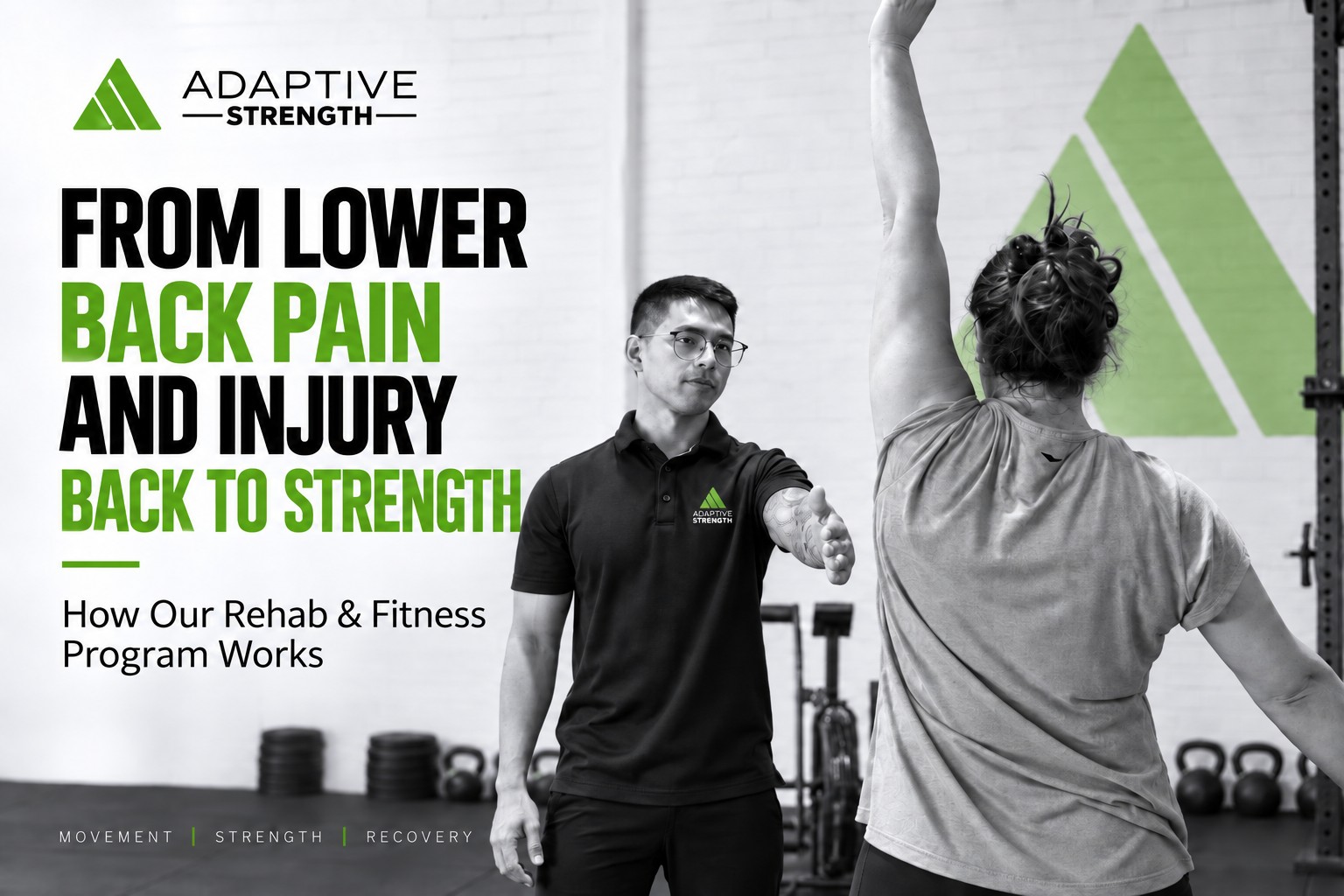
Our Rehab & Fitness Program combines physiotherapy with individualised, supervised strength training.
Your physiotherapist assesses what is going on and helps determine what needs attention.
We look at:
Your symptoms.
Your movement.
Your strength.
What you can currently tolerate.
What aggravates your back.
And what you actually want to get back to doing.
From there, we build an individualised training program around you.
You continue training under supervision on the gym floor while your physiotherapist can review, modify and progress the plan as needed.
And this is an important difference at Adaptive Strength:
They aren’t treating you in one room and then handing you over to someone completely disconnected from your rehabilitation.
They coach.
They supervise.
They modify.
They progress.
The person helping you understand and manage your back can also be involved in progressively building you stronger.
That means we don’t necessarily have to wait until everything feels completely “fixed” before you can start training.
The Goal Is to Get Your Life Back
I don’t think anyone wants to spend the rest of their life thinking about their lower back.
You don’t want every workout to revolve around it.
You don’t want to wonder whether bending down is going to hurt.
You don’t want to avoid lifting things.
Gardening.
Travelling.
Sport.
Training.
Playing with your kids or grandchildren.
Or anything else you enjoy because you don’t trust your back.
You want your back to stop being the thing that dictates what you can and can’t do.
That is what we are working towards.
Less pain.
Better movement.
More strength.
More confidence.
More ability to handle what life asks of you.
There should always be a next step.
And eventually, that step should take you back towards proper training and the life you want to live.
Want Help With Your Lower Back Pain?
If lower back pain is starting to affect how you move, train or live, our Rehab & Fitness Program may be able to help.
If you'd like to know more, you can book a quick call with me, Kurt, Head Coach at Adaptive Strength.
We can have a chat about what is happening with your back, what you want to get back to doing, and whether our Rehab & Fitness Program might be the right fit for you.
Book a Quick Call With Kurt