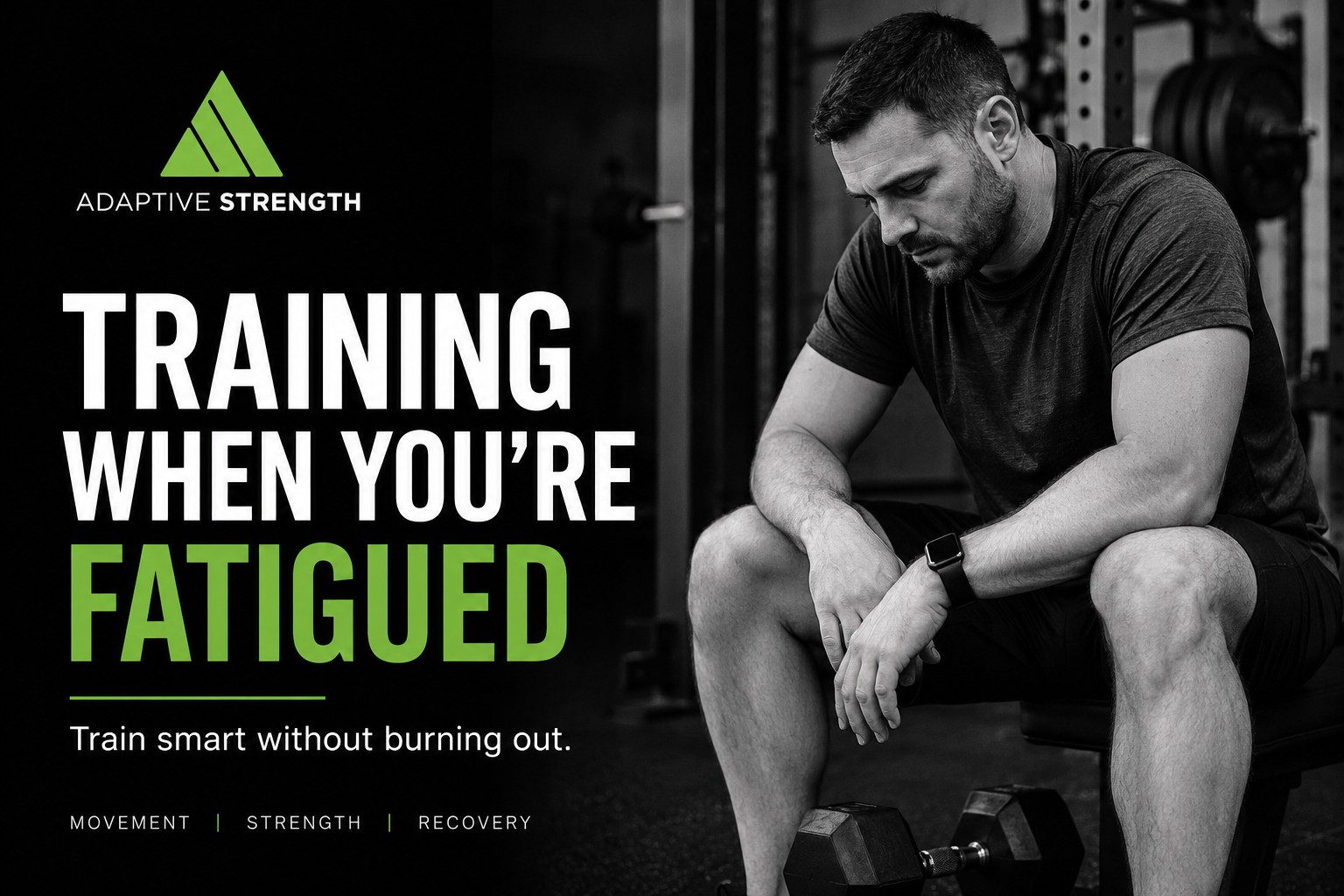
At some point, we all feel it — fatigue that makes getting through the day hard enough, let alone getting through a workout.
Whether it’s from work stress, poor sleep, parenting duties, or just a particularly busy period, the result is often the same:
But here’s the good news:
At Adaptive Strength, we work with people in all kinds of situations — shift workers juggling energy, parents running on less sleep than they’d like, people recovering from injury, and everyday people just trying to stay consistent.
When fatigue sets in, we don’t automatically stop training.
The goal is to train in a way that matches what you actually have available that day — so you can keep moving forward without running yourself into the ground.
Strength Training Can Be a Great Option When You’re Tired
If you’re experiencing fatigue, a well-designed strength session can be a great option.
The key words there are well designed.
We’re not talking about max lifts, huge training volume or grinding every set to failure.
A simple strength session with controlled reps, sensible loads and plenty of rest can allow you to keep training without turning an already tiring day into an even bigger recovery problem.
You can still work on your strength.
You can still maintain your movement.
You can still do something productive.
Avoid HIIT and High-Intensity Cardio
This is where a lot of people go wrong.
When energy is low, they try to push through with a “sweat-it-out” mindset — doing intense circuits, long cardio sessions or HIIT workouts.
But if you’re already fatigued, choosing the type of training specifically designed to push you to your limits usually doesn’t make much sense.
HIIT and hard conditioning are useful training tools.
But they’re also demanding.
Pull the intensity back.
Train, but train at a level you can actually recover from.
You can save the hard intervals and demanding conditioning work for a day when you have more in the tank.
Keep the Rep Range Low
When you’re fatigued, it’s probably not the time to burn yourself out with set after set of 15–20 reps.
Something like 3–5 reps per set with a comfortable, submaximal weight can work well for many strength exercises.
Fewer reps done well are far more valuable than more reps done poorly — especially when you’re running on limited reserves.
Focus on quality over quantity.
Rest as Needed Between Sets
Forget the stopwatch.
When you’re tired, there’s no shame in taking more rest between sets.
Let your breathing return to normal.
Give yourself a moment to recover.
A well-rested set of three good repetitions can be far more useful than rushing into the next set simply because the timer says it’s time.
Taking more rest when you need it isn’t a sign that you’re not working hard enough.
Use Active Recovery Between Strength Exercises
If you don’t want to stand around between sets, you can still keep moving — just gently.
We often program mobility drills, breathing exercises or light movements between strength work.
- 90/90 hip mobility
- Deep squat mobility
- Thoracic rotations
- Controlled breathing
- Band pull-aparts
- Other light mobility work appropriate for you
This can also be a good opportunity to work on some of the movement qualities you might otherwise rush through when you’re feeling fresh and keen to get into the heavier work.
Manage Load — Don’t Chase PBs
Now is not the time to max out or prove a point.
Instead of chasing a personal best, keep the load submaximal.
Enough effort to train, but with several good reps still left in reserve.
You’re still lifting.
You’re still getting useful work done.
You’re just deliberately leaving something in the tank.
That’s making the session fit the person standing in front of us that day.
You Should Leave the Session Feeling Better Than You Arrived
This is one of our core training principles at Adaptive Strength — and it’s even more important when you’re tired.
If you leave the gym more exhausted, depleted or mentally foggy than when you walked in, something’s probably off.
The right session, matched to your energy level, should ideally leave you feeling better.
You might not set any records.
You might not do everything that was originally written in the program.
But you might walk out moving more freely, breathing easier and feeling like you’ve actually done something useful.
Even a Short Session Counts
If you’re tired, 20–30 minutes of quality training can be enough.
It might be three exercises.
A few warm-up sets.
Some good strength work.
And you’re done.
That still counts.
That still keeps the habit going.
That still gives you something positive from the session.
Don’t fall into the trap of “all or nothing.”
Show up.
Do what you reasonably can.
Then get out.
Sometimes the Smartest Move Is a Mobility Day
This article is about training smart through fatigue — and sometimes that means pulling right back and just moving gently.
If you’re sleep-deprived, run down or simply don’t have much in the tank, a full training session might not be the best choice.
But that doesn’t mean the session has to be a complete write-off.
Sometimes we’ll turn it into a mobility day.
Mobility Days Are Part of the Program
At Adaptive Strength, we also deliberately program mobility days into our members’ training plans.
That might include:
- Hip mobility
- Thoracic and spinal movement
- Shoulder mobility
- Controlled breathing
- Light carries
- Gentle bodyweight movement
- Easy walking
The goal is not to create more fatigue.
It’s to keep you moving, work on areas that feel stiff or restricted, and help you leave the session feeling better than when you arrived.
Not every session needs to push the limits.
Some days, the better choice is to move better, move more freely and support recovery so you’re ready to train harder again when the time is right.
Movement. Strength. Recovery.
This is also a good example of what we mean when we talk about:
The balance doesn’t have to be identical every time you train.
That is one of the benefits of individualised programming and having a coach on the floor who can actually adjust things when needed.
One Important Note About Fatigue
This article is mainly talking about the normal fatigue that can come with poor sleep, work stress, parenting, busy periods and life in general.
If your fatigue is persistent, unexplained, unusually severe or affecting your normal day-to-day life, that is different.
In that situation, it’s worth speaking with your GP rather than simply assuming you need to push through it.
Final Thoughts: Train to Support, Not Deplete
At Adaptive Strength, our goal is simple:
That means adjusting your training to suit your current capacity — not fighting your body every step of the way.
Fatigue doesn’t mean failure.
It might simply mean your capacity today is different from what it was last week.
Good programming takes that into account.
Want Help Training Around Real Life?
If fatigue, work stress, poor sleep, injuries or a busy schedule keep derailing your training, we can help you build a more flexible approach.
At Adaptive Strength in Booragoon, we create individualised programs around your goals, current capacity, movement, strength and recovery.
You still train hard when it makes sense.
But the program can also adapt when life gets in the way.
If you'd like to know more, you can book a quick call with me, Kurt, Head Coach at Adaptive Strength.
We can have a chat about what your training currently looks like, what tends to get in the way, and whether Adaptive might be the right fit for you.
Book a Quick Call With Kurt