Not long ago, one of our newer members said to me:
There was a bit of frustration in it.
But there was also genuine curiosity.
Should I be noticing something by now?
It’s a fair question.
Because when you start training, you don’t just put in the time and effort.
You start looking for proof that it’s working.
Has the number on the scales changed?
Do I look different in the mirror?
Do my clothes fit differently?
Can I see more muscle?
And when none of those things seem to have changed after a few weeks, it’s easy to start wondering:
“Am I actually getting anywhere?”
This is where I think people can judge their progress far too early.
Because after three weeks, the changes you’re hoping to see might still be pretty subtle.
But that doesn’t mean the training isn’t doing anything.
In fact, some of the first signs that your training is working often show up in what you can do before they show up in how you look.
Maybe an exercise already feels less awkward.
Maybe you’re lifting a little more.
Maybe you’re recovering better between sessions.
Maybe something that felt difficult in week one already feels more manageable.
Those things matter.
They might not be the dramatic result you were hoping to see after three weeks.
Yet!
But they’re often the first signs that you’re heading in the right direction.
Your Body Can Be Changing Before You Can See It
When you first start strength training — particularly if you’re coming back after a long break — quite a lot can start happening relatively quickly.
You’re learning the exercises.
Your technique is improving.
Your body is getting better at coordinating movements.
You’re learning how to produce force and recruit your muscles more effectively.
Your work capacity can start improving.
Your confidence under load starts growing.
You might already be able to lift slightly more than you could in week one.
Those are adaptations.
They just don’t necessarily show up in the mirror yet.
And that’s where people can get discouraged.
They’re waiting for the visible result, while missing all the things that are already beginning to improve underneath it.
What About Fat Loss or Building Muscle?
If fat loss is your goal, around 0.5kg per week can be a realistic and sustainable rate for many people.
But even then, your bodyweight isn’t necessarily going to move neatly down by exactly 500 grams every seven days.
Fluid.
Food.
Sleep.
Stress.
Hormonal changes.
Training.
They can all affect what the scales say from one day to the next.
So after three weeks, the difference might still be fairly subtle.
And if your goal is to build muscle, that generally takes even more time.
You’re unlikely to suddenly wake up three weeks into training looking dramatically more muscular.
But you might already be lifting more.
Moving better.
Handling more work.
Training with better technique.
And becoming more capable of doing the kind of training that eventually builds noticeable muscle.
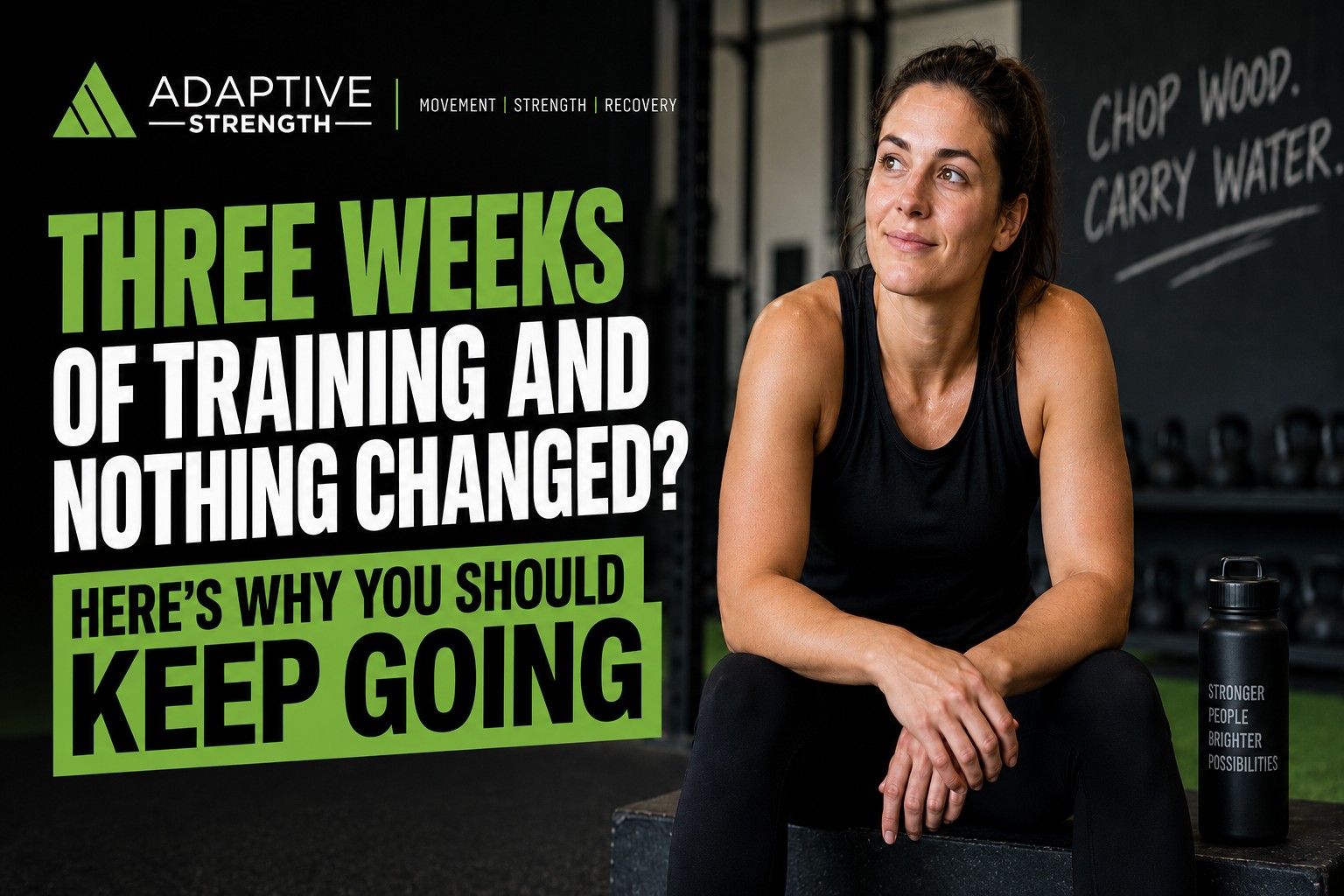
Chop Wood. Carry Water.
This is one of our core values at Adaptive Strength, and I think it fits this situation perfectly.
CARRY WATER.
The idea is simple.
Keep doing the work.
Not just when you’re motivated.
Not just when the scales move.
Not just when somebody comments that you look different.
Turn up.
Follow the program.
Train.
Recover.
Come back.
Then do it again.
There’s nothing particularly glamorous about that.
But that’s how most meaningful progress is made.
You don’t need to prove in three weeks that the entire process works.
You need to keep giving the process enough time to work.
Three Weeks In: What Should You Actually Be Looking For?
Instead of only asking:
“Do I look different yet?”
Look at some of the other things that may already be changing.
Are You Lifting More?
Maybe the 12kg kettlebell you started with has become 16kg.
Maybe you’ve added weight to your deadlift.
Maybe you’re completing the same sets with more control.
That’s progress.
Are You Moving Better?
Maybe the squat that felt awkward in week one already feels more natural.
Maybe you’re moving through a greater range.
Maybe you’re feeling less stiff.
Maybe you’re becoming more confident with movements you haven’t done for years.
That’s progress.
Are You Recovering Better?
Perhaps your first session left you sore for four days.
Now you’re training and feeling fairly normal the following day.
That’s not a sign the training has stopped working.
Your body may simply be getting better at handling it.
That’s progress too.
Can You Do More?
More weight.
More repetitions.
More work.
A slightly harder exercise.
A longer walk without getting tired.
Going up the stairs without thinking about it.
Getting off the floor more easily.
Progress isn’t always something you see in a photo.
Sometimes you notice it because life starts feeling easier.
Are You Actually Becoming Consistent?
This one gets overlooked.
Maybe three weeks ago you weren’t training at all.
Now you’ve trained two or three times each week for three weeks.
That might not produce a dramatic before-and-after photo. Yet!
But you’ve started doing something consistently that you weren’t doing before.
Now the job is to keep stacking those weeks.
Three weeks becomes six. Six becomes twelve. Twelve becomes six months.
And over time, those small improvements start adding up to something much bigger.
What Happens Outside the Gym Matters Too
Training doesn’t happen in isolation.
The hour you spend in the gym is only one part of the picture.
Nutrition
Your body needs enough nutrition to train, recover and adapt.
If you’re trying to build muscle, protein and overall nutrition matter.
If you’re trying to lose fat, your eating habits matter.
Training can do a lot.
But it can’t completely compensate for everything happening outside the gym.
Sleep
Sleep matters.
You recover when you’re not training.
If you’re constantly running on four or five hours of sleep, that can affect your energy, recovery and training quality.
You don’t need perfect sleep every night.
Very few people have that.
But it is part of the bigger picture.
Stress
High levels of life stress can affect your sleep, recovery, appetite, energy and how consistently you train.
Your body doesn’t experience your workout in isolation from the rest of your life.
Work stress still counts.
Parenting still counts.
Poor sleep still counts.
Everything else going on in your life still counts.
That doesn’t mean you stop training every time life gets busy.
It means the training needs to make sense alongside the rest of your life.
Consistency Beats the Occasional Heroic Effort
This is something I believe strongly.
I’d much rather see someone train consistently for the next year than absolutely destroy themselves for three weeks and then disappear.
You don’t need every session to be incredible.
You don’t need a personal best every week.
And you don’t need to crawl out of the gym feeling like you’ve survived something.
Some sessions will be great.
Some will be average.
Some weeks life will make training harder than others.
That’s okay.
One session doesn’t transform you.
Neither does one bad night’s sleep.
Neither does one takeaway meal.
It’s what you repeatedly do that matters.
Chop Wood. Carry Water.
Don’t Let the Mirror Be Your Only Scoreboard
One of the problems with judging progress purely by how you look is that it can make you miss everything else that’s improving.
At Adaptive Strength, I’d rather look at the bigger picture.
Are you getting stronger?
Are you moving better?
Are you becoming more capable?
Can you tolerate more training?
Are you recovering better?
Are you doing things you couldn’t do when you started?
Because if those things are moving in the right direction, something is happening.
The mirror may simply be a little slower to show it.
So instead of asking:
“Do I look different yet?”
Try asking:
“Am I doing things today that I couldn’t do three weeks ago?”
Maybe you’re lifting a little more.
Moving better.
Recovering faster.
Feeling more confident.
Turning up more consistently.
Those things matter.
Keep stacking them up.
Chop Wood. Carry Water.
Because the visible results often come after you’ve spent enough time doing the less-visible work.
Three weeks isn’t a long time.
But it might already be the beginning of something.
Want Help Making Sure Your Training Is Actually Moving Forward?
If you’ve started training but aren’t sure whether you’re progressing, we can help you look at more than just the scales or the mirror.
At Adaptive Strength in Booragoon, we build individualised programs around where you’re starting, what you’re trying to achieve and what you need to keep progressing.
We track your training.
We progress your program.
And our coaches are there to make sure what you’re doing today actually connects to where you’re trying to go.
If you’d like to know more, you can book a quick call with me, Kurt, Head Coach at Adaptive Strength.
We can have a chat about what you’re trying to achieve, what you’ve been doing so far and whether Adaptive might be the right fit for you.
Book a Quick Call With Kurt