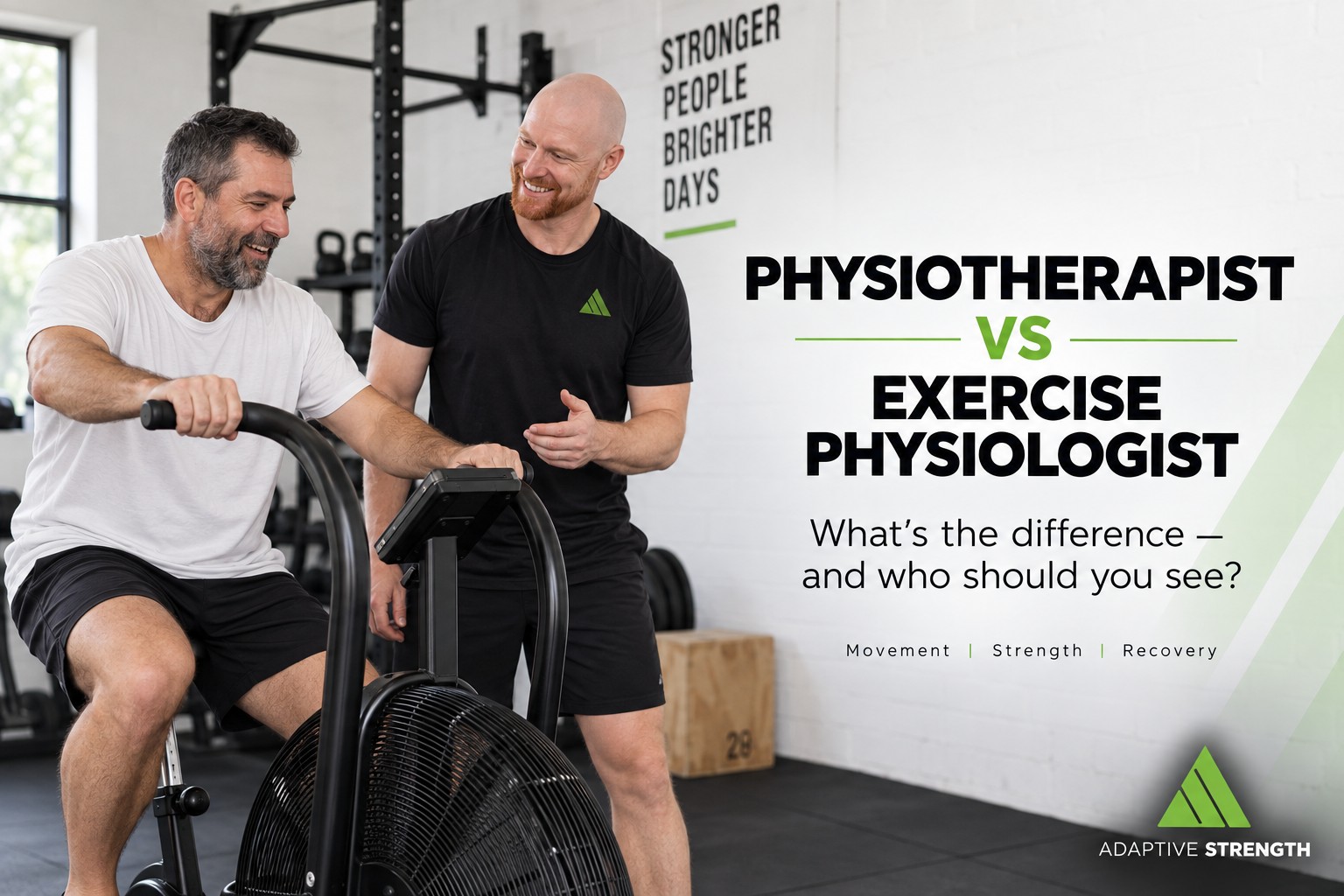
We get asked this a lot.
You’ve hurt your knee.
Your back keeps flaring up.
You’ve had surgery and want to get strong again.
Or maybe you have osteoporosis, diabetes, cardiovascular disease or another health condition and you know exercise would help — but you’re not sure who you should see.
Part of the confusion is that physiotherapists and exercise physiologists can actually do many of the same things.
There is a lot of overlap.
Both can work with pain and injury.
Both can prescribe exercise.
Both can help people improve movement and physical function.
Both can help people become stronger.
Both may be involved in helping someone return to work, sport, training or everyday life.
But they come into that work with different professional training, different areas of expertise and different scopes of practice.
And there is one important distinction worth understanding:
An exercise physiologist does not diagnose medical or musculoskeletal conditions in the same way.
So, who should you see?
Let’s make it practical.
First, What Do Physiotherapists and Exercise Physiologists Have in Common?
Both are university-qualified allied health professionals.
Generally, you are looking at around four years of university education before entering either profession, although there are different study pathways available.
Physiotherapists are registered through the Physiotherapy Board of Australia and Ahpra.
Accredited Exercise Physiologists are accredited through Exercise & Sports Science Australia — ESSA.
Both professions are also recognised across Medicare, private health insurance and a range of compensable schemes, depending on the person’s eligibility and cover.
But the qualification itself is probably not what matters most to you.
That’s where the differences become more useful.
Physiotherapist: Assessing the Problem and Helping You Move Forward
A physiotherapist will often be the logical place to start when you have something new, painful or unexplained going on.
For example:
You’ve injured your knee playing sport.
Your shoulder has suddenly started hurting.
Your back pain has changed.
You’ve lost movement or function.
You’ve recently had surgery.
You don’t know what is causing the problem.
You need a clinical assessment and diagnosis.
A physiotherapist can assess what is happening, provide a diagnosis where appropriate and help you work out what to do next.
Treatment may include education and exercise.
It may also include hands-on treatment when appropriate, particularly when pain or restricted movement is limiting what you can currently do.
That might include manual therapy, soft tissue treatment, dry needling or other techniques depending on the practitioner and the problem.
But there is something I feel strongly about here.
Hands-on treatment can be useful.
Settling symptoms can be useful.
Restoring movement can be useful.
But if your goal is to get back to training, sport, work, gardening, running or simply feeling confident in your body again, eventually we have to progressively rebuild what your body can actually do.
At some point, rehab needs to start looking more like training.
Exercise Physiologist: Using Exercise as Treatment
An Accredited Exercise Physiologist has a different area of expertise.
Exercise physiologists specialise in prescribing and adapting exercise around a person’s health, physical function and goals.
And importantly, exercise physiology is much broader than simply being the person you see after finishing physiotherapy.
An exercise physiologist may work with people who have:
Musculoskeletal injuries.
Persistent or chronic pain.
Diabetes.
Cardiovascular disease.
Osteoporosis.
Cancer.
Neurological conditions.
Disability.
Reduced strength or physical function.
Multiple chronic health conditions.
Difficulty returning to exercise after illness or injury.
For some of these people, there may be no need for physiotherapy at all.
The main problem isn’t necessarily an injury that needs diagnosing.
An exercise physiologist can assess things such as physical capacity, strength, movement, exercise tolerance and how someone responds to exercise.
Then they can build an individualised exercise program around that person.
Maybe the goal is improving bone strength for someone with osteoporosis.
Maybe it is improving strength and fitness for someone managing diabetes.
Maybe it is rebuilding physical function after cancer treatment.
Maybe someone has persistent pain and needs help becoming stronger and more confident with movement again.
Maybe they’ve finished the early stages of injury rehabilitation and now need to progressively build more strength and capacity.
That is where an exercise physiologist can be extremely valuable.
The Traditional Model Often Creates a Handover
When we talk about injuries in particular, there is a pathway you often see.
You hurt your knee, shoulder or back.
You see a physiotherapist.
They assess the problem.
They provide a diagnosis.
They help settle the symptoms.
They give you some rehabilitation exercises.
Then, once things have improved enough, you might be discharged and eventually move on to an exercise physiologist, personal trainer or gym.
EXERCISE LATER.
There is nothing inherently wrong with that approach.
The problem is the gap it can sometimes create.
Who decides when you’re ready to progress?
Who turns the rehab exercises into proper strength training?
How does the person coaching you in the gym know what the physio was trying to achieve?
What happens if something starts hurting again once the training becomes more demanding?
Who is responsible for continuing to build you once the pain has improved?
And who is responsible for continuing to build you from:
“My pain is better.”
to:
“I’m strong and confident enough to do what I actually want to do again.”
That handover between rehabilitation and training is something we have deliberately tried to remove at Adaptive Strength.
The Overlap Between Physiotherapy and Exercise Physiology Is Bigger Than Most People Realise
This is where the distinction can become confusing.
People sometimes think:
EXERCISE PHYSIOLOGIST = EXERCISE.
It isn’t that clean.
Physiotherapists use exercise extensively.
Exercise physiologists work with pain, injuries and complex health conditions.
Both professions may help someone:
Regain movement.
Rebuild strength.
Improve physical function.
Increase exercise tolerance.
Return to activity.
Progressively become more physically capable.
So there is genuine crossover.
But their professional backgrounds remain different.
A physiotherapist is particularly well placed to clinically assess and diagnose a new or unexplained musculoskeletal problem.
An exercise physiologist is particularly well placed to use exercise to manage and improve health, physical function and capacity across a very wide range of conditions.
It gives us more options.
And at Adaptive Strength, that overlap goes even further because of how we have deliberately built our model.
At Adaptive Strength, We Don’t Put Rehab and Training in Separate Boxes
At Adaptive Strength, the difference between the two professions matters.
But we don’t want that difference creating a gap in your care.
Our team includes physiotherapists, exercise physiologists and exercise science professionals who also coach strength training on the gym floor.
That last part is important.
THEY ALSO COACH.
Our physiotherapists don’t simply treat someone in a room, give them four rehab exercises and then send them somewhere else when they’re ready to train.
Our exercise physiologists aren’t sitting separately from the strength program either.
They coach.
They supervise.
They modify.
They progress.
They write and update programs.
They help people get stronger.
So the physio who has been helping you with your knee may also be one of the coaches helping you progressively load that knee in your strength program.
An exercise physiologist working with someone with osteoporosis may also be coaching them through their individualised strength training on the gym floor.
The clinical side and the training side don’t have to be disconnected.
That is very deliberate.
Sometimes a physiotherapist may continue working with someone from the early stages of injury rehabilitation all the way into increasingly demanding strength training.
Sometimes an exercise physiologist may be the right professional from the beginning because the main issue is osteoporosis, diabetes, cardiovascular health, persistent pain or another condition where exercise is central to the management plan.
Sometimes the expertise of more than one person on our team is useful.
“Which professional’s box do I fit into?”
It is:
“What do I need right now — and what needs to happen next?”
So, Should I See a Physiotherapist or an Exercise Physiologist?
There are still some useful starting points.
A Physiotherapist May Be the Best Place to Start If:
You have a new or unexplained injury.
You’re experiencing pain and don’t know what is causing it.
You have had a sudden change in movement or function.
You’ve recently had surgery.
You need the problem clinically assessed and diagnosed.
Hands-on treatment may be useful as part of your management.
You’re unsure whether it is appropriate to start or continue training because of something that is hurting.
An Exercise Physiologist May Be the Best Place to Start If:
You have a known chronic or medical condition and exercise needs to be prescribed around it.
You have osteoporosis, diabetes, cardiovascular disease or another condition where exercise can be an important part of management.
You need to improve your strength, fitness or physical function.
You have persistent pain or an existing musculoskeletal condition and need exercise individually adapted around it.
You need exercise modified around multiple health conditions.
You are returning to exercise after illness or injury.
Or the main question is no longer:
“What is wrong with me?”
but:
“How do I progressively build what my body can do?”
And sometimes, either profession may be appropriate.
There is far more crossover than most people realise.
What If I Still Don’t Know Who I Need?
That’s okay.
Tell us what is going on.
Tell us what you’re struggling with.
Tell us what you want to get back to doing.
We can help work out the most appropriate place to start.
Maybe that is with one of our physiotherapists.
Maybe an exercise physiologist makes more sense.
Maybe the initial problem is fairly simple but you need a longer-term strength plan.
Maybe there are several things going on and we need to look at the bigger picture.
Our job is to help you find the right starting point and then make sure there is a plan for what happens next.
Movement. Strength. Recovery.
Ultimately, this is where our broader philosophy comes into it.
Maybe pain or injury means movement needs attention first.
Maybe the real priority is building strength.
Maybe a chronic health condition means exercise needs to be carefully prescribed and progressed.
Maybe fatigue, surgery or illness means recovery has to influence how much training makes sense right now.
These things overlap.
So do the professionals who help manage them.
Sometimes the rehab exercise becomes the strength exercise.
Sometimes improving strength improves movement.
Sometimes recovery means modifying the training for a while before progressing again.
The goal is to progressively help you become more capable.
The Right Professional — With a Plan for What Comes Next
Physiotherapists and exercise physiologists are different professions.
Their training is different.
Their scope is different.
And there are situations where one is clearly the better starting point.
But there is also significant overlap.
And I believe that overlap becomes particularly powerful when the people involved aren’t working in separate silos.
At Adaptive Strength, we have deliberately built a team where physiotherapy, exercise physiology and strength coaching can work together.
Because whether you first come through the door because of knee pain, osteoporosis, diabetes, surgery, persistent back pain or simply because you know you need to become stronger, the question eventually becomes:
Where are you now?
Where do you want to get to?
And what needs to happen next to help you get there?
That is the part that matters most.
Not Sure Who to Book With?
If you’re not sure whether you should see a physiotherapist or an exercise physiologist, you don’t have to figure it out on your own.
If you'd like to know more, you can book a quick call with me, Kurt, Head Coach at Adaptive Strength.
We can have a chat about what is going on, what you want to achieve and which member of our team is likely to be the best place to start.
Book a Quick Call With Kurt