Within the fitness industry, Semi-Private Personal Training and Small Group Training are often used interchangeably.
But in reality, they can be two very different forms of training.
What makes it even more confusing is that the term Semi-Private Personal Training is now being used to describe all sorts of different training models.
Two gyms might both advertise “semi-private training” — but what actually happens once you walk through the door can be completely different.
That makes it difficult for someone trying to compare memberships and work out what they’re actually paying for.
So rather than getting too caught up in the name, I think there’s a much more important question:
actually getting?
What Is Small Group Training?
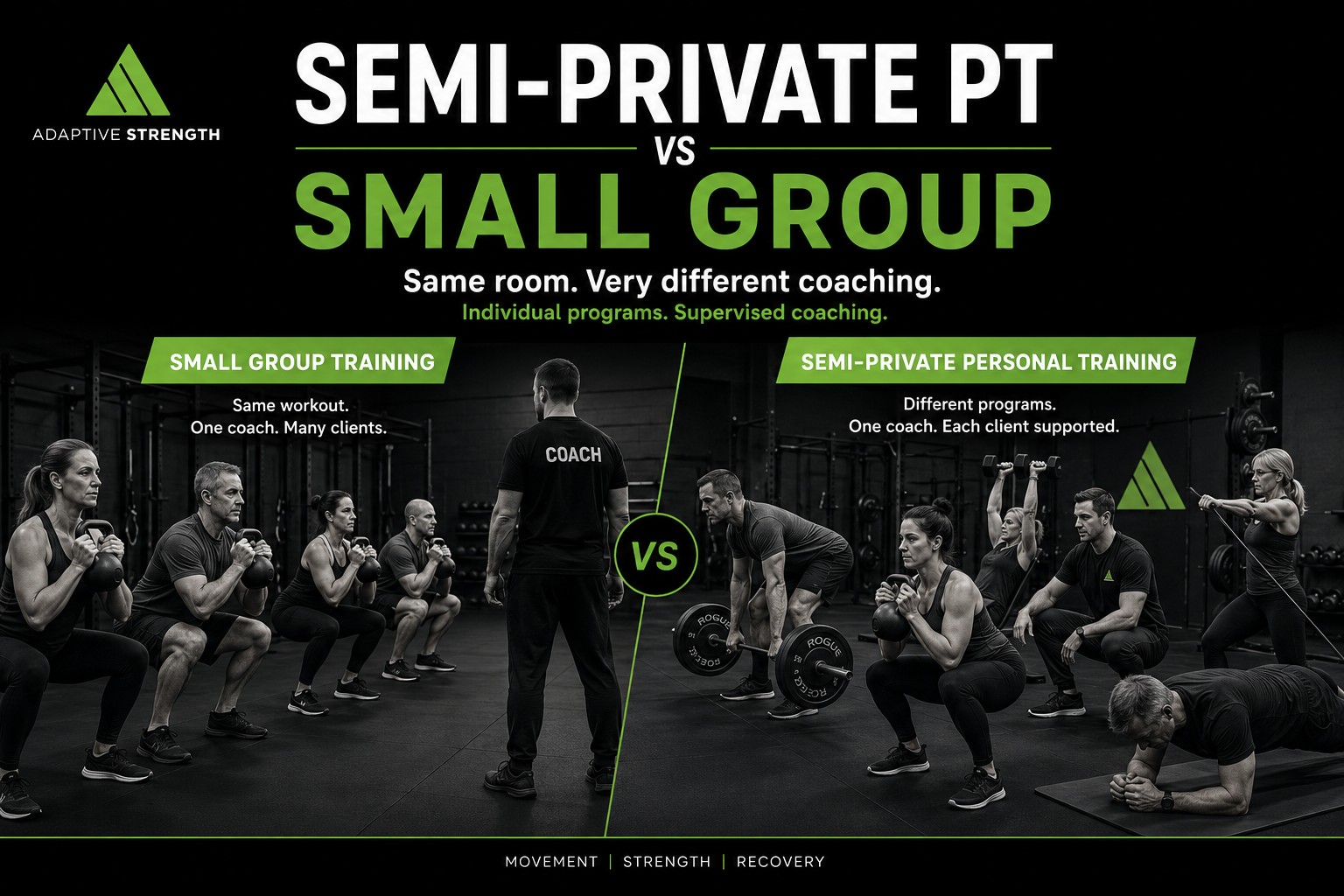
Traditional group training generally has one coach leading a number of people through the same workout.
Everyone might squat.
Everyone might press.
Everyone might do the same circuit.
The weights or difficulty may be adjusted depending on the person, but fundamentally, everyone is following the same session.
Small Group Training takes that concept and reduces the number of people.
Instead of 15 or 20 people, perhaps there are six or eight.
There is absolutely nothing wrong with that style of training.
For plenty of people, it can be enjoyable, motivating and exactly what they’re looking for.
But it isn’t the same thing as Personal Training.
A Smaller Group Doesn’t Automatically Make It Personal Training
As Semi-Private Personal Training has become more popular, the term has started being used very loosely.
We now see gyms advertising “semi-private personal training” when, in reality, everyone in the session is still following essentially the same workout.
Instead of 15 people doing the same workout, perhaps there are now six.
Smaller group?
Absolutely.
More attention from the trainer?
Probably.
But does that automatically make it Personal Training?
The number of people in the room is only part of the equation.
What matters much more is what each person is actually doing.
Same Workout + Different Weights ≠ Individualised Programming
This is probably one of my biggest issues with how the term “personalised” is sometimes used.
Six people might all be doing the same squat.
One person uses 20kg. Another uses 40kg. Another uses 60kg.
Because the weights are different, this is sometimes described as individualised programming.
I strongly disagree with that.
The difference is whether the program itself has been built for the individual.
Coaching vs Cheerleading
This is another difference I think matters.
In many group training environments, the trainer’s job is to manage the session.
Keep everyone moving.
Watch the clock.
Count reps.
Provide encouragement.
Again, there is nothing necessarily wrong with that if that’s the service you’re looking for.
But in Personal Training, I expect more.
- Teaching
- Watching technique
- Adjusting exercises
- Progressing loads
- Understanding why you’re doing the exercise
- Knowing what you’re working towards
- Making decisions based on the person standing in front of them
So, What Is True Semi-Private Personal Training?
Usually, you might be training alongside around 4–6 other people.
But again, the number of people in the room isn’t what defines the service.
everyone has their own program.
Your program should be built around:
- Your goals
- Your starting point
- Your training history
- Your movement
- Your injuries or health considerations
- Your strengths and weaknesses
- What you personally need to work on
The person beside you might be doing something completely different.
And that’s exactly how it should be.
Everyone Can Be Doing Something Different
This is probably the easiest way to understand the difference.
One day, you could be training beside:
- An older adult with a hip replacement
- Someone preparing for an Ironman
- A new mum getting back into strength training
- Someone managing a chronic health condition
- Someone rehabbing a shoulder
- Someone who simply wants to get stronger
They can all be in the same session.
because everyone is doing something different.
One person might be goblet squatting.
Another might be pressing.
Another might be doing core work.
Another might be working through shoulder rehabilitation.
Someone else might be deadlifting.
They aren’t trying to keep up with each other.
They aren’t waiting for the coach to yell out the next exercise.
That is the difference.
What Should You Expect From True Semi-Private or Supervised Personal Training?
Your Own Individualised Program
You should have a program designed around you.
Not the workout everyone else happens to be doing that day.
Your starting point and your progression should be based on what you need.
A Small Supervised Training Environment
You still get the energy and community of training around other people.
But because everyone has their own program, you’re not forced to keep pace with the group.
You work through your own session.
A Skilled Coach Supervising Every Session
There should be someone there to actually coach you.
Not just start the clock.
Your coach should help with technique, exercise execution, loading, progression and modifications when needed.
Your Program Can Change When You Need It To
Maybe your knee is irritated today.
Maybe your shoulder isn’t happy with an exercise.
Maybe you’ve been sick.
Or perhaps the opposite has happened and something has become too easy.
Your coach can adjust the session rather than forcing you to complete what everyone else is doing.
Your Progress Is Monitored
The goal isn’t to simply collect workouts.
Your training should progress.
Weights should change.
Exercises should progress.
Your capacity should improve.
And your program should evolve as you do.
You Have Ongoing Accountability
At Adaptive Strength, each member also has a Personal Progress Coach.
Think of them a little like a case manager.
They help keep an eye on your progress, check in when needed, organise program reviews and help remove roadblocks when something isn’t working.
You Still Get the Community
Individual programming doesn’t mean training alone.
You still get to know the people around you.
You talk.
You encourage each other.
You build relationships.
You get the community of a smaller training environment — without everyone being forced through the same workout.
What About Price?
Semi-Private or Supervised Personal Training will generally cost more than a group class.
And it should.
You’re paying for a higher level of individual programming, coaching, supervision and ongoing support.
The important thing is to make sure you’re actually receiving that additional service.
If a gym charges you more because there are fewer people in the room, but you’re still following exactly the same workout as everybody else, that’s a question worth asking.
What Should You Ask When Comparing Gyms?
Different gyms use different terminology.
Small Group Training.
Semi-Private Personal Training.
Small Group Personal Training.
Supervised Personal Training.
So don’t assume two services are the same simply because they use the same name.
Personal Training Has Always Been at the Centre of Adaptive Strength
We were one of the earlier studios in Perth to move into this style of Personal Training.
But importantly, we didn’t come from a group-class model.
We started with Personal Training.
We worked out how to deliver that same individualised approach in a supervised environment.
That’s an important distinction.
Personal Training has always been at the centre of what we do.
At Adaptive Strength, We Call It Supervised Personal Training
At Adaptive Strength, we now call our model Supervised Personal Training.
You may have heard a similar model described elsewhere as Semi-Private Personal Training.
We prefer Supervised Personal Training because we think it better describes what actually happens.
In a supervised training environment.
Whatever a gym chooses to call it, the important thing is not the label.
Looking for Individualised Personal Training?
At Adaptive Strength in Booragoon, our Supervised Personal Training combines individualised programming with the support, coaching and community of a supervised training environment.
You have your own program.
You train at your own pace.
And you have a skilled Strength Coach on the floor helping you progress it.
If you'd like to know more about how it works, you can book a quick call with me, Kurt, Head Coach at Adaptive Strength.
We can have a chat about what you're looking for, what you'd like to achieve and whether Supervised Personal Training at Adaptive might be the right fit for you.
Book a Quick Call With Kurt