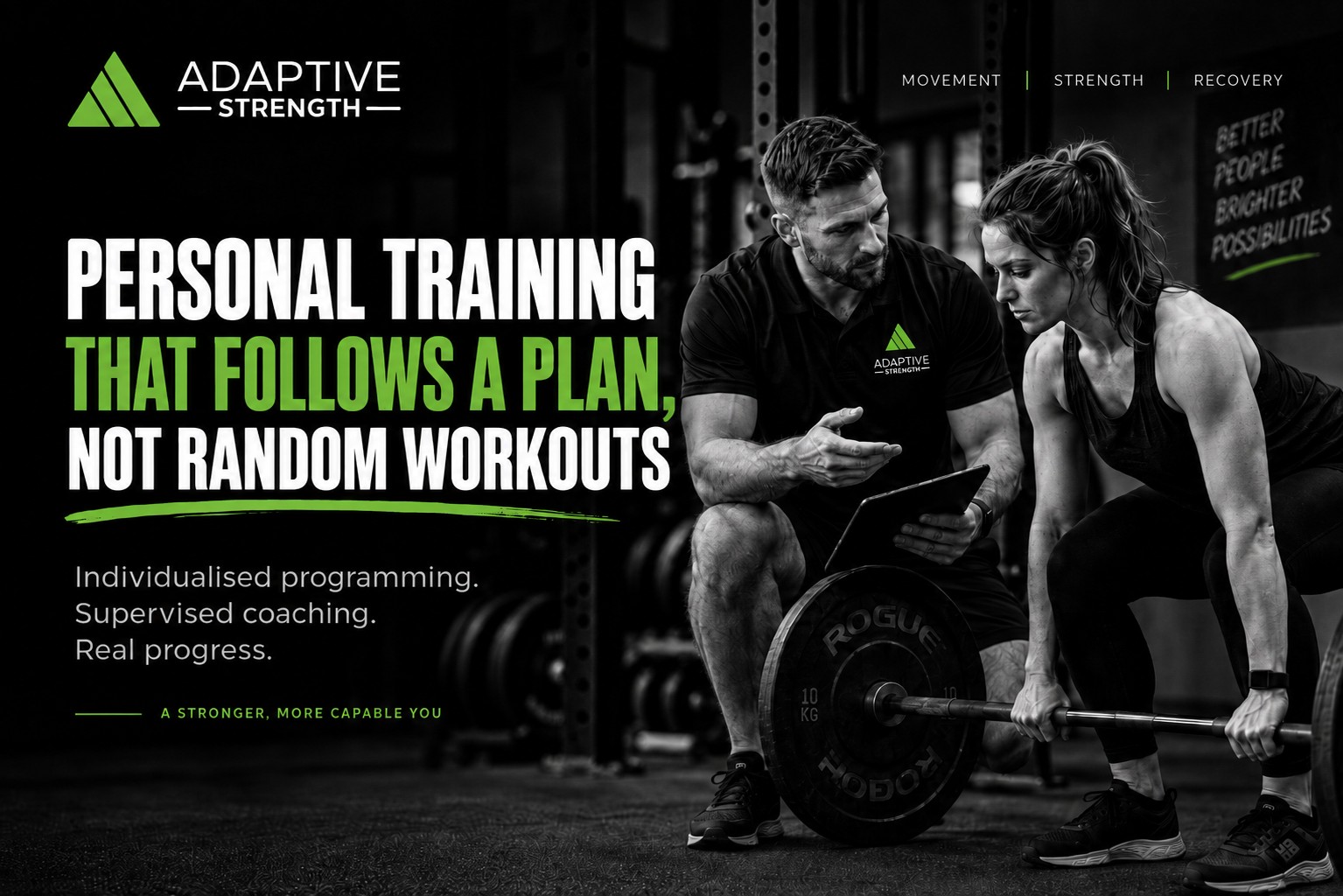
At Adaptive Strength, our personal training is not built around random workouts.
We develop individualised programs.
That might sound like a small difference, but to me it is actually one of the biggest differences between what we do and what many people experience in a typical gym, bootcamp, fitness class or even some personal training sessions.
A program is about where you are going.
And for most people who come to Adaptive Strength in Booragoon, that distinction matters.
Because most of our members aren't just looking to “get sweaty” for 45 minutes.
They want to:
- Get stronger
- Move better
- Rebuild confidence after an injury
- Return to sport
- Improve their health
- Keep up with their kids
- Stay strong and independent as they get older
- Feel like they're finally training in a way that makes sense for their body
That doesn't happen by accident.
It happens by following a plan.
A Workout Can Make You Tired. A Program Should Move You Forward.
There is no shortage of ways to make someone tired.
You can do 100 burpees.
Push a sled until your legs feel like jelly.
Do a circuit of squats, lunges, push-ups, rowing and kettlebell swings.
Throw in some battle ropes for good measure.
You'll probably leave sweaty.
You'll probably be tired.
You might even feel like you've had a great workout.
But the question I care about is:
Because being tired and making progress are not the same thing.
That is where a program is different.
A program has a reason behind it.
The exercises are chosen for a purpose.
The weights, sets, reps, ranges of movement and progressions should make sense based on:
- Where you are now
- What you're trying to achieve
- What training you've done before
- What your body can currently tolerate
- Any injuries or limitations we need to consider
- What we want to build towards next
We're not just asking:
We're asking:
That's programming.
When I think about a good training program, it isn't simply a list of strength exercises.
At Adaptive, a lot of our approach comes back to Movement. Strength. Recovery.
All three should be considered within the plan.
The balance between Movement, Strength and Recovery won't always be the same.
Sometimes we need more attention on movement.
Sometimes the priority is pushing strength.
Sometimes an injury, illness or stressful period means recovery needs a little more consideration.
But there should still be a plan behind it.
Your Body Adapts to What You Repeatedly Do
Your body is very good at adapting.
If you repeatedly lift weights, you can become stronger.
If you repeatedly practise a movement, you usually become better at that movement.
If you gradually increase the challenge over time, your body has a reason to adapt.
But the important word there is:
This is where people often get stuck.
They either do too little for too long and stop progressing.
Or they do too much too soon, get excessively sore, aggravate something or simply can't sustain it.
A good program sits somewhere in the middle.
Enough challenge to create progress.
Not so much that every session knocks you around for the rest of the week.
Most People Don't Need Random. They Need Consistency.
One of the biggest mistakes I see when people are training by themselves is changing everything too often.
They start a program.
Two weeks later they see a new exercise on Instagram.
So that goes in.
Then someone tells them about a new training method.
They try that.
Then they get bored and change the whole routine.
Then three weeks later they're wondering why they aren't getting stronger.
Usually the problem isn't effort.
Strength training needs enough repetition for you to actually get better at something.
That doesn't mean doing the exact same exercises forever.
It means keeping enough consistency to develop the movement and build strength while gradually changing things for a reason.
Take a deadlift.
Someone new to training might begin with a kettlebell deadlift from an elevated position.
As their movement, confidence and strength improve, we might lower the starting position.
Add more weight.
Change the tempo.
Introduce another variation.
Eventually, a barbell deadlift may make sense.
To the member, it might simply feel like:
But behind the scenes there is a method.
And making sure the next step actually makes sense.
That's very different from throwing six exercises together because we haven't done them recently.
Individualised Personal Training Matters Because People Are Different
Two people can have exactly the same goal and need completely different programs.
Two people might walk in and say:
Great.
But one hasn't exercised properly in ten years.
The other has trained consistently for five years.
One has a history of lower-back pain.
The other has recently finished rehabilitation for a shoulder injury.
One wants to play tennis.
The other wants to stay strong enough to travel, garden and keep up with their grandchildren.
Same broad goal.
Very different people.
At Adaptive Strength, we look at things like:
- Your current strength and fitness
- Your injury history
- How you move
- Your training experience
- Your confidence with different exercises
- Your goals
- Your lifestyle and schedule
- How often you can realistically train
- What your body is currently ready for
Then we develop the program around you.
That's the point of individualised personal training.
Not putting six people in a room and making six people do the same thing.
The Program Gives the Coach a Roadmap
A good program doesn't mean the coach becomes less important.
Quite the opposite.
The program gives the coach a roadmap.
When you walk into Adaptive Strength, your coach isn't standing there wondering what we should do with you today.
There is already a plan.
We know what you're working towards.
We know what you've been doing.
We know what we're trying to progress.
Then the coach uses judgement.
- If a weight looks too easy, we can progress it.
- If something doesn't feel right, we can modify it.
- If you're moving really well, perhaps we push a little harder.
- If you've had a terrible week and barely slept, perhaps today's session changes.
- If your knee is irritated, we might change the exercise, range, load or volume without throwing away everything else you're working on.
This is where coaching and programming work together.
I think you need both.
Because the best program in the world isn't much use if nobody is watching the person actually doing it.
And good coaching becomes much more powerful when the coach knows where we're trying to go.
A Plan Doesn't Mean Being Rigid
This is another important point.
Following a program doesn't mean blindly doing exactly what is written regardless of what happens.
People aren't machines.
Life changes.
A good program doesn't fall apart the moment real life happens.
It gives us something to adjust from.
We can change today's session without losing sight of the bigger picture.
That's very different from random training.
Random means there was never much of a direction in the first place.
Programs Help Prevent the “All or Nothing” Trap
This is something I hear a lot from people before they start with us.
When they're motivated, they go hard.
Five sessions this week.
New diet.
Extra cardio.
Everything at once.
Then work gets busy.
They miss a couple of sessions.
Training stops.
A few weeks later they come back feeling guilty and try to make up for the time they've missed.
So they go too hard again.
They're incredibly sore.
An old injury gets irritated.
They miss another session.
And the whole thing starts again.
A good program gives us a much better way to handle that.
Missed a week?
Fine.
We don't need to punish you.
We don't need to “make up” the sessions.
We adjust where necessary and keep going.
Been away for three weeks?
Maybe we reduce the load a little for the first session or two and rebuild.
Work is crazy this month and you can only train twice instead of three times?
We work with that.
Your life shouldn't have to become perfect before the plan works.
At Adaptive Strength, I'm much more interested in someone training consistently over the next few years than showing me how hard they can train for the next three weeks.
We Are Not Trying to Smash You. We Are Trying to Build You.
This is a big part of what we believe at Adaptive Strength.
We are here to build you.
That doesn't mean training should be easy.
Far from it.
If you want to become stronger, at some point we're going to need to challenge you.
But there should be a reason for that challenge.
It might mean helping you deadlift more weight.
It might mean helping you climb stairs with more confidence.
It might mean helping your knee tolerate tennis again.
It might mean getting your shoulder strong enough to comfortably work overhead.
It might mean helping you return to training after surgery, an injury or years away from exercise.
Whatever the goal, the process usually has some version of:
That's what a program is supposed to do.
Personal Training Should Be More Than Someone Counting Your Reps
There are plenty of workouts available for free.
You can find thousands on YouTube.
There are apps that can tell you what exercises to do.
You can join a class and follow whatever is written on the whiteboard that day.
For some people, that's exactly what they want.
But that isn't what we're trying to provide at Adaptive Strength.
Our personal training is for people who want more direction.
They want to know:
- Why am I doing this exercise?
- What are we trying to improve?
- When do I progress?
- What happens if something hurts?
- What are we working towards next?
They want an individual plan.
They want a coach there when they train.
And they want the program to evolve as they do.
That's what supervised personal training means to us.
The Bottom Line
A program should move you forward.
At Adaptive Strength, our personal training isn't built around finding a different way to exhaust you every time you walk through the door.
It's built around having a plan.
A plan for your movement.
A plan for your strength.
A plan that considers recovery.
A plan that can change when it needs to.
And a coach who understands where we're trying to take you.
Because personal training should be more than a collection of workouts.
It should actually take you somewhere.
Want to Know What Your Training Plan Could Look Like?
If you're looking for personal training but don't want to simply be given another generic workout, we can have a conversation about what you're trying to achieve.
At Adaptive Strength in Booragoon, we start by looking at your goals, training history, current ability, injuries or limitations and what you realistically want training to look like in your life.
From there, we can work out an appropriate starting point and what a training plan could look like for you.
If you'd like to know more, you can book a quick call with me, Kurt, Head Coach at Adaptive Strength.
We'll have a chat about what you're looking for, what you've tried before and whether Adaptive might be the right fit.
Book a Quick Call With Kurt