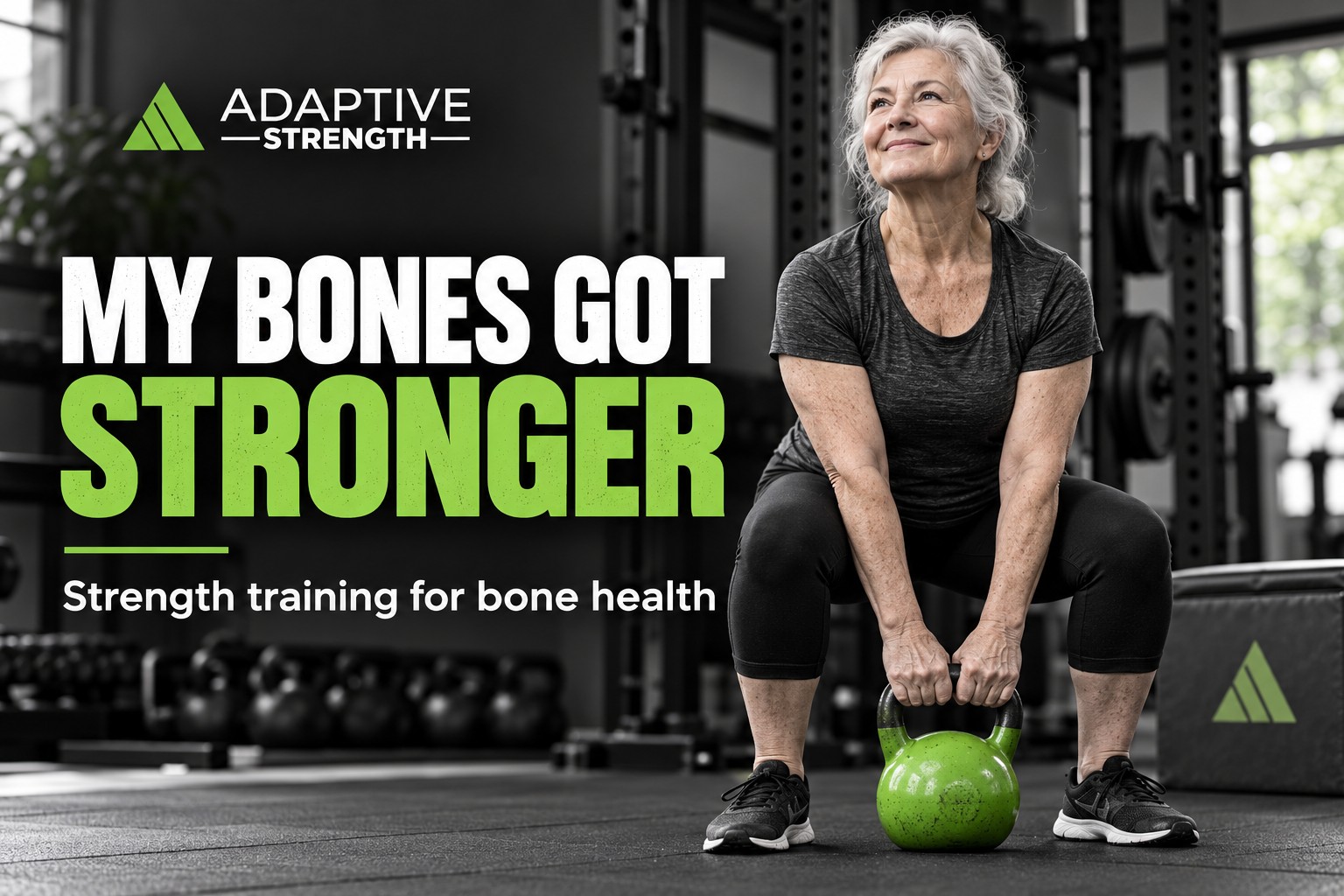
The other day, one of my 68-year-old clients came rushing up to me with this huge grin on her face.
“My bone mass… it’s 2.9kg now! It was only 2.2kg eighteen months ago!”
She was beaming — proud, confident, and honestly a little shocked at what her body had managed to do.
(For privacy, I won’t use her real name — let’s call her Mary.)
Now, if you’ve ever been told you have osteopenia or osteoporosis, you know how scary those words feel. They sound final… like a slow, inevitable decline.
But seeing Mary so excited — because she had literally built new bone — was the perfect reminder of something we talk about all the time:
Bones aren’t set in stone. They change. And when you train the right way — especially with resistance — your body responds in a big way.
A Quick Bit of Science (Don’t Worry — The Easy Version)
Bones aren’t like concrete. They’re more like a living construction site that’s always being broken down and rebuilt.
Two key workers are always on shift:
- Osteoclasts – the demolition team, clearing old bone
- Osteoblasts – the builders, laying down new bone
As we age — especially in our 50s, 60s and beyond — the demolition crew starts outworking the builders.
That’s when bone density drops.
BUT…
Give the builders a good enough reason to work harder?
They do.
And that “reason” is resistance training.
Why Resistance Training Works So Well for Bone Health
Your body is smart.
If you lift weights, move with load and challenge your muscles, it thinks:
So it strengthens the bones.
Not theoretically.
Not “maybe.”
Not “only for young people.”
When you lift weights safely and consistently, your bones experience mechanical loading.
That loading gives the body a reason to maintain and build stronger bone — particularly in areas where bone health really matters, such as the hips and spine.
“But Am I Too Old to Start?”
Absolutely not.
In fact, this is exactly when resistance training becomes most powerful.
We see people every week at Adaptive Strength starting strength training later in life.
Women in their 50s training to improve their bone health.
People in their 60s getting stronger and improving their balance.
People in their 70s learning to lift weights safely for the first time in their lives.
And yes — people like Mary, who was absolutely thrilled to see her bone mass measurement increase by 700 grams in 18 months.
Bones respond to strength training at any age.
The real “too late” moment is simply… not starting.
It Is About More Than Bone Density
The number mattered to Mary.
But what she said next mattered just as much.
That is a big deal.
That confidence is everything.
Because good bone-health training is not only about the number on a scan or a body-composition report.
It is also about:
- building more muscle strength
- improving balance
- feeling steadier on your feet
- reducing your risk of falls
- feeling more confident in what your body can do
It is about getting up from a chair more easily.
Carrying your shopping.
Walking confidently.
Going up and down stairs.
Travelling.
Playing with the grandkids.
And continuing to live an active life as you get older.
There Is Still Plenty You Can Do
If you've been told you have osteopenia, osteoporosis or low bone density, there are things you can do.
Strength training can be part of that.
The important part is starting at the right level and progressively building what your body can handle.
You can still get stronger. You can still improve your balance. And you can still build a body that feels more capable and confident as you get older.
Mary’s excitement that day was not really about a number.
It was about seeing proof that the work she had been putting in was making a difference.
And that made my week.
Want to Get Stronger and Look After Your Bone Health?
If you’ve been diagnosed with osteopenia, osteoporosis or low bone density and you’re unsure how to start strength training, we can help.
At Adaptive Strength in Booragoon, we work with people who want to become stronger, improve their balance and keep doing the things that matter to them as they get older.
Our physiotherapists, exercise physiologists and coaches can build an individual program around your current ability, confidence and goals.
If you'd like to know more, you can book a quick call with me, Kurt, Head Coach at Adaptive Strength.
We can have a chat about where you’re at and whether Adaptive might be the right fit for you.
Book a Quick Call With Kurt