Maybe you want to get stronger.
But you’re also stiff.
Or your knee has been giving you trouble.
Or you’re constantly tired and never seem to recover properly.
A lot of training approaches put most of their attention into one area.
A HIIT class might be all about intensity — harder, faster, more sweat, more fatigue.
Yoga might put most of the focus on flexibility and movement.
Reformer Pilates might give you plenty of controlled movement.
A traditional strength program might focus heavily on lifting more weight.
There’s nothing necessarily wrong with any of those things.
But when one approach becomes the answer to everything, we have a problem.
I don’t believe the body works that way.
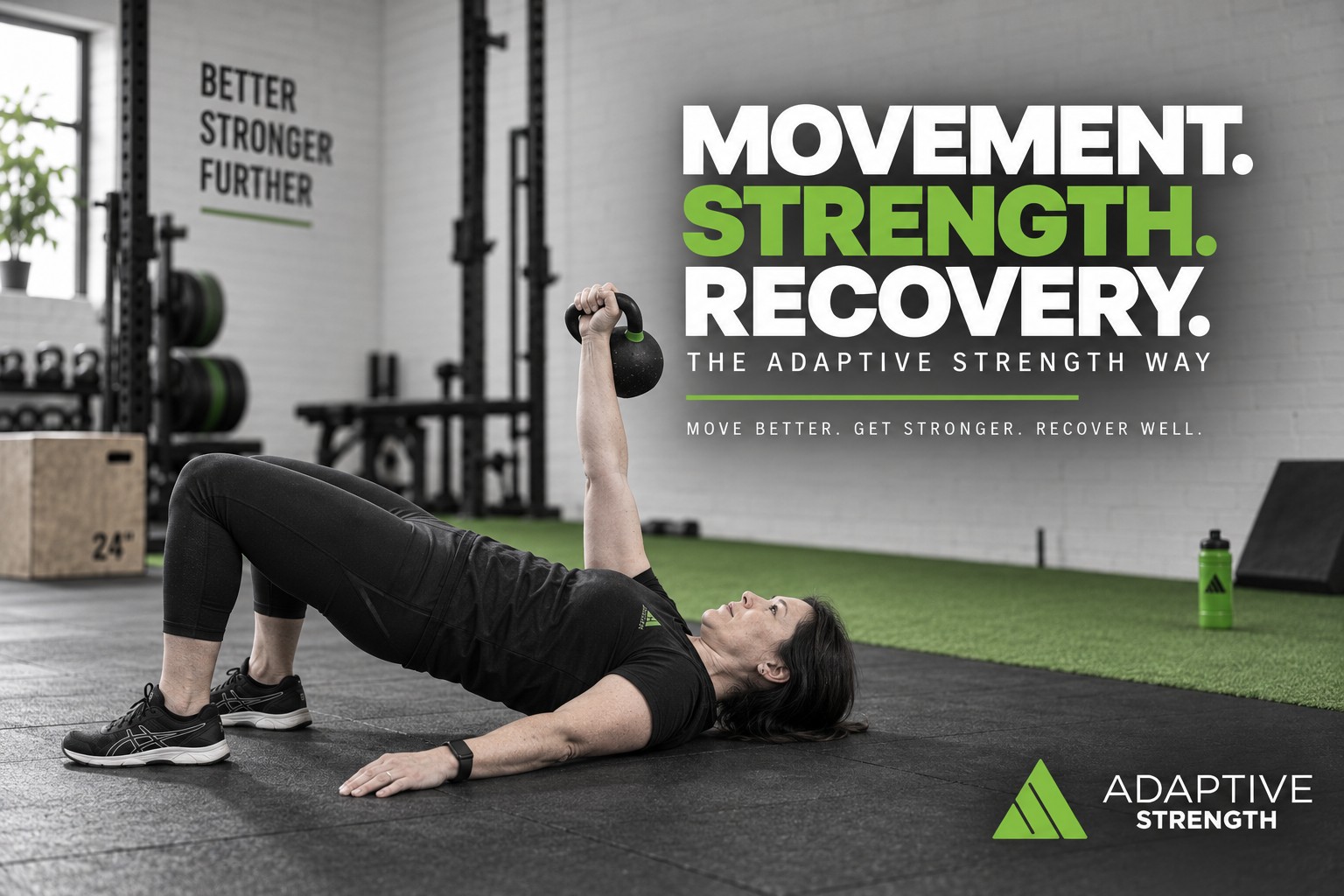
Your body needs Movement. Strength. Recovery.
Some people need more movement.
Some need more strength.
Some need more recovery.
Most of us need a combination of all three.
And that balance changes over time.
I think good training needs to help you move better, get stronger and recover well enough to keep doing it.
That is the thinking behind the way we train at Adaptive Strength.
And having coached people since 2012, I genuinely believe it gives people a much better way to build a strong, capable and resilient body.
Movement: Life Is Easier When Your Body Moves Well
We could all move better.
But moving better doesn’t mean everybody needs more stretching.
Some people are stiff and need more mobility.
Their hips might be tight.
Their ankles might not move particularly well.
They might struggle to comfortably get their arms overhead.
Other people are at the opposite end of the spectrum.
They have plenty of mobility.
Getting into a position isn’t difficult.
Controlling that position is.
They may need more stability, control and strength rather than another stretching program.
Movement means having the mobility, stability and control you need for the things you want to do.
Squat.
Bend.
Reach.
Get off the floor.
Play tennis.
Work in the garden.
Lift.
Train.
When your body moves well, life tends to feel easier.
You’re not constantly fighting stiffness or trying to work around movements your body struggles with.
And importantly, movement work doesn’t always mean stopping strength training and doing stretches instead.
Often we improve movement through strength training itself.
A goblet squat can help someone improve their squat while building leg strength and working on the hip and ankle mobility needed to get into the position.
A loaded carry can build strength, stability and control at the same time.
A Turkish get-up can challenge mobility, stability, coordination and strength together.
You Can’t Ignore the Movement You Don’t Have
This is something I feel strongly about.
If you can’t comfortably get your arm overhead, putting a heavy barbell above your head and hoping everything sorts itself out is a bad idea.
The missing movement doesn’t suddenly appear because there’s weight in your hands.
Your body still has to get the bar overhead somehow.
Maybe you arch excessively through your back.
Maybe the shoulder gets irritated.
Maybe something starts hurting.
Simply adding more weight to a movement your body is already struggling to perform is not good strength training.
The better approach is to work on the shoulder movement you need, choose an exercise that suits what you can currently do, and build strength from there.
Maybe that means a different pressing variation.
Maybe carries.
Maybe a Turkish get-up progression.
And as your movement improves, the strength work can progress with it.
That’s good coaching.
Strength: Being Strong Makes Life Easier
I believe strength is one of the most useful physical qualities you can build.
Not because everyone needs to deadlift twice their bodyweight.
But because when you’re stronger, life is easier.
Things simply take less effort.
Carrying the shopping.
Getting off the floor.
Moving furniture.
Gardening.
Playing with your kids or grandchildren.
Playing sport.
Travelling.
Doing a physical job.
The stronger you are relative to what life asks of you, the easier those things tend to feel.
And strength should be built around the individual.
Your starting point.
Your experience.
Your injuries.
Your movement.
Your goals.
What you actually want to be able to do.
Your program should be individualised for you — not somebody else’s workout with a different weight.
Then, as you improve, the program improves with you.
More load.
More control.
More challenging exercises.
More work.
More capacity.
We keep building.
Recovery: Training Only Works If You Can Recover From It
This is the part people often underestimate.
You don’t get stronger simply because you worked hard.
Your body needs the opportunity to adapt to the work.
And your training doesn’t happen in a vacuum.
Work matters.
Sleep matters.
Stress matters.
Family matters.
Injury matters.
What you did yesterday matters.
What you’re planning to do tomorrow matters.
Recovery means matching the training to what your body can realistically handle and recover from right now.
Sometimes that means pushing harder.
Sometimes taking more rest.
Sometimes shortening the session.
Sometimes changing an exercise.
Sometimes having a lighter day.
Sometimes doing mobility instead.
Recovery doesn’t mean avoiding hard training.
We absolutely want people to train hard when it makes sense.
But there is a difference between hard training and mindlessly exhausting yourself.
The goal is to keep progressing over time.
When One Takes Over, the Balance Starts to Tip
This is something I’ve seen again and again over the years.
Movement.
Strength.
Recovery.
Put too much emphasis on one area while ignoring the other two and eventually the balance starts to tip.
You can become very strong.
But if you’re also incredibly stiff and can’t comfortably get into the positions your training requires, that can eventually contribute to irritation, pain or injury.
You can become incredibly flexible.
But if you don’t have the strength and control to own those ranges of motion, more flexibility probably isn’t what you need.
And you can have great movement and plenty of strength.
But if you hammer yourself day after day without enough recovery, eventually something gives.
Your performance drops.
Your technique gets worse.
You feel exhausted.
Niggles start appearing.
You stop enjoying training.
Or you simply stop turning up.
That’s why I don’t see Movement, Strength and Recovery as three separate options.
Your body needs all three.
The amount of each will be different for every person.
And it will change as you change.
Sometimes the strength exercise improves the movement.
Sometimes recovery means modifying the strength work.
Sometimes a mobility restriction changes the exercise we choose.
You shouldn’t always be able to see where one finishes and the next begins.
Why I Believe This Is a Better Way to Train
I genuinely believe we have built something special at Adaptive Strength.
Not because we invented squats.
Or deadlifts.
Or kettlebells.
Or mobility exercises.
We didn’t.
We don’t start with today’s workout.
We start with you.
How do you move?
What do you want to achieve?
What has stopped you before?
Is there pain or injury we need to consider?
How strong are you now?
What does your life allow you to recover from?
Then we build the program.
And we’ve deliberately built a team capable of supporting that approach.
Our team includes physiotherapists, exercise physiologists and exercise science professionals who also coach strength training on the gym floor.
Our physios and EPs don’t just work in treatment rooms.
They coach.
They supervise.
They modify.
They progress.
Movement, Strength and Recovery aren’t being handled in separate silos.
They are part of the same system.
Good Training Should Build You
I don’t think a good workout should simply be judged by how exhausted you are afterwards.
Making someone tired is easy.
Making someone sore is easy.
Writing a hard workout is easy.
Add more reps.
Take away the rest.
Throw in another exercise.
Make the circuit longer.
Anyone can make something harder.
That’s what I believe good coaching should be about.
Can we help you move better?
Can we make you stronger?
Can we keep progressing the program as you change?
Can we modify it when life, injury or fatigue gets in the way?
Can we help you keep doing this long enough for it to genuinely change what your body can do?
That’s training.
Chop Wood. Carry Water.
CARRY WATER.
None of this is a quick fix.
Movement takes practice.
Strength takes time.
Recovery needs to be respected.
You turn up.
Follow the program.
Do the work.
Recover.
Come back.
And repeat.
That’s not particularly exciting marketing.
But after years of coaching people, I believe it is far closer to how real progress actually happens.
Session after session.
Week after week.
Month after month.
You gradually become capable of more.
What Does Movement. Strength. Recovery. Mean for You?
It means you don’t have to arrive at the gym already moving well, injury-free, highly motivated and full of energy.
Maybe you’re stiff.
Maybe you’re already very mobile but need more control.
Maybe you’re recovering from an injury.
Maybe you haven’t trained for 20 years.
Maybe you’re tired and stressed from work.
Maybe you’re already strong and want to go further.
We work from there.
Your program can include what you need today while still building towards what you want tomorrow.
More movement where you need movement.
More strength where you need strength.
More recovery when you need recovery.
And sometimes all three are happening together.
As you change, the balance changes with you.
That’s why we call it Adaptive Strength.
The Adaptive Strength Way
I genuinely believe this is a better way for many people to train.
Not because it promises overnight results.
It doesn’t.
But because it starts with the person rather than forcing the person into a workout.
Move better.
Get stronger.
Recover well enough to keep doing it.
Build a body that is strong.
Capable.
Resilient.
And gives you more freedom to live the life you want.
That’s Movement. Strength. Recovery.
That’s the Adaptive Strength way.
Want to See if This Approach Is Right for You?
If you want to get stronger but also know your movement, injuries, recovery or current fitness need to be taken into account, we can help you work out the right starting point.
At Adaptive Strength in Booragoon, we build individualised programs around your goals, your movement, your strength and what your body can currently handle.
If you'd like to know more, you can book a quick call with me, Kurt, Head Coach at Adaptive Strength.
We can have a chat about where you’re at now, what you’d like to achieve, and whether the Adaptive Strength approach might be the right fit for you.
Book a Quick Call With Kurt