One of the things I believe strongly about strength training is this:
More reps.
More sets.
More weight.
More fatigue.
More sweat.
None of those automatically mean you had a better training session.
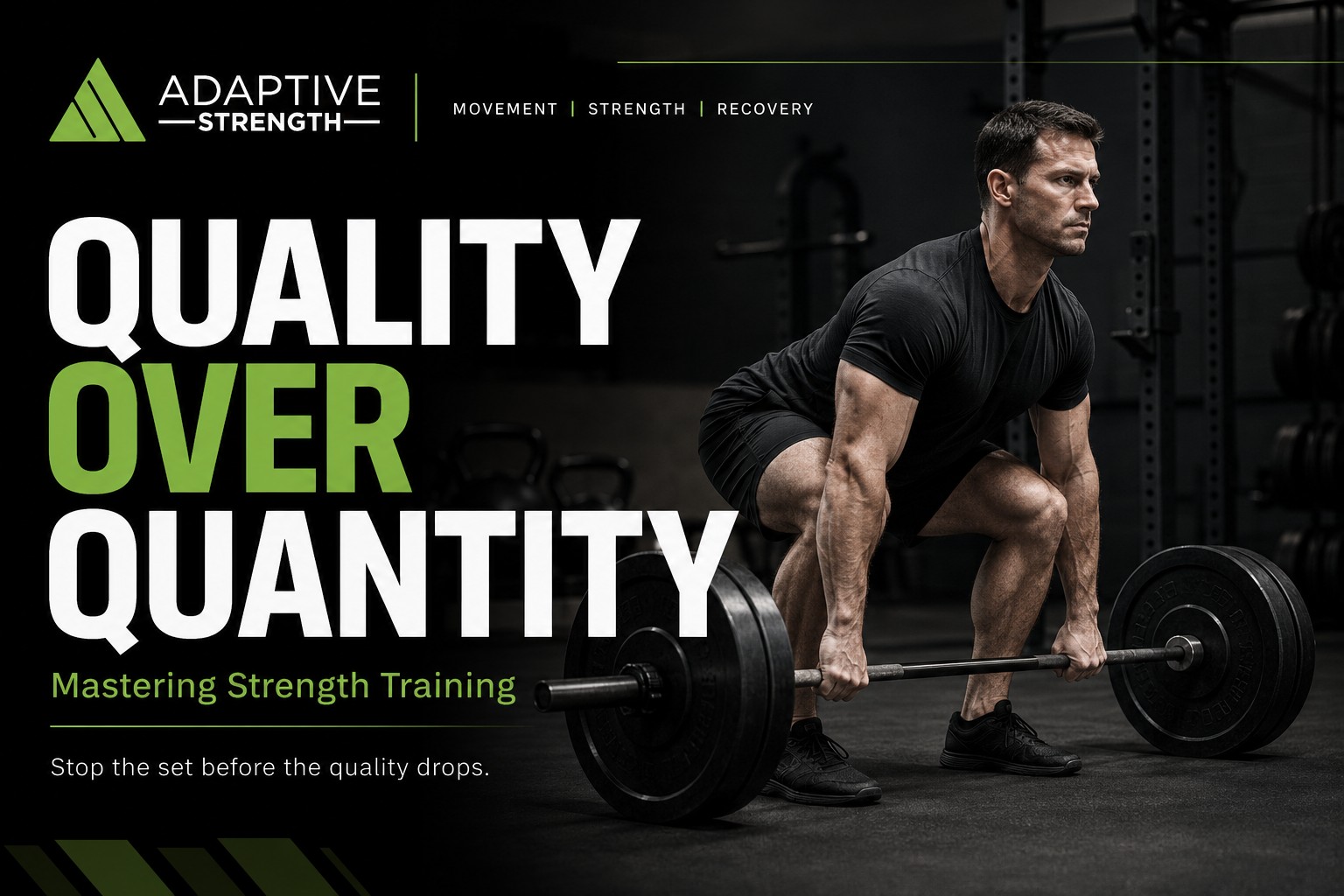
In fact, sometimes the best thing you can do is stop the set before everything starts falling apart.
At Adaptive Strength, we put a lot of emphasis on the quality of the movement.
Can you control the weight?
Can you maintain good technique?
Are the reps still moving well?
Are you still producing good force?
Or are you now just fighting your way through the last few repetitions because the program says you have to?
There’s a difference.
Strength Training Should Look Like Strength Training
If I’m training someone for strength, I generally don’t want every set turning into a conditioning workout.
I don’t want the last three repetitions looking completely different from the first three.
And I don’t want someone grinding through ugly reps simply because they think stopping early means they didn’t work hard enough.
There are absolutely times when training should be hard.
There are times when we deliberately push closer to your limit.
But I don’t think every set needs to finish with you hanging on for dear life.
Know When the Set Is Finished
One of the skills we try to teach people is recognising when the quality of the set is starting to change.
There are a few things I look for.
The first few repetitions move well.
Then suddenly every rep starts becoming a grind.
That can be a sign you’re reaching the point where the quality of the work is dropping.
That doesn’t automatically mean the set has to stop.
But it’s something worth paying attention to.
Maybe you were moving smoothly between repetitions.
Now you’re standing there for five or ten seconds trying to convince yourself to do the next one.
Again, that’s information.
Your body is telling you the set has changed.
This is probably the biggest one.
If you have to completely change how you perform the exercise just to get another rep, I start questioning the value of that rep.
Your squat changes.
Your back position changes.
Your press turns into something completely different.
Your range gets shorter.
RPE can be useful here.
If a set that should feel like a 6 or 7 suddenly becomes a 9 or 10, something has changed.
That doesn’t mean RPE 8 or 9 is always wrong.
Sometimes that’s exactly what we want.
But if the goal of the session is quality strength work, I generally want to leave enough in reserve that the repetitions still look like the exercise we intended to train.
Strength training and conditioning are not the same thing.
If you’re so out of breath that you can’t set yourself properly, create tension or perform the exercise well, you probably don’t need another exercise.
You probably need more rest.
Forget what the stopwatch says.
Recover.
Then do another good set.
Leave a Few Good Reps in the Tank
This is something I come back to again and again.
You don’t always have to empty the tank.
If you could have done another one or two good repetitions, that doesn’t mean the set was wasted.
Quite often, that’s exactly where I want you.
You’ve done enough work to create a training effect.
But you haven’t pushed so far that the movement, speed and technique have completely fallen apart.
And importantly, you’re more likely to be able to come back and train well again.
Quality First
Anyone can make a workout harder.
Add more reps.
Take away rest.
Add another exercise.
Make the circuit longer.
That’s easy.
The harder part is deciding:
For me, that is one of the big differences between simply exercising and actually training.
The reps have a purpose.
The load has a purpose.
The rest has a purpose.
And sometimes the smartest thing you can do is finish the set while the repetitions are still good.
It’s not about doing as much as possible.
It’s about doing enough — and doing it well.
That’s a much better way to get stronger over the long term.
Want Help Training With More Purpose?
If your workouts feel random, you’re constantly chasing fatigue, or you’re not sure whether you’re doing too much or not enough, we can help.
At Adaptive Strength in Booragoon, we build individualised strength programs around your goals, current ability and what you actually need to progress.
The aim isn’t to make every session harder.
It’s to make every session useful.
If you'd like to know more, you can book a quick call with me, Kurt, Head Coach at Adaptive Strength.
We can have a chat about how you’re currently training, what you’re trying to achieve, and whether Adaptive might be the right fit for you.
Book a Quick Call With Kurt