At Adaptive Strength, we meet a lot of people who’ve been sidelined by pain.
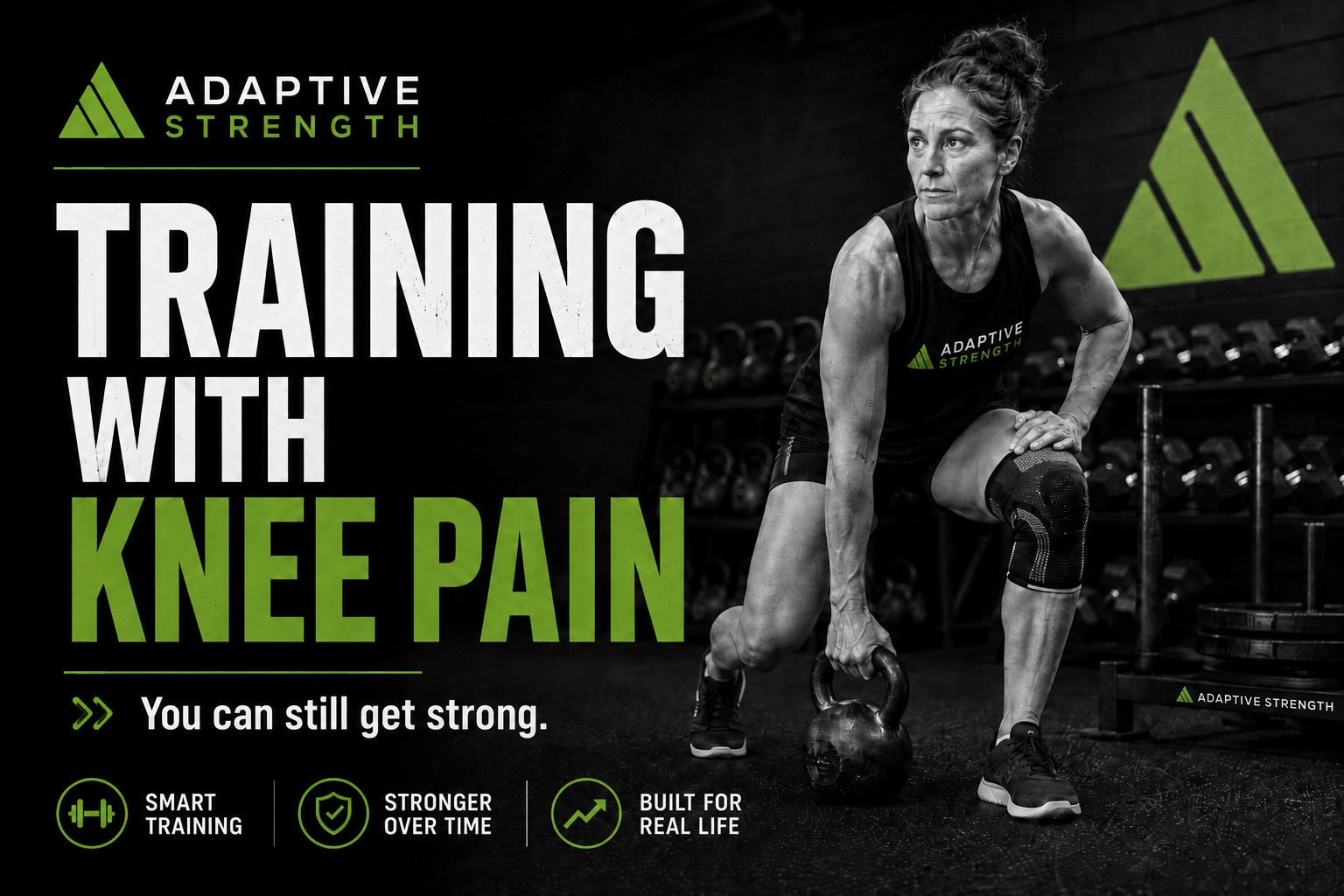
Often it’s the knees — frustrating, persistent, sometimes sharp or “gravelly,” and often just bad enough to rob someone of their confidence to move the way they want.
But if you think knee pain means the end of training or building strength, think again.
Let’s take a common example we’ve seen.
A woman in her late 40s walks through our doors.
She’s active at heart — used to love training and being fit.
But for the past few years, knee pain, especially in the left one, has become a constant companion.
The pain is sharp at times, with a grinding sensation behind the kneecap.
Some movements don’t feel good, and at times she’s simply not confident in what the knee will tolerate.
It’s frustrating.
But despite the annoyance and limitations, she’s not here just for pain relief.
Her main goal?
Not just her legs — her whole body.
She wants to build her core, upper-body strength and general fitness.
She doesn’t want her knees to become an excuse not to train.
She wants to work around them while also doing the right things to help the knees improve.
And that’s exactly the sort of thing we help people do at Adaptive Strength.
You Don’t Have to “Fix” Everything Before You Start Training
Let’s bust a common myth.
You don’t always have to wait until everything feels perfect before you start getting strong.
A lot of people think:
But in many cases, those two things don’t need to live in completely separate worlds.
You can barely tell where one finishes and the other starts.
A split squat might be part of your knee rehabilitation.
But it is also strength training.
A sled drag might help us gradually build knee capacity.
It is also conditioning and leg training.
A step-up might be something we use to rebuild confidence and strength around the knee.
But again — it’s still just training.
That is the model we follow at Adaptive.
We’re not trying to put you into a little rehab box until somebody decides you’re finally allowed to exercise again.
We want to work on the problem while also helping you become stronger and more capable.
Of course, there are times when a knee needs proper assessment.
If there has been significant trauma, swelling, locking, repeated giving way or you simply aren’t sure what is going on, that is where our physiotherapy team may need to be involved.
But having knee pain does not automatically mean everything else has to stop.
Train Everything That Isn’t the Knee — And Do It Well
Here’s what I really want you to hear:
This is something I think gets forgotten far too often.
Rather than spending the whole session foam rolling, doing three band exercises and then going home, there is usually plenty of good training we can still do.
We can train your upper body.
We can train your core.
We can train your hips.
We can train the other leg.
We can work on your fitness.
And importantly, we can still train the painful knee too — just in a way it currently tolerates.
Upper-Body Strength
There is often no reason to hold back here just because your knee is sore.
Depending on the person, you might do:
- Overhead presses and landmine variations
- Horizontal and vertical pulling
- Rows and assisted pull-ups
- Bench pressing
- Heavy carries to challenge grip, trunk and shoulder strength
The knee might be the problem that brought you through the door.
That doesn’t mean it has to become the entire program.
Core Training
And I mean real core training.
Not 30 minutes of crunches because we’ve run out of ideas.
We might use:
- Pallof presses
- Dead bugs
- Loaded carries
- Bracing exercises
- Other compound movements where appropriate
The goal is still to build a stronger body.
Hinge-Dominant Lower-Body Training
Just because squats hurt doesn’t mean you stop training your legs.
This is where we can use movements that load the hips more and, depending on the person, may be better tolerated at that point in time.
That might include:
- Romanian deadlifts
- Hip thrusts
- Supported single-leg hinges
- Sled pushes and backward drags
- Step-ups
- Split-stance work in controlled ranges
These can let us continue building strong legs while we’re also working out what the knee itself can tolerate.
But I don’t want the long-term plan to simply be:
The knee needs to get stronger too.
So while we train around it, we also gradually find the knee movements and loads it can tolerate.
Then we build from there.
Smart Conditioning
You don’t need to run or do box jumps to get your heart rate up.
Depending on what your knee tolerates, options might include:
- Stationary bike or airbike
- Rowing machine
- Sled work
- Upper-body conditioning
- Carries
- Circuits built around exercises you can currently tolerate
Again, the point isn’t to find one magical “knee-friendly” exercise.
It’s to keep training while making sensible decisions about what the knee can and can’t handle right now.
What About the Knee Itself?
Yes, we’ll work on it.
But I don’t want it to dominate everything you do.
We want to rebuild trust in the joint.
We want to improve what it can tolerate.
We want to gradually give you more options rather than fewer.
That might mean modifying:
- The range of movement
- The load
- The exercise variation
- The amount of support
- The total volume
- How quickly we progress things
Sometimes a squat to a box is fine but a deeper squat isn’t.
Sometimes a supported split squat works well.
Sometimes we start with a smaller range and gradually increase it.
Sometimes sled work gives us a really useful way of getting the legs working without aggravating things.
And sometimes an exercise simply doesn’t suit you right now — so we use something else.
We don’t want to ignore pain and blindly push through everything.
But we also don’t want to become so frightened of irritating the knee that we stop loading it altogether.
We still want to strengthen the muscles around the knee and lower body:
- Quadriceps
- Hamstrings
- Calves
- Glutes and hips
And we want to gradually expose the knee to more as its capacity improves.
This is where the rehab and strength worlds start to blend together.
You’re doing real training.
It just happens to be training that has been adapted for you.
This is a good example of what Movement. Strength. Recovery. means to us at Adaptive.
They are not really three completely separate things.
They overlap.
A good strength exercise can improve movement.
A rehabilitation exercise can build strength.
A well-managed training load can help recovery.
And if we do it properly, sometimes it becomes pretty difficult to tell which part is “rehab” and which part is “training”.
That is exactly how I think it should be.
This Isn’t a Group Class or DIY Program — It’s Coaching That Works
You’re never left guessing at Adaptive Strength.
Your program is individual to you.
Your coach is there on the gym floor to guide you, help with technique and make changes when something isn’t working.
Every exercise should have a reason.
And those decisions are based on you, not what happens to be written on a whiteboard for everyone that day.
If the knee is doing well, we might progress it.
If it’s irritated, we might adjust the load, range or exercise.
And if something needs a proper assessment, our physiotherapists or exercise physiologist are right there within the same facility.
It is to make better decisions about how you train.
The Goal Isn’t Just a Better Knee
This is probably the biggest point.
If someone comes to us with knee pain, obviously we want the knee to improve.
But that isn’t usually their actual end goal.
They want to:
- Get strong again
- Go hiking
- Play golf or tennis
- Train at the gym
- Keep up with their kids or grandchildren
- Travel
- Get up and down from the floor comfortably
- Feel confident using their body again
So while we work on the knee, we’re also working on the person.
I want you stronger.
I want you fitter.
I want you more capable.
And ideally, over time, I want you thinking about your knee less and less because it is no longer controlling everything you do.
The Result?
You feel strong again.
You move with more confidence.
You start getting back to the things you enjoy.
And you do it without having to wait for some imaginary moment when your knee becomes “perfect”.
You might still need to manage it.
You might still have exercises that work better than others.
But the knee stops being the reason you don’t train.
Don’t Let Your Knee Stop Everything
If you’ve been putting off strength training because of knee pain, you don’t necessarily need to wait until the knee is completely fixed.
You may simply need a better way to train around it while also building it back up.
That is how we approach it at Adaptive Strength.
Not Sure How You Should Train Around Your Knee?
If you want to get stronger but you’re not sure what you should or shouldn’t be doing because of your knee, that is something we can help you work through.
At Adaptive Strength in Booragoon, we can look at your goals, training history, current ability and what is happening with your knee, then work out an appropriate starting point.
If the knee needs physiotherapy or exercise physiology input, we can incorporate that into the process as well.
And if you’d simply like to know more about how we could help, you can book a quick call with me, Kurt, Head Coach at Adaptive Strength.
We can have a chat about what you’d like to get back to doing, what your knee is currently stopping you from doing and whether Adaptive might be the right fit for you.
Book a Quick Call With Kurt