I was 21 when I had surgery to remove a tumour above my left knee, along with a bursa from the same knee.
Before that, I had come from a highly competitive Taekwon-Do background.
Training hard, moving quickly and trusting my body were normal for me.
Then suddenly I was lying in a hospital bed.
Recovery was slow.
Painful.
And frustrating.
Even six months later, I remember questioning every step I took.
I remember it still giving way.
I remember the discomfort when I tried doing a leg extension.
I remember being scared to go back to Taekwon-Do.
I remember wondering whether I was actually ready to do more.
And underneath all of that was a much bigger fear:
I wasn’t just trying to get rid of pain.
I wanted to trust my body again.
I wanted to train.
I wanted to kick.
Move.
Compete.
Feel like myself again.
But how was I supposed to get from “recovered” back to properly training again?
That experience stayed with me.
There Was a Missing Middle
Eventually, the surgery was behind me.
I wasn’t lying in a hospital bed anymore.
I wasn’t in the early stages of rehab.
On paper, you could probably say I was “recovered.”
But I certainly didn’t feel recovered.
I didn’t fully trust my knee.
I didn’t feel strong.
I didn’t feel confident.
And I definitely didn’t feel ready to go back to the level of training and Taekwon-Do I had come from.
That was the part nobody seemed to have a clear answer for.
I wasn’t injured enough to need early-stage rehab anymore.
But I wasn’t strong, confident or capable enough to return to the things I actually wanted to do.
There is a big difference between:
“Your injury has settled.”
and
“Your body is ready to do what you want it to do.”
That gap is something I have never forgotten.
Recovery Is More Than Getting Out of Pain
Getting pain down is important.
Healing matters.
Regaining movement matters.
But for many people, that is only the beginning.
If your goal is to get back to tennis, running, lifting, gardening, work or sport, the absence of pain doesn’t automatically mean you are ready.
Can you tolerate the activity?
Do you have enough strength?
Do you have the movement you need?
Can you keep going when you get tired?
Do you trust your body again?
And that is where rehab needs to start becoming training.
Performance Doesn’t Mean Elite Sport
When I use the word performance, I don’t just mean athletes.
Performance looks different for everyone.
Returning to competition.
Playing tennis again.
Working in the garden for two hours.
Travelling without worrying about your back.
Picking up your grandchildren.
Walking without constantly thinking about your knee.
Going back to work confidently.
Feeling strong and capable in everyday life.
Performance simply means having the capacity to do the things that matter to you.
That is the destination.
Not simply being discharged.
Not simply being told the injury has healed.
Actually being able to use your body again.
Why I Built Adaptive Strength This Way
That experience at 21 never really left me.
I could see a gap.
There were people who were very good at helping you through the early stages of an injury.
And there were gyms and coaches who were very good at training healthy people hard.
The person whose pain had improved but still didn’t trust their body.
The person who had finished rehab but wasn’t ready for normal training.
The person who wanted to get stronger again but didn’t know how hard they could safely push.
The person who had been told they were “fine” but certainly didn’t feel fine.
I knew how that felt because I had been that person.
And over time, filling that gap became more than an idea.
It became something I was passionate about building.
I wanted to create the kind of environment I wish I had when I was 21.
A place where someone didn’t have to choose between rehab and proper training.
A place where the goal wasn’t simply to get them out of pain and send them on their way.
A place where we could help them move better, rebuild strength, regain confidence and progressively get back to doing the things that mattered to them.
That is a big part of why Adaptive Strength exists today.
I Wanted to Build the Team I Wish I Had
If you are going to genuinely bridge the gap between rehab and training, you need people who understand both sides.
That is why I have worked hard to build a highly skilled team around this idea.
Today, our team includes physiotherapists, exercise physiologists and exercise science professionals who also coach strength training on the gym floor.
Our physios and EPs don’t just treat someone in a room and then send them somewhere else to train.
They also coach.
They supervise.
They modify.
They progress.
They can be part of the process from recovery through to progressively rebuilding strength, capacity and confidence.
Movement. Strength. Recovery.
Looking back, this is probably the simplest way I can describe the journey I needed myself.
After injury, movement can change.
You may become stiff.
Protective.
Hesitant.
You might lose range of motion.
Or you might technically have the movement, but no longer feel confident using it.
Movement is about rebuilding the mobility, control and freedom you need for what you want to do.
Then we need to rebuild capacity.
Can the body tolerate more load?
Can the knee handle more?
Can the shoulder press again?
Can the back tolerate lifting?
Can you repeat the movement rather than only doing it once?
Strength gives you more options.
And often, confidence starts growing as the body becomes more capable.
Recovery is what allows the process to keep moving.
Sometimes we push.
Sometimes we pull back.
Sometimes something needs modifying.
Sometimes we need to give the body more time.
Recovery isn’t separate from training.
It helps guide how much training makes sense today so we can keep building tomorrow.
These three things don’t exist in separate boxes.
They work together.
Sometimes strength training improves movement.
Sometimes movement work helps recovery.
Sometimes the rehab exercise gradually becomes the strength exercise.
That is exactly how we want it to work.
An Injury Can Change What You’re Capable of Today
An injury can change what you’re capable of today.
It can change how you train for a while.
It can mean we need to rebuild movement, strength, confidence and capacity.
That might mean temporarily changing an exercise.
Reducing some load.
Using a different variation.
Working through a smaller range.
Or spending more time rebuilding something that has been lost.
But the aim is not to keep you there forever.
The goal is to help you progressively get back to doing as much of the life you want as possible.
Pain Gone Doesn’t Always Mean Job Done
This is one of the biggest things I learned from my own experience.
Getting out of pain is important.
But if your goal was to get back to Taekwon-Do, tennis, gardening, running, lifting or work, the absence of pain isn’t necessarily the finish line.
Can you tolerate the activity?
Do you have the strength?
Do you have the movement?
Do you have the confidence?
Can you sustain it?
Can you do it again next week?
And that transition should be progressive.
Not one giant leap from rehab exercises straight back into everything you used to do.
Step by step.
Load by load.
Session by session.
Capacity built over time.
It Should Start Feeling Like Training Again
You might still have some specific exercises in the program.
You might still be modifying certain movements.
You might still be managing symptoms.
But you should also be training.
Getting stronger.
Improving your fitness.
Building confidence.
Increasing what your body can tolerate.
Working towards something.
Because most people don’t want to become really good at rehab exercises.
They want to get back to their life.
Your Body Should Become Easier to Use
Ultimately, I don’t think most people care about rehab for the sake of rehab.
They want a body they can use.
A body they can trust.
Get down on the floor.
Lift something heavy.
Play sport.
Travel.
Work.
Garden.
Walk.
Run.
Train.
Live.
That is what all the movement work, strength work and recovery work should be building towards.
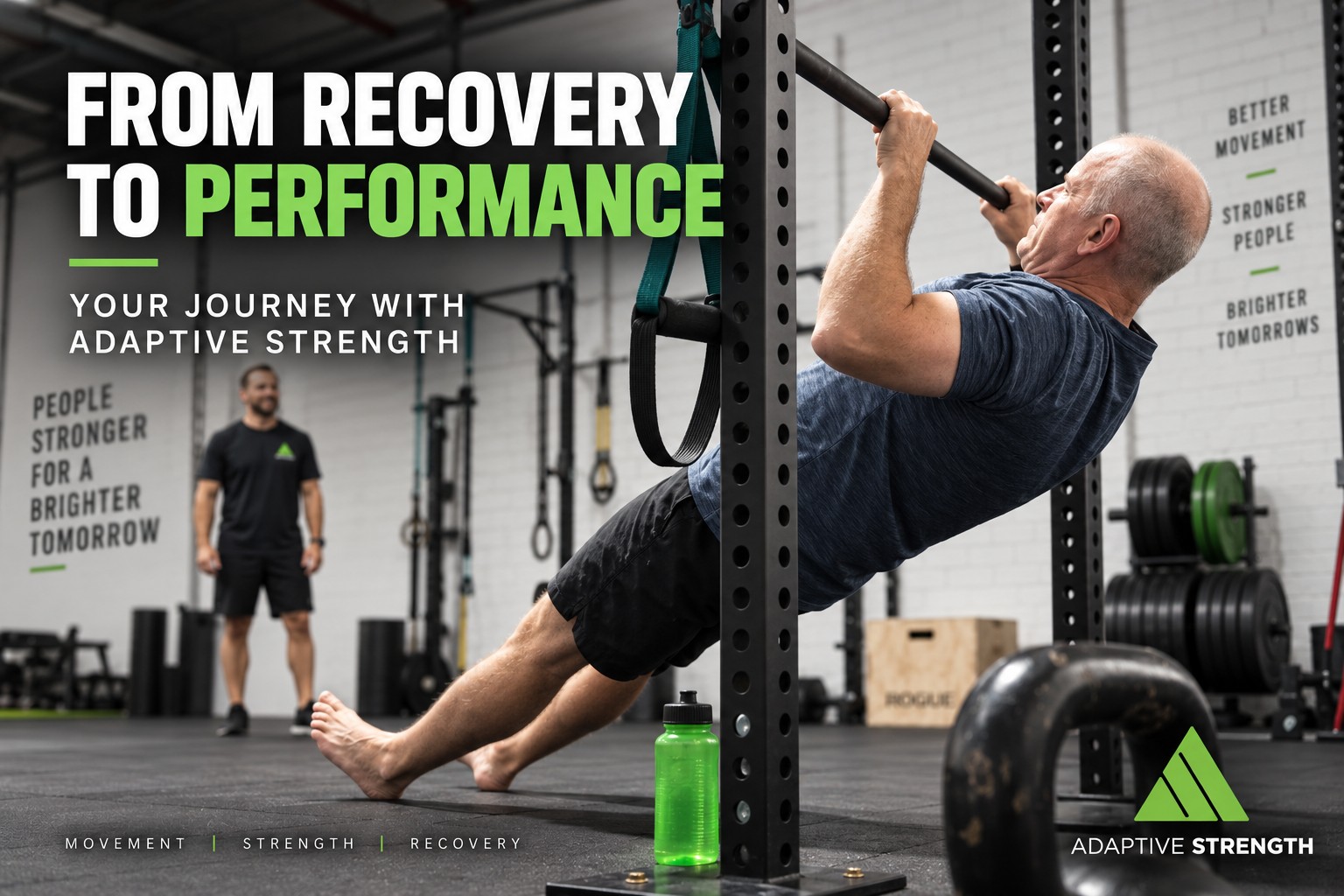
From Recovery to Performance
When I think back to being 21 and questioning every step I took, I understand how frustrating that gap can feel.
You don’t just want somebody to tell you the injury has healed.
You want to trust your body again.
You want to move.
You want to get stronger.
You want to get back to doing something.
That experience became one of the driving forces behind Adaptive Strength.
I wanted to build the kind of place I wish I had back then.
A place where rehab didn’t simply stop when the pain settled.
A place where strength training didn’t ignore the injury that came before it.
A place where Movement. Strength. Recovery. could work together from the beginning.
From recovery.
To strength.
To whatever performance means for you.
Want Help Bridging the Gap From Rehab Back to Training?
If pain or injury has settled but you still don’t feel strong, confident or ready to get back to the things you want to do, we may be able to help.
At Adaptive Strength in Booragoon, we bring physiotherapy, exercise physiology and strength coaching together within one system.
The goal is not simply to help you feel better.
It is to progressively help you move better, build strength and regain the capacity to do the things that matter to you.
If you'd like to know more, you can book a quick call with me, Kurt, Head Coach at Adaptive Strength.
We can have a chat about where you’re currently at, what you’d like to get back to, and whether Adaptive might be the right fit for you.
Book a Quick Call With Kurt