If you’ve ever felt like your personal trainer and physiotherapist were speaking different languages, you’re not alone.
One of our members came to us with this exact problem.
Let’s call him James.
James had been doing everything right — on paper.
He was working with a personal trainer once a week to build strength and seeing a physiotherapist every fortnight to deal with some persistent injuries and niggles.
His goals were clear:
- Get stronger
- Improve his cardio fitness
- Regain his mobility
- Get on top of his shoulder and hip issues
The only problem?
pulling in opposite directions.
The personal trainer kept pushing the strength work, even when James’ shoulder and hip were flaring up.
The physio, on the other hand, kept pulling things back to very basic rehab exercises.
James felt stuck in the middle.
One side was telling him to push harder.
The other was telling him to back off.
There was no shared plan, no clear progression, and no results.
And James was getting frustrated.
That’s when James found Adaptive Strength in Booragoon.
A Smarter Way to Train
What immediately stood out to James was how different our approach is.
At Adaptive Strength, we bridge the gap between rehab and performance.
Our team includes physiotherapists, exercise physiologists and exercise science professionals who also coach strength training on the gym floor.
Our physiotherapists and exercise physiologists don’t just work in a treatment room.
They also work on the gym floor as strength coaches.
Alongside our Exercise Science coaches, they help assess, program, coach and progress our members.
Instead of James bouncing between two professionals with different plans, he now has one team working together towards the same goal.
And this is something we believe strongly:
and exercise is rehab.
If we program things properly, sometimes you can barely tell where the rehab finishes and the strength training begins.
This means no more dull rehab-only sessions or unsafe weightlifting that aggravates injuries.
That doesn’t mean we ignore pain or injury.
And it doesn’t mean everything has to become a rehab exercise.
It means we build the program around what James can do, what needs to improve, and where we’re trying to take him.
Movement. Strength. Recovery.
James now follows one structured, individualised program that brings together the things he actually needs.
Instead of rehab and training competing with each other, they’re part of the same plan.
That means James can still train properly.
He can still lift.
He can still work on his fitness.
He can still progress.
But the program also takes account of what is happening with his shoulder and hip.
What Does a Session Look Like?
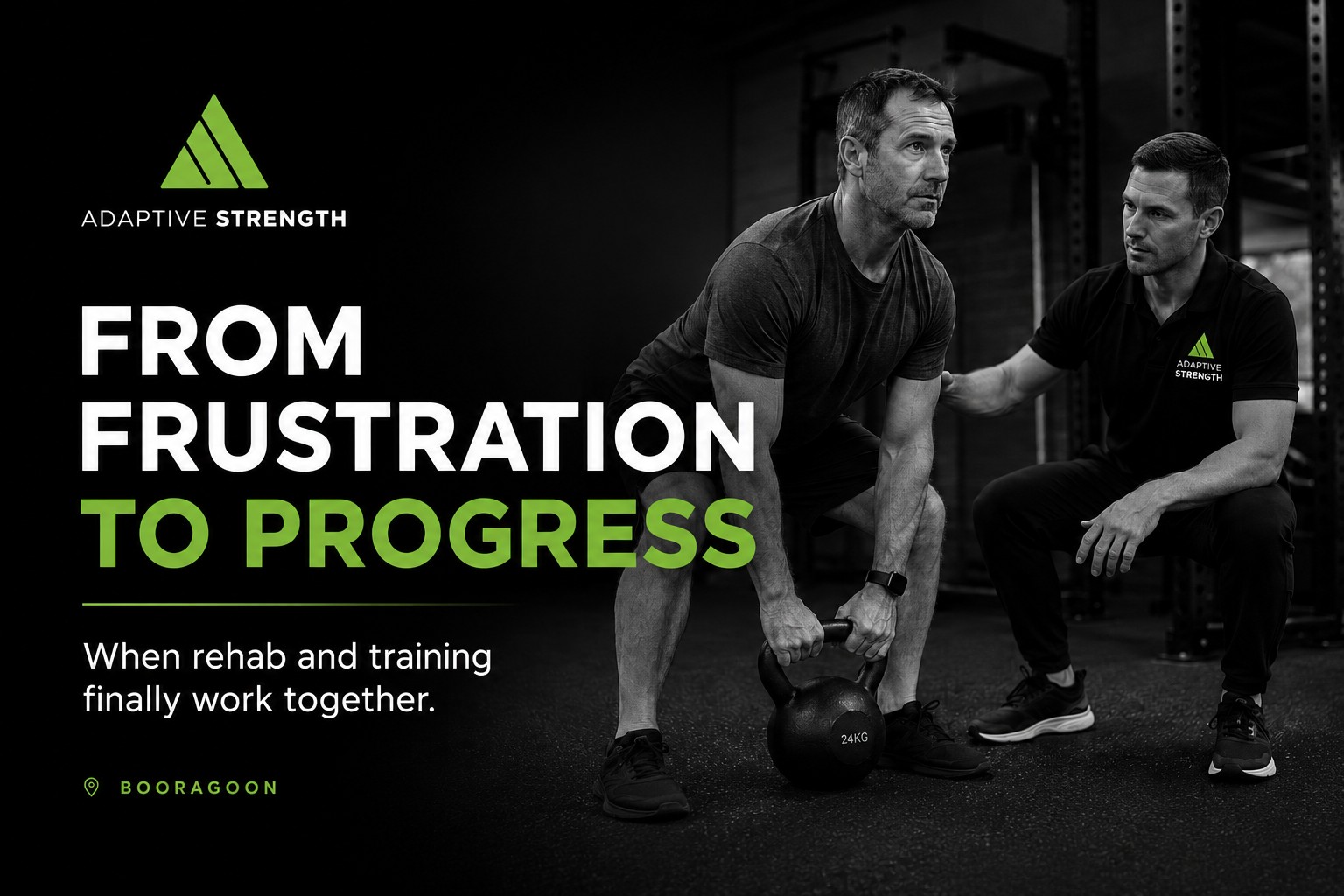
Every time James comes into the gym, there’s a qualified coach on the floor.
That might be a physiotherapist, an exercise physiologist or an exercise science coach.
Their job isn’t simply to watch him complete a program.
They coach.
They adjust.
They progress.
And they make decisions based on how James is moving and how he is feeling that day.
If his shoulder is irritated, we can modify the plan.
If his hip is moving better, we might be able to progress something.
If an exercise isn’t working, we can change it.
If something is going well, we keep building.
And importantly, it still feels like proper training.
He’s lifting.
He’s working.
He’s improving his fitness.
And he’s progressing.
The Personal Progress Coach: A Key to Success
One Person Keeping an Eye on the Bigger Picture
What James really values is the support of his Personal Progress Coach.
This is a dedicated team member who acts like a case manager — keeping an eye on the bigger picture and making sure all the different parts of his training, rehab and recovery continue working together.
He doesn’t have to chase updates, coordinate different providers or wonder who he should speak to when something changes.
There is someone keeping an eye on the whole process.
The Cost of Confusion vs. the Value of Integration
James’ integrated program at Adaptive — with personalised training, physio-informed coaching, program updates and ongoing support — actually costs him less than what he was paying before for separate personal training and physiotherapy.
Think about that.
to stay stuck.
He was spending more money, but the pieces still weren’t working together.
Now, instead of paying two people to pull him in different directions, he has one team working from the same plan.
And now he’s getting stronger, moving better, and making real progress — without the stress, wasted time or frustration.
The Problem Isn’t Physio or Personal Training. It’s When They Don’t Work Together.
For people dealing with injury while also trying to get stronger, the traditional model of:
can easily become disconnected.
The physio manages one part.
The trainer manages another.
And the client is left in the middle trying to make the two approaches fit together.
Sometimes that works.
But when it doesn’t, progress can stall quickly.
That’s exactly the gap Adaptive Strength was built to bridge.
Because if your goal is to get stronger, fitter and more capable, rehab shouldn’t exist in a completely separate world from your training.
You need:
- A training program that adapts to your injury and your goals
- Coaches who know what to modify and when
- A clear progression from where you are now to where you want to go
- A support system to keep you consistent
- Regular program updates based on how you’re responding
- Rehab and strength training working towards the same outcome
looking after an injury and getting stronger.
You should be able to do both.
From Rehab Back to Proper Training
This is probably the part that matters most.
James didn’t come to Adaptive because he wanted to spend the rest of his life doing rehab exercises.
He wanted to train.
He wanted to get stronger.
He wanted better fitness.
He wanted to move properly again.
The rehab was necessary, but it was never supposed to be the final destination.
That’s why we don’t see rehabilitation and strength training as two completely separate stages.
Sometimes one needs more attention than the other.
Sometimes we need to pull something back.
Sometimes we can push ahead.
But the goal is always to keep moving forward.
Ready for a Better Way?
If you’re stuck between a physio telling you to go easy and a trainer telling you to push harder, there may be a better way.
At Adaptive Strength in Booragoon, we bring physiotherapy, exercise physiology and strength coaching together within one system.
Your program is built around your goals, your current ability, your injuries or limitations and where we’re trying to take you.
You still train hard.
You still progress.
But the rehab and the strength work are working together rather than competing with each other.
If you'd like to know more, you can book a quick call with me, Kurt, Head Coach at Adaptive Strength.
We can have a chat about what you're dealing with, what you'd like to achieve, and whether Adaptive might be the right fit for you.
Book a Quick Call With Kurt