One of the mistakes I see in training is people rushing to do more before they’ve learned to move well.
More weight.
More reps.
More sessions.
Harder workouts.
But if you’re stiff, struggling to control a movement or constantly working around something that doesn’t feel right, simply doing more probably isn’t the answer.
One of our principles at Adaptive Strength is:
THEN MOVE OFTEN.
That doesn’t mean your movement has to be perfect before you can train.
Far from it.
You can improve your movement while you’re getting stronger.
In fact, sometimes the strength exercise itself is part of what helps you move better.
The goal is to give you enough mobility, control and confidence to train well — and then progressively build your strength and capacity from there.
We Could All Move Better
When I say someone needs to move better, that doesn’t automatically mean they need more flexibility.
Everyone is different.
Some people are stiff.
Their hips don’t move particularly well.
Their ankles are restricted.
They struggle to get their arms overhead.
For them, improving mobility might be a big part of the solution.
But then you have someone at the opposite end of the spectrum.
They’re naturally very mobile.
Getting into a position isn’t the problem.
Controlling that position is.
For them, getting even more flexible probably isn’t what they need.
They may need more stability, strength and control through the range of motion they already have.
What Does Moving Well Actually Mean?
I’m not looking for some mythical version of perfect human movement.
I’m asking simpler questions.
Can you squat, hinge, push, pull and carry with enough control and range of motion for what you’re trying to do?
Do you have the mobility you need?
Can you control the positions you’re moving through?
Can you breathe, brace and create tension when the exercise requires it?
Does something feel restricted, uncomfortable or unnecessarily difficult?
And importantly:
Does the movement you currently have allow you to safely and confidently do the things you want to do?
That might be lifting weights.
Playing tennis.
Working in the garden.
Getting down onto the floor with your grandchildren.
Returning to sport.
Or simply moving through everyday life without feeling stiff and restricted.
Adding More Weight Isn’t Always the Answer
If the movement is already giving you trouble, simply adding more load usually isn’t going to solve the problem.
If someone has enough shoulder movement to comfortably get their arm overhead, great.
We can teach the lift, build control and progressively load it.
But what if they have significantly limited overhead shoulder flexion?
They may have to compensate somewhere else just to get the weight above their head.
Perhaps they arch heavily through their back.
Perhaps the shoulder position becomes uncomfortable.
Now repeatedly loading that movement may increase the chance of irritating something or causing pain.
That doesn’t mean they can never press overhead.
It means the military press might not be the right starting point for that person today.
We might first work on the shoulder movement they need.
We might choose a different pressing variation.
We might use carries.
We might use a Turkish get-up progression.
And as their movement and control improve, the exercise can progress with them.
That’s training around the person — rather than forcing the person to fit the exercise.
We Assess Before We Decide
Before we build someone’s program, we want to understand how they currently move.
How is their squat?
Their hinge?
Shoulder movement?
Rotation?
Balance?
Mobility?
Are there movements that feel restricted or uncomfortable?
Where do they have plenty of movement but perhaps need more control?
And importantly:
What does that person actually want to be able to do?
From there, movement work becomes part of the program.
But that doesn’t necessarily mean handing somebody a list of “corrective exercises” and telling them to come back when they’re fixed.
Sometimes a mobility drill is appropriate.
Sometimes it’s a breathing exercise.
Sometimes it’s crawling.
And sometimes the strength exercise itself is helping improve the movement.
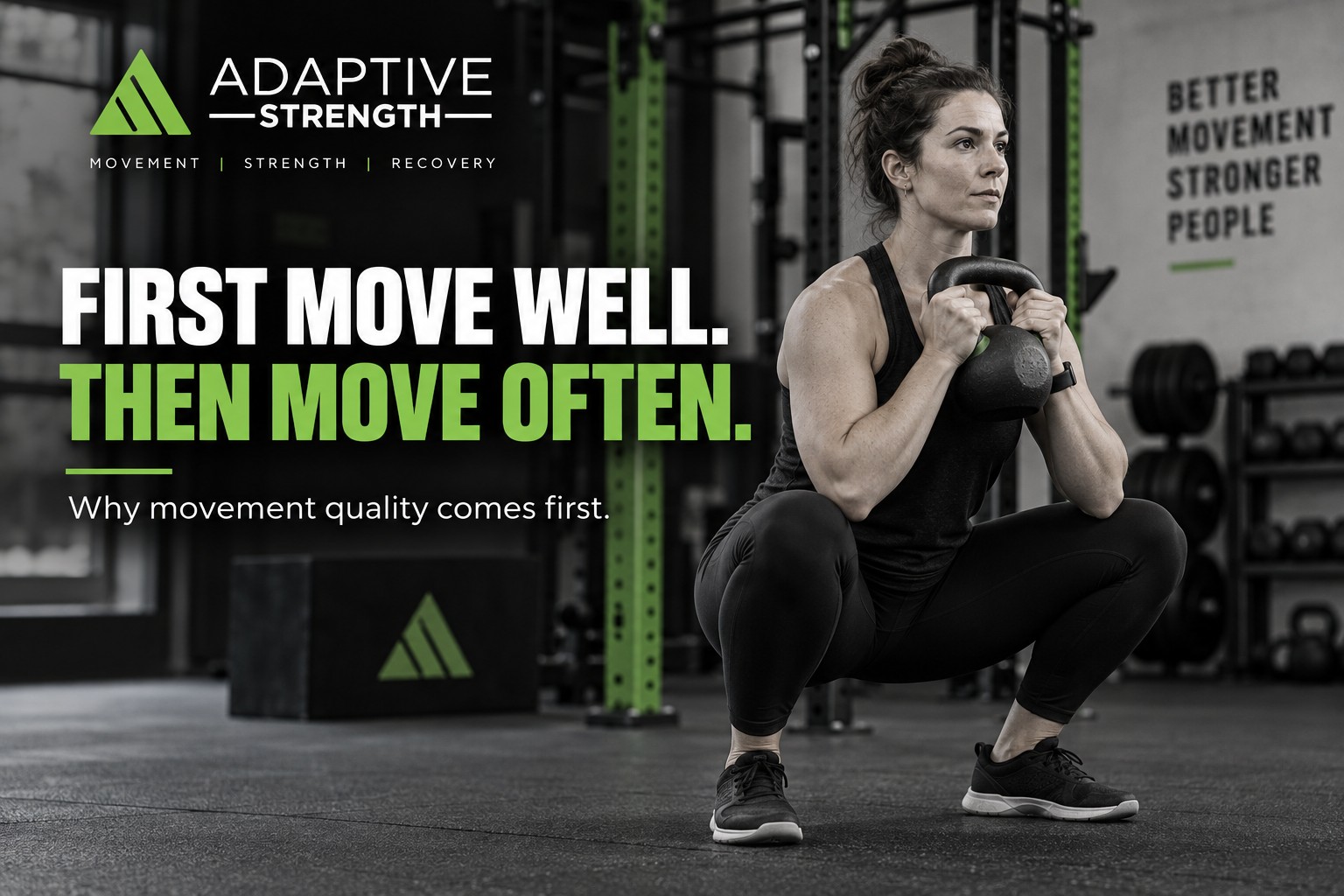
A goblet squat can build strength while helping someone become more comfortable and controlled in a squat.
A loaded carry can develop strength, posture, breathing and trunk control at the same time.
A well-chosen deadlift can teach someone how to hinge while simultaneously making that hinge stronger.
If the program is well designed, you shouldn’t always be able to see where the movement work finishes and the strength work begins.
We Don’t Wait for Perfect Movement
This part is important.
We’re not trying to create perfect movers before we let anyone lift a weight.
You could spend forever chasing perfect movement.
As your movement, confidence and capacity improve, we progressively ask more of you.
More load.
More repetitions.
More challenging variations.
More training.
We don’t wait for perfection. We build from the level you’re ready for.
That starting point will be different for everyone.
Moving Well Should Make Life Feel Better
This is probably the biggest benefit.
Movement isn’t just something we assess inside the gym.
You should notice it in life.
When you have the mobility you need and movements start feeling easier and more natural, everyday things can start feeling different too.
Getting off the floor.
Reaching overhead.
Bending down.
Walking.
Playing sport.
Working in the garden.
And that’s a pretty good reason to work on movement even if you have absolutely no interest in achieving the world’s deepest squat.
Then We Move Often
Moving well once isn’t particularly useful if your body can’t tolerate doing it repeatedly.
That’s where strength and capacity start to matter.
Maybe you can squat comfortably once.
Great.
Can you repeatedly get down and stand back up?
Can you do it while carrying something?
Can you continue doing it when you’re tired?
Can you still do it ten years from now?
That’s when we start building more strength, more capacity and more resilience.
First we establish the movement.
Then we build your ability to use it.
Movement. Strength. Recovery.
This is where our broader approach at Adaptive Strength fits together:
Gives you the mobility, control and freedom you need to do what you want to do.
Builds your capacity to handle more load, more work and more demanding tasks.
Helps you adapt, manage what life throws at you and come back ready to do it again.
They aren’t three separate boxes.
They overlap.
Movement work can build strength.
Strength training can improve movement.
And sometimes adjusting your training is part of recovery.
The goal is to have all three working together.
First Move Well. Then Move Often. Then Keep Building.
The goal isn’t perfect movement.
And it isn’t spending six months doing mobility exercises before you’re allowed to lift something heavy.
The goal is to give you enough movement to train well, then progressively build strength and capacity on top of it.
Sometimes you need more mobility.
Sometimes you need more stability.
Sometimes you need more strength.
And sometimes you need a combination of all three.
That’s why the starting point should fit the person.
First move well.
Then move often.
Then keep building.
Want to Move Better and Get Stronger?
If stiffness, pain or limited movement is making training harder than it should be, we can help you work out a better starting point.
At Adaptive Strength in Booragoon, we build individualised programs around your movement, your current ability and what you’re trying to achieve.
The aim isn’t to keep you doing mobility drills forever.
It’s to help you move better, build strength and develop the capacity to keep doing the things that matter to you.
If you’d like to know more, you can book a quick call with me, Kurt, Head Coach at Adaptive Strength.
We can have a chat about what you’re dealing with, what you’d like to be able to do, and whether Adaptive might be the right fit for you.
Book a Quick Call With Kurt