Maybe you went to see a physio, chiropractor or another health professional because something was hurting.
Maybe you’d injured your shoulder.
Your knee was giving you trouble.
Your back kept flaring up.
Or perhaps you were stiff, restricted or struggling with a movement.
So you were given a few exercises.
A band exercise for your shoulder.
Some quad work for your knee.
A core exercise for your back.
Some stretching or mobility work.
You’ve been doing them.
Maybe they’ve helped. They may be exactly what you need at that point.
But then comes the question that I think often gets missed:
When do you add load?
When do you make things harder?
When do you get back to proper training?
When do you get back to the activity you actually care about?
Because rehab shouldn’t just be a collection of exercises you repeat forever.
It should be taking you somewhere.
That’s where a corrective strategy becomes much more important than simply finding the “correct” exercise.
A single exercise isn’t magic.
That’s the difference between a corrective exercise and a corrective strategy.
What Is a Corrective Strategy?
A corrective strategy is simply a plan for dealing with whatever is currently limiting you — and progressively building beyond it.
Maybe you have pain.
Maybe you’re recovering from an injury.
Maybe you’ve lost mobility.
Maybe you have plenty of mobility but not enough stability or control.
Maybe something isn’t strong enough yet.
Maybe you can do the movement, but your body currently can’t tolerate enough load or repetition to do what you want to do.
Or maybe an exercise or activity simply needs to be modified for a while because it hurts.
The strategy is about working out what needs attention now, choosing the right starting point, and then progressively moving you forward.
Sometimes that starting point is very simple.
And that’s fine.
But the exercise should have a purpose.
What are we trying to improve?
How will we know when it’s getting better?
What does the next progression look like?
Where are we ultimately trying to get you?
That’s the strategy.
Part of the process is also helping you understand what good movement feels like in your own body.
What does a good hinge feel like?
What does a stable shoulder position feel like?
What does good tension feel like?
Can you recognise when a movement feels controlled rather than forced?
That matters too.
Over time, we want you to become better at understanding your own body — not completely dependent on someone else telling you what to do every time something changes.
Corrective Exercise Doesn’t Have to Mean Bands and Stretching
People often hear the term corrective exercise and think:
Bands.
Light dumbbells.
Stretching.
Mobility drills.
And sometimes those are exactly the right tools — particularly early on.
But corrective doesn’t have to mean light, isolated or boring.
As you improve, the strategy should evolve too.
Sometimes a mobility drill is what you need.
Sometimes a breathing exercise helps.
Sometimes crawling is useful.
And sometimes the strength exercise itself is helping improve the movement.
A goblet squat can build leg strength while helping someone become more comfortable and controlled in their squat.
A loaded carry can challenge trunk control, breathing, shoulder stability and strength at the same time.
A kettlebell deadlift can help someone learn a better hinge while simultaneously making that hinge stronger.
A Turkish get-up can develop mobility, stability, control and strength together.
And sometimes the corrective is the exercise.
If the program is well designed, you shouldn’t always be able to see where the rehab finishes and the strength training begins.
Why Corrective Exercises Alone Can Miss the Point
A clamshell isn’t bad.
A bird dog isn’t bad.
A banded shoulder exercise isn’t bad.
An ankle mobility drill isn’t bad.
In the right situation, each of them can be exactly the right exercise.
The issue isn’t whether the exercise is good or bad.
The issue is whether there’s a plan for what comes next.
Why are you doing it?
What are you trying to improve?
Is it helping?
How are you progressing it?
Where does it lead?
If you’ve been doing exactly the same three rehab exercises for months, it’s reasonable to ask:
What’s next?
Maybe we increase the range.
Maybe we add load.
Maybe we move to a harder variation.
Maybe the exercise gradually becomes part of a proper strength movement.
How We Integrate Rehab and Strength Training
At Adaptive Strength, rehab and strength training aren’t two completely separate worlds.
The goal is to have them working towards the same outcome.
Here’s how we think about it.
Understand the Person
We don’t only look at where something hurts.
We want to understand how you currently move and what you can tolerate.
How is your squat?
Your hinge?
Shoulder movement?
Rotation?
Balance?
Mobility?
Is something restricted?
Does something feel uncomfortable?
Where do you have plenty of movement but perhaps need more control?
And importantly:
What do you actually want to get back to?
Training in the gym?
Playing tennis?
Running?
Working in the garden?
Getting back to work?
Picking up your grandchildren?
The destination matters because it helps shape the strategy.
Decide What Needs Attention
Once we understand where you are, we work out what actually needs attention.
Maybe it’s mobility.
Maybe stability.
Maybe strength.
Maybe better control.
Maybe load tolerance.
Or perhaps an aggravating exercise simply needs to be changed for a while.
There isn’t one corrective formula that everyone follows.
The strategy should fit the person.
Choose the Right Starting Point
Sometimes the starting point is simple.
A mobility drill.
A breathing exercise.
A light resistance exercise.
A regression of a movement.
But sometimes we can start with a proper loaded strength exercise straight away.
The goal isn’t to make everything look like rehab.
The goal is to choose the starting point that makes sense for the person standing in front of us.
Progress It
This is the part that matters.
The exercise should go somewhere.
More range.
More control.
More load.
More repetitions.
A harder variation.
A more demanding position.
More speed when appropriate.
More work capacity.
The strategy should progress as you progress.
Get Back to Proper Training
This is the destination.
Not endless corrective exercises.
Not permanent rehab.
The goal is to progressively build you back towards the movement, strength and capacity you actually want.
What Can This Look Like in Practice?
Every person is different, but here are a few examples of how a corrective strategy might work.
Shoulder Pain
Let’s say pressing overhead hurts.
We don’t automatically decide you have a weak rotator cuff and give you a band exercise forever.
We look at your shoulder movement.
Can you comfortably get your arm overhead?
How much control do you have?
What positions irritate it?
What can you currently do without aggravating it?
Maybe you need some specific shoulder work.
Maybe we use carries.
Maybe a Turkish get-up progression makes sense.
Maybe we use a different pressing variation for a while.
And as the shoulder improves, we progressively build proper strength back in.
The military press might not be the right exercise today.
That doesn’t mean it can’t become the right exercise later.
Lower Back Pain
Someone with back pain might initially need us to change how they’re training.
Perhaps we spend some time working on breathing, trunk control or their hinge.
But that doesn’t mean they need to stay on the floor doing basic core exercises forever.
A kettlebell deadlift might become part of the strategy.
Then perhaps more load.
A different deadlift variation.
Carries.
Squats.
More demanding strength work.
The goal isn’t simply to protect the back forever.
It’s to progressively build a back and body that can handle more.
Knee Pain
Someone with knee pain may initially struggle with squatting, stairs or lunging.
We might look at their available movement, strength and what loads they can currently tolerate.
Maybe we use a supported squat.
A step-up.
Split-stance work.
A different range of motion.
Tempo work.
And over time, we make those movements stronger and more demanding.
Again, there isn’t one magic knee exercise.
There’s a strategy for moving from where you are now towards what you want to be able to do.
It Should Still Feel Like Training
You might be managing an injury.
You might be modifying exercises.
You might have some specific rehab work in the program.
But you’re still training.
You can still get stronger.
You can still improve your fitness.
You can still train the parts of your body that aren’t affected.
And you can still work towards something.
That matters.
Because most people don’t want to spend the rest of their life doing rehab exercises.
They want to get back to doing something.
They want to train.
They want to move better.
They want to feel stronger.
They want to get back to sport, work, gardening, travel or everyday life.
The rehab should help them get there.
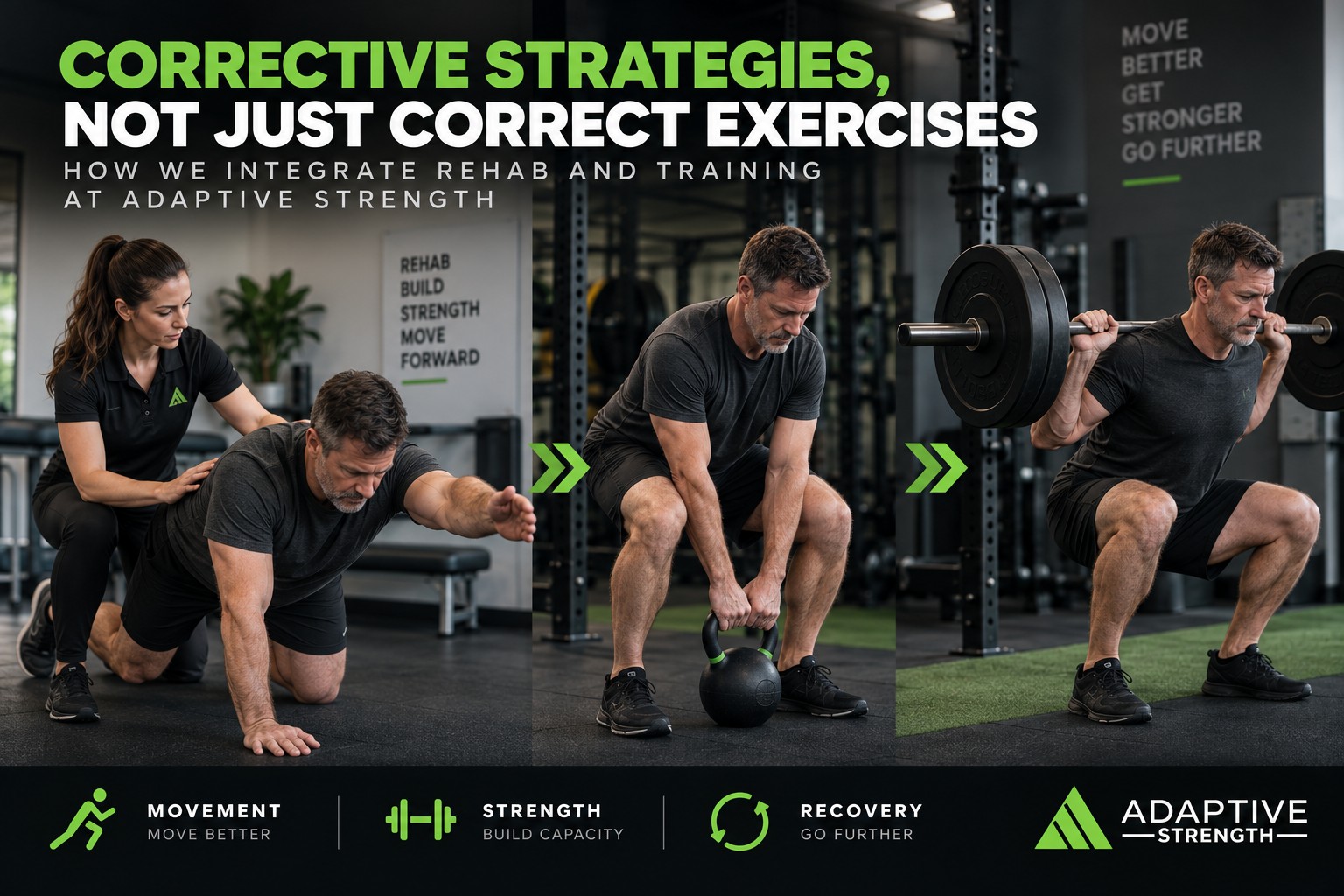
Movement. Strength. Recovery.
A good corrective strategy often involves all three.
Do you have the mobility, stability and control you need for what you’re trying to do?
Is there a position or movement that needs improving?
Can we progressively increase your capacity?
Can we make that movement stronger?
Can your body tolerate more load and more demanding tasks?
What needs modifying or managing while something is irritated, injured or recovering?
Do we need to temporarily change an exercise?
Reduce some load?
Give something more time?
These aren’t three separate stages.
They overlap.
A strength exercise might also improve movement.
A mobility drill might be useful during recovery.
A rehab exercise might gradually become a proper strength exercise.
Sometimes we’re working on Movement, Strength and Recovery in the same exercise.
One Team, One Plan
This is also where the way we work at Adaptive Strength becomes important.
Our team includes physiotherapists, exercise physiologists and exercise science professionals who also coach strength training on the gym floor.
Our physios and EPs don’t just work in treatment rooms.
They also coach, supervise, modify and progress training.
That makes it much easier for the rehab and the strength work to follow the same plan.
Instead of rehab happening in one place and strength training happening somewhere completely separate, we can connect the two.
Rehab Should Have Somewhere to Go
This is probably the biggest point.
If you’re doing a mobility drill, where is it leading?
If you’re doing a band exercise, how are we progressing it?
If you’re rebuilding your squat, when do we start adding load?
If your shoulder is improving, what comes next?
There should be a plan.
Sometimes the exercise is simple.
Sometimes it’s heavy.
Sometimes it clearly looks like rehab.
Sometimes it looks exactly like strength training.
What matters is that each stage is taking you somewhere.
Movement. Strength. Recovery.
All working towards the same outcome.
At Adaptive Strength, we don’t just want to give you the right exercise.
We want to give you the right strategy — and keep progressing it.
Stuck Doing Rehab But Want to Get Back to Proper Training?
If you’ve been given exercises but aren’t sure how they’re supposed to get you back to the things you actually want to do, we may be able to help.
At Adaptive Strength in Booragoon, we bring physiotherapy, exercise physiology and strength coaching together within one system.
Your rehab doesn’t have to sit separately from your training.
We can progressively build the two together.
If you'd like to know more, you can book a quick call with me, Kurt, Head Coach at Adaptive Strength.
We can have a chat about what you're dealing with, where you're currently stuck, what you'd like to get back to, and whether Adaptive might be the right fit for you.
Book a Quick Call With Kurt