If you’ve ever found yourself asking:
“How many calories should I eat?”
“Why am I not losing fat even though I’m exercising?”
“Do I need to do cardio every day to see results?”
…then this article is for you.
Fat loss gets made far more complicated than it needs to be.
Calories.
Macros.
Heart-rate zones.
HIIT.
Metabolism.
Fat-burning workouts.
Wearable devices telling you how many calories you supposedly burned.
It can become confusing very quickly.
But the basic idea behind fat loss is actually pretty simple.
And once you understand a few basic numbers, it starts to make a lot more sense.
What Is BMR and Why Should You Care?
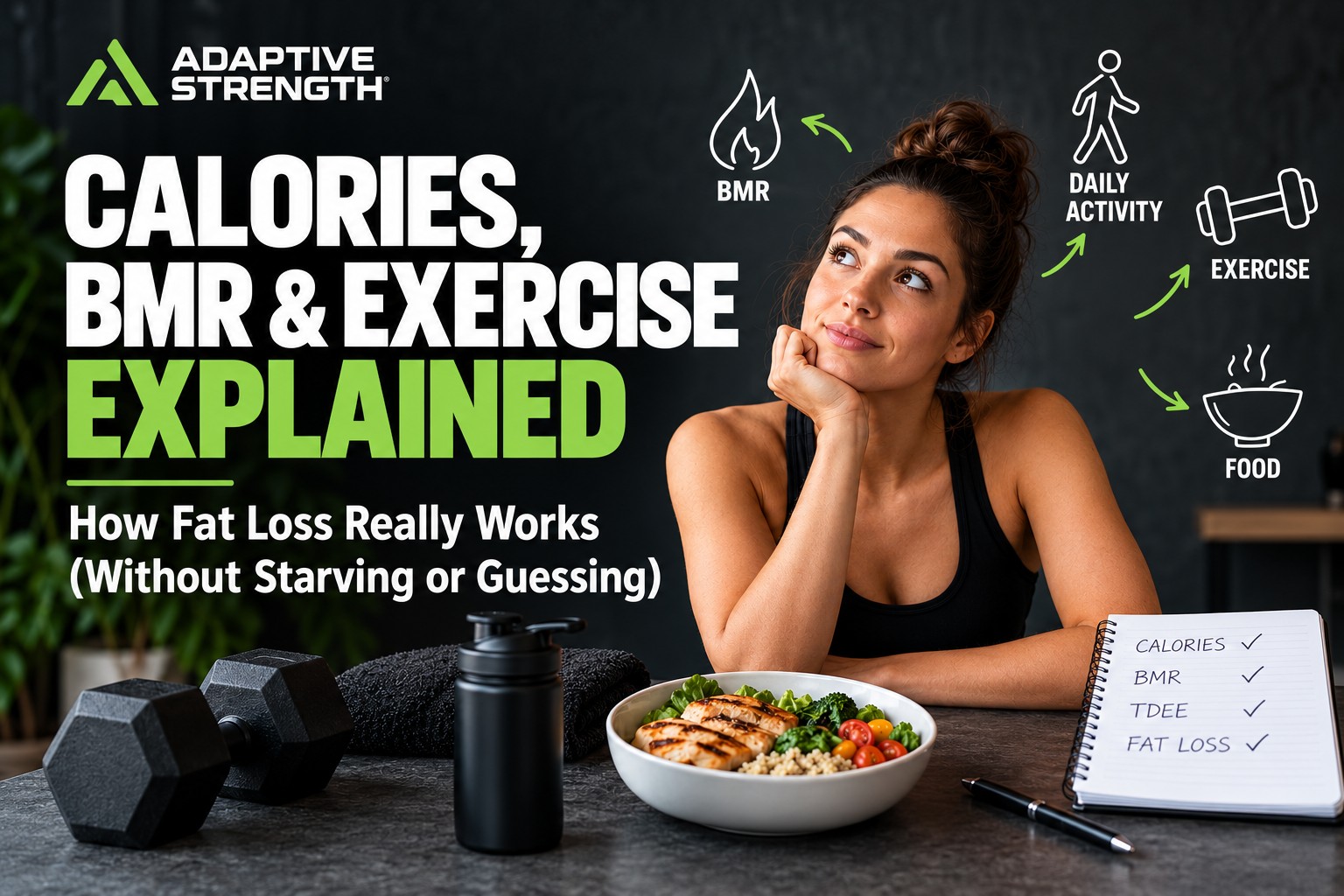
Your Basal Metabolic Rate (BMR) is the number of calories your body needs to keep you alive while at rest.
Think breathing, circulating blood, repairing cells and keeping your brain and organs working.
Even if you stayed in bed all day doing absolutely nothing, your body would still burn calories to:
- Keep your heart beating
- Maintain your breathing
- Regulate your temperature
- Run your brain and organs
- Repair cells and tissue
Your BMR is influenced by things such as:
- Age
- Weight
- Height
- Gender
- Muscle mass
For example, a 26-year-old woman who weighs 80kg and is around 5'4" tall might have a BMR of roughly 1,500–1,600 calories per day.
So even before she goes for a walk, goes to work or trains at the gym, her body is already using around 1,500 calories just keeping her alive.
That is the first number to understand.
What Are Maintenance Calories?
BMR isn't the whole picture.
During a normal day, you also use energy through:
- Walking
- Standing
- Working
- Shopping
- Cleaning
- Exercise
- Sport
- Digesting food
When we add all of this together, we get your Total Daily Energy Expenditure, or TDEE.
You can think of this as roughly how many calories you burn across an entire day.
So our example woman might have a BMR of around 1,500–1,600 calories, but once we add normal daily movement and activity, her total daily energy expenditure might be around 1,800–2,000 calories.
That number is roughly her maintenance calories.
Eat around maintenance = your weight tends to stay similar.
Eat less than maintenance = your weight tends to come down.
Eat more than maintenance = your weight tends to go up.
That is really the basic idea.
The Basics of Fat Loss: Creating a Calorie Deficit
Let’s make this very clear:
One kilogram of body fat stores about 7,700 calories.
So to lose roughly half a kilogram per week, you need to create a deficit of about 3,500 calories across that week — or around 500 calories per day.
There are three ways to create that deficit:
- Eat less — consume fewer calories than maintenance.
- Move more — increase daily activity and/or exercise.
- Do both — usually the most practical approach.
Here’s a simple example.
If your maintenance is around 1,800 calories per day:
You could eat around 1,300 calories per day.
Or eat 1,600 and increase your activity.
Or eat somewhere in between and combine it with walking and training.
The best approach?
The one that fits your lifestyle and that you can actually keep doing.
You Don’t Need to Burn Off Your Food
This is another misconception.
Someone eats a 400-calorie meal and thinks:
No.
Your body isn't sitting there doing nothing until you start exercising.
Remember, your body is already using energy all day.
Your brain.
Your organs.
Walking around the office.
Going to the shops.
Cooking dinner.
Training.
Sleeping.
It all contributes to your total daily energy expenditure.
You don't need your workout calorie number to match your dinner.
That is one of the reasons I don't want people becoming obsessed with how many calories their watch says they burned during a workout.
The workout is only one part of the equation.
Three Hours in the Gym Is Still Only Three Hours
This is another useful way to look at it.
Imagine you train three times per week for one hour.
What happens during the other 165 hours still matters.
How much you eat.
How much you walk.
How active your job is.
How much sitting you do.
What your weekends look like.
You can have three excellent workouts and still eat enough across the rest of the week to wipe out the calorie deficit you thought you were creating.
That doesn't make exercise unimportant.
It just helps explain why someone can be exercising regularly and still not losing weight.
Why Strength Training Matters During Weight Loss
This is where strength training becomes incredibly important.
If the only goal is making the scale smaller, you can simply eat less.
But that's not really what most people want.
They want to lose body fat.
They want their waist smaller.
They want their clothes fitting better.
They want that firmer, more toned look.
And they want to feel stronger.
I don't want you simply becoming a smaller, weaker version of yourself.
While you lose weight, we want to keep as much muscle and strength as possible.
That is one of the big jobs of strength training.
Lose fat. Keep muscle. Get stronger.
That's a much better outcome than simply making the number on the scales smaller.
What About Cardio?
Cardio can absolutely help with weight loss.
Walking.
Cycling.
Swimming.
Running.
Rowing.
They all increase how much energy you use.
But that doesn't mean you need to spend every day doing HIIT or trying to burn as many calories as possible.
Strength training and cardio have different jobs.
Cardio can help increase your activity and improve your fitness.
Strength training helps you maintain and build muscle and become stronger.
You don't have to choose one or the other.
Strength training + regular everyday movement + some cardio if you enjoy it or it supports your goals.
You don't need endless cardio.
And you certainly don't need every workout to leave you wrecked.
“But My Heart Rate Wasn’t Very High”
This is another one we hear.
“I wasn't puffing that much.”
“I didn't really sweat.”
“My heart rate wasn't very high.”
So people assume the workout didn't do much.
But if you're strength training, the goal isn't necessarily to keep your heart rate as high as possible.
Sometimes you lift.
You rest.
You recover.
Then you perform another good-quality set.
You may not be dripping in sweat.
You may not be gasping for air.
That doesn't mean nothing is happening.
“Am I getting stronger?”
Not:
“How wrecked did I feel afterwards?”
You Don’t Need to Starve Yourself Either
There is another mistake people make once they understand calorie deficits.
They think:
Maybe on paper.
But now you have another problem.
Can you actually sustain it?
Are you constantly hungry?
Do you have enough energy to train?
Are you recovering?
Are you losing strength?
Are you likely to stick to it for more than a couple of weeks?
The goal isn't to create the biggest calorie deficit you can survive.
It is to create one you can maintain long enough to get a result.
Fat loss does not need to involve starving yourself.
So What Actually Works?
For most people, the basics are pretty simple.
Understand roughly how many calories you need.
Create a sensible calorie deficit.
Strength train.
Walk and stay active.
Add some cardio if you enjoy it or it helps your fitness.
Eat enough protein.
Be consistent.
Give it time.
That is basically it.
You don't need a magical fat-burning workout.
You don't need to do HIIT every day.
You don't need to burn off every meal.
You don't need to starve yourself.
And you don't need to guess.
Fat Loss Is Simpler Than It Is Often Made to Sound
Your body uses energy every day.
Your BMR is the energy required just to keep you alive.
Add your normal movement, exercise and digestion, and you get your approximate daily energy expenditure.
Eat roughly the same amount as you use and your weight tends to stay similar.
Eat less than you use and, over time, your weight tends to come down.
That is the basic idea.
And when weight loss is the goal, I don't just want the scale moving down.
I want you keeping muscle.
Getting stronger.
Feeling fitter.
And building something you can actually maintain.
Lose fat. Keep muscle. Get stronger.
Keep it simple.
And let consistency do the work.
Want Some Help Making Sense of It?
If you'd like some help putting the numbers and the training together, you can book a quick call with me, Kurt, Head Coach at Adaptive Strength in Booragoon.
We can have a chat about what you're trying to achieve, what you've tried before, and whether Adaptive might be the right fit for you.
Book a Quick Call With Kurt