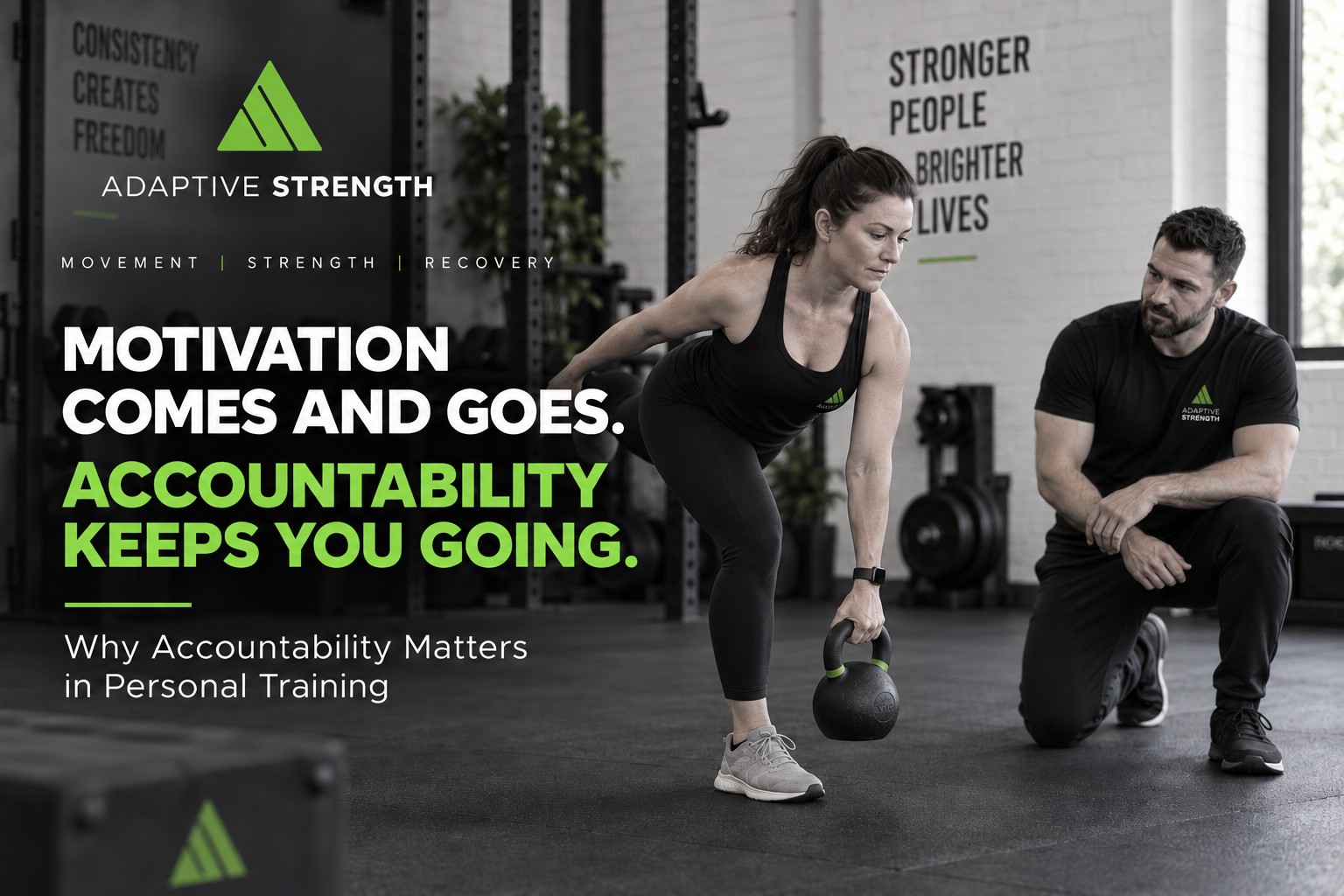
Motivation Comes and Goes: Why Accountability Matters in Personal Training
Most people know exercise is good for them.
The harder part is doing it consistently.
Some weeks you feel motivated.
Other weeks work gets busy, the kids get sick, you are tired, you have been away, or something simply gets in the way.
That is normal.
I don’t think the answer is to rely on motivation.
Consistency is easier when there is some structure around you.
A program.
A regular training time.
Coaches who know what you are working towards.
Someone paying attention to your progress.
And a bit of accountability when you need it.
That is what accountability means to me.
It is not someone standing over you, making you feel guilty because you missed a session.
It is knowing that someone notices, someone cares, and someone is there to help you keep going when life gets in the way.
Accountability Goes Both Ways
You still have to do the work.
You still have to turn up.
You still have to make decisions that support the things you say are important to you.
But I also believe the coach has responsibilities.
We need to give you a program that makes sense for you.
We need to know what you are trying to achieve.
We need to progress the program as you improve.
And if something changes — work, family, illness, an injury, your schedule or your energy — we need to help you adapt rather than simply watching the whole routine fall apart.
We are accountable for giving you good coaching and paying attention.
That is the two-way street.
If You Don’t Turn Up, We Notice
If you don’t turn up, or you miss a couple of sessions, we notice.
Especially if you have been training consistently and that is not normal for you.
So we will usually check in.
Not to pressure you or make you feel guilty.
We simply want to make sure you are okay.
Most of the time there is a pretty normal explanation.
You have been sick.
Work has become hectic.
Family life has got in the way.
You have been away.
Or you have simply had one of those weeks where training did not happen.
Usually it is just a matter of checking in, seeing how you are going and helping you get back into your normal routine the following week.
Sometimes there is something else going on.
Maybe an injury has flared up.
Maybe your normal training times no longer work.
Maybe you are struggling to get back into the habit.
That is useful for us to know, because then we can actually help.
If you have been turning up consistently and then miss a couple of sessions, I think somebody should notice.
Because we know you. We know your normal routine. And we care whether you are doing okay.
Sometimes Accountability Means Having an Honest Conversation
Good coaching is not always just encouragement.
Sometimes it means having a conversation.
If you have told us you want to train twice a week, but you have barely made it in for the last month, I think it is reasonable for us to talk about it.
Respectfully.
Not:
“Why haven’t you been training?”
More:
“You told us this was important to you. What is getting in the way?”
Maybe the answer is work.
Maybe your schedule has changed.
Maybe you are tired.
Maybe something hurts.
Maybe you have simply lost momentum.
Once we know what the problem is, we can usually do something about it.
Sometimes accountability is simply reminding someone of what they told us mattered.
You Need a Plan Worth Being Accountable To
It is much easier to stay consistent when there is a reason behind what you are doing.
At Adaptive Strength, members have an individual program.
You know what you are working on.
Your coaches know what you are working on.
And the program can change as you change.
That matters.
If every session is random, it is difficult to know whether you are actually getting anywhere.
A good program gives the training some direction.
Accountability helps you keep doing it long enough for that program to work.
Your Personal Progress Coach
Every member at Adaptive Strength also has a Personal Progress Coach.
Their job is to keep an eye on the bigger picture.
They check in.
They review how training is going.
They help organise program updates.
They communicate with the coaching and clinical team when needed.
And they help make sure you do not quietly fall through the cracks.
You still have the responsibility to train.
But you do not have to manage everything by yourself.
The Goal Is Not to Make You Dependent on Us
I do not think a good coach should try to make someone dependent on them forever.
Part of coaching is teaching.
Over time, I want people to understand their training better.
Know why they are doing certain exercises.
Become more confident.
Recognise what their body needs.
And take more ownership of their own health and strength.
Some people will always prefer being coached and supervised.
That is completely fine.
Others may eventually need less help.
If someone becomes more confident, capable and independent because we have coached them well, I see that as a success.
Chop Wood. Carry Water.
Chop Wood. Carry Water.
This is why Chop Wood. Carry Water. is one of our core values at Adaptive Strength.
You can read more about what we stand for on our Adaptive Strength Core Values page.
You are not going to feel motivated every time you train.
Some sessions will feel great.
Some will not.
Some weeks will go perfectly.
Other weeks will be messy.
You will get sick.
Work will get busy.
You will travel.
Family life will interrupt things.
You will occasionally miss training.
Then you come back.
Keep doing the work.
Not perfectly.
Just consistently enough, for long enough, to keep moving forward.
That is why accountability matters.
It helps turn training from something you do when you feel motivated into something that becomes part of your normal life.
And when something knocks you out of that routine, there are people around you to help you get back into it.
Want to Know More About Training at Adaptive Strength?
If you are looking for individualised strength training with coaching, structure and accountability, you can book a quick call with me, Kurt, Head Coach at Adaptive Strength in Booragoon.
Book a Quick Call