If you’re over 50 and ready to take control of your health, there’s no better place to start than with strength training.
But before you pick up a dumbbell or step into the gym, there’s one thing you need to know:
That doesn’t mean spending months getting ready before you’re allowed to train.
It means understanding where you’re starting from, taking into account any injuries, health conditions or limitations, learning the key movements, and having a clear plan for how you’re going to progress.
At Adaptive Strength in Booragoon, we specialise in helping people begin strength training safely, confidently and with a plan.
That’s why we’ve developed a structured onboarding process that ensures you’re not simply jumping into random exercise — but starting at the right level, learning how to train well and building from a strong foundation.
Here’s our Pre-Strength Training Checklist — a step-by-step guide to what we think matters when starting strength training in your 50s and beyond.
Why Preparation Matters More After 50
The body changes with age — there’s no denying it.
Muscle mass and strength can decline if we don’t do something to maintain them.
Bone density can become more important, particularly for people with osteopenia or osteoporosis.
And by the time you reach your 50s or 60s, there’s a fair chance you’ve collected a few things along the way.
An old knee injury.
A shoulder that hasn’t felt quite right for years.
A hip or knee replacement.
A health condition.
Or perhaps simply ten years since you last did any proper strength training.
This doesn’t mean you should avoid exercise.
Quite the opposite:
But it needs to be approached intelligently.
That’s why our team in Booragoon has developed a structured, evidence-informed checklist to make sure we understand where you’re starting from, what needs to be considered and how to build your training safely and progressively.
The goal isn’t to hold you back.
It’s to give you the right foundation to become stronger.
Start With a Proper Assessment
Before we start writing exercises into your program, we want to understand the person doing them.
At Adaptive Strength, our onboarding begins with an initial consultation and assessment.
We want to know:
- Your medical history
- Whether you have osteopenia or osteoporosis
- Any joint replacements
- Previous injuries or surgeries
- Current pain or physical limitations
- Cardiovascular or other health conditions
- Your previous training experience
- What exercise you’re currently doing
- And most importantly, what you actually want to achieve
This isn’t about trying to find reasons why you can’t train.
It’s about collecting the information we need to make good decisions about how you should train.
For many people, it’s straightforward and we can get on with training.
For others, there might be something we want our physiotherapist or exercise physiologist to look at more closely.
Sometimes we may want some additional information from your GP.
That’s part of having a proper plan.
What If You Have Osteoporosis?
Osteoporosis deserves a special mention because it’s one of the reasons some people become nervous about strength training.
But having osteoporosis doesn’t mean strength training is off the table.
Far from it.
Appropriately prescribed resistance training can play an important role in maintaining and improving physical capacity and supporting bone health.
What changes is how we approach it.
Exercise selection matters.
Loading matters.
Progression matters.
And depending on the severity of the osteoporosis and fracture risk, we may want our physiotherapist or exercise physiologist more directly involved.
Know Your Body — Get a Movement Screen
Once we understand your history, the next step is to see how your body moves right now.
That’s where our movement assessment comes in.
This isn’t a test you have to pass.
We’re not looking for a list of things that are “wrong” with you.
We’re looking for useful information.
What can you do comfortably?
What feels restricted?
Where do you lack mobility or flexibility?
What movements feel stiff or difficult?
What are you confident doing?
And what might need a different starting point?
That helps us choose exercises that actually make sense for you and, where appropriate, work on helping you move better and more freely.
Shoulder Movement
We’ll look at how comfortably you can move your shoulders and reach overhead.
If you’ve got limited shoulder range or an old injury, that may influence how we start pressing or pulling exercises.
It doesn’t necessarily mean you can’t train those movements.
It means we choose the right variation and build from there.
Hip and Lower-Body Movement
We’ll also look at things such as:
- Squatting
- Hip hinging
- Stepping
- Balance
- Getting up and down
- How comfortable you are loading the lower body
If you’ve had a hip or knee replacement, have an old injury or haven’t performed these movements for years, we may modify the range, use some support or choose a different exercise initially.
Build the Foundation — Learn the Movements
Before we start chasing heavier weights, we want you to understand the movements you’re going to use.
Our early coaching might include:
- Hip hinge patterning
- Squatting
- Pushing and pulling
- Carrying
- Bracing under load
- Overhead movement
- Getting up and down from the floor
- Hip or thoracic mobility where appropriate
Some of these things might look simple.
That’s okay.
We’re developing the skills that let us do more later.
I don’t believe you need perfect movement before you’re allowed to train.
People are built differently.
People move differently.
And sometimes two people will need two different versions of the same exercise.
But I do want you to understand what you’re doing.
I want you to develop exercise competency.
And I want you confident enough with those movements that we can start adding meaningful load.
Respect the Importance of Good Technique
Once you start strength training, how you perform the exercise matters.
At Adaptive Strength, we’re not interested in rushing someone through a session just so they can say they completed every exercise on the sheet.
If something needs more attention, we give it more attention.
That might mean:
- Adjusting the exercise
- Changing the range of movement
- Slowing the movement down
- Reducing the load
- Adding some support
- Spending more time practising it
Whether it’s a deadlift, squat, row, press or loaded carry, we want you developing good technique and confidence with the movement.
But there’s an important point here.
The reason we teach you to move well is so we can eventually make you stronger.
At some point, the weight needs to increase.
The challenge needs to increase.
Your body needs a reason to adapt.
Start With the Right Load — Then Build It
There are two approaches I don’t particularly like.
The first is:
The second is:
Neither tells us much about what you should actually do today.
The right starting weight is the one that gives you an appropriate challenge right now.
Then we build it.
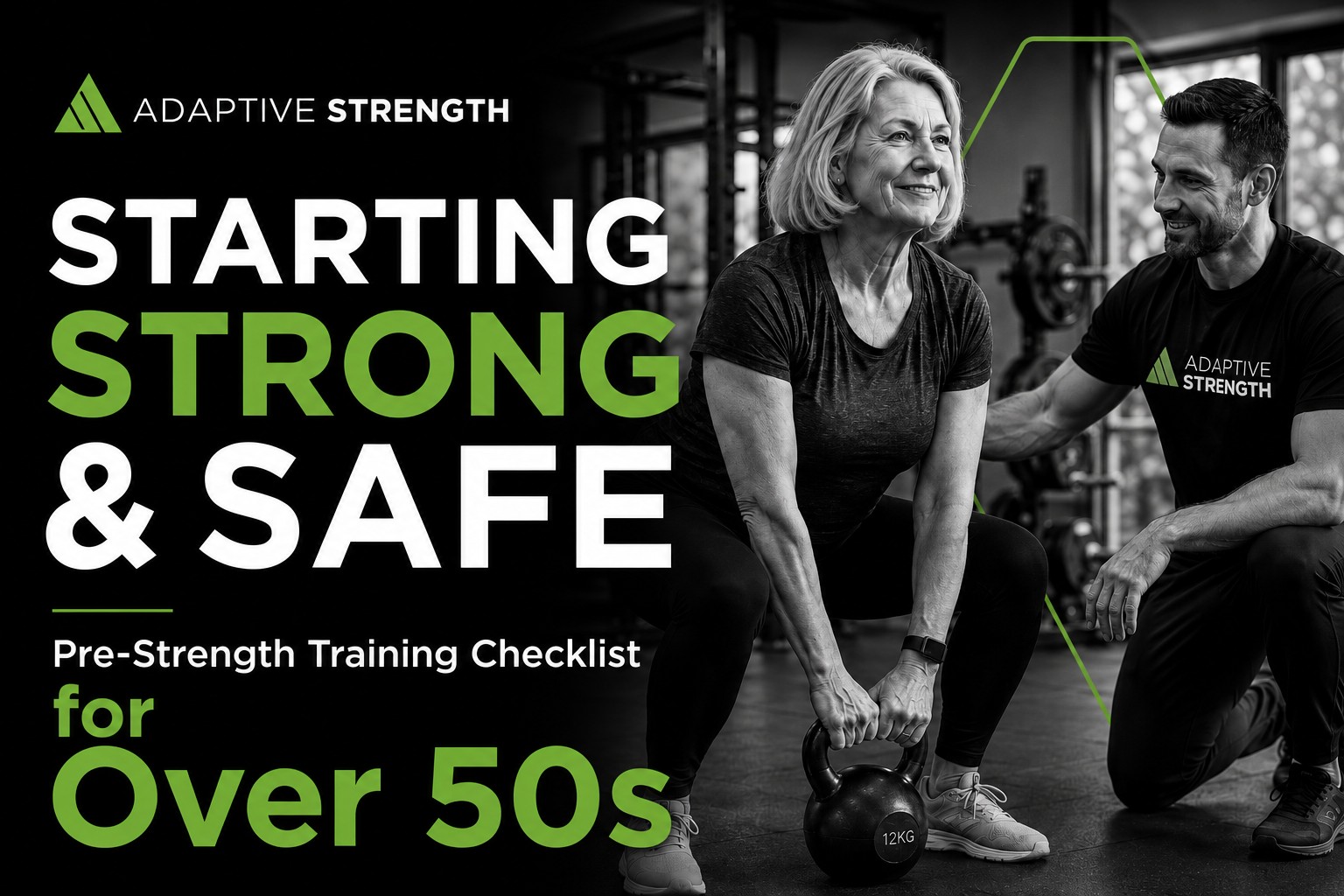
You might start with a kettlebell deadlift.
As your technique, confidence and strength improve, the kettlebell gets heavier.
Later, a barbell might make sense.
You might start squatting to a box.
Over time we can add load, increase the range or progress the exercise.
Someone else may start at a completely different point.
That is exactly why the program is individual.
If you’re stronger six months from now, your training should look different.
Movement. Strength. Recovery.
When we build somebody’s program at Adaptive, a lot of our thinking comes back to three things:
Recovery isn’t what happens when training stops.
Recovery is part of training.
Movement, Strength and Recovery aren’t three separate programs.
They work together.
And the balance between them will change as you progress.
Have a Plan — And a Skilled Coach Paying Attention
This is one of the biggest things that separates how we train people at Adaptive Strength from simply joining a gym and being left to figure things out yourself.
You have an individualised program.
There’s a reason behind what you’re doing.
And you have a skilled strength coach on the gym floor paying attention to how it’s going.
Highly Skilled Strength Coaching
Our strength coaches come from university backgrounds in Exercise Science, Exercise Physiology or Physiotherapy.
They understand strength training.
They understand movement.
They understand progression.
And they’re used to coaching people who may also have previous injuries, health conditions or physical limitations to work around.
This is more than someone standing beside you and counting repetitions.
If something looks too easy, we can progress it.
If an exercise doesn’t feel right, we can modify it.
If you’ve been sick for two weeks, we can adjust things rather than pretending nothing happened.
If you're moving well and getting stronger, we keep building.
And if something needs more specific clinical assessment or treatment, we also have physiotherapy and exercise physiology within Adaptive.
That means we can bring the right person into the process when needed.
The coach provides the skill and judgement to adapt it to the person standing in front of them.
Your First Program Is Just the Starting Point
Your first program is exactly that.
Your first program.
It isn’t where we expect you to stay.
Initially, perhaps we use some more supported exercises.
Maybe the weights are conservative while you learn.
Perhaps we modify around an old knee or shoulder.
Maybe your conditioning work is short while we build your capacity.
That’s fine.
That’s the starting point.
But as you improve, your training should improve with you.
The goal isn’t to keep you doing a “beginner program” forever.
The goal is to build what you're capable of doing.
Your Pre-Strength Training Checklist
- Do we understand your goals?
- Do we know your recent training history?
- Are there any medical conditions we need to consider?
- Do we know about previous injuries, surgeries or joint replacements?
- Do osteoporosis or bone-health concerns need specific consideration?
- Do we understand how you currently move?
- Have we chosen exercises appropriate for your starting point?
- Are you learning to perform those exercises well?
- Is the load appropriate?
- Is there a plan to progressively make the training more challenging?
- Can you recover from the amount of training you’re doing?
- Do you have someone paying attention and making adjustments when needed?
If we know those things, we have a pretty good foundation to build from.
Start Strong — And Keep Building
If you’re over 50 and thinking about strength training, how you start matters.
Understand where you’re at.
Take account of anything that needs to be considered.
Learn the movements.
Start with an appropriate load.
Then build.
Keep developing all three.
Because the goal isn’t simply to get through your first few weeks of strength training.
The goal is to become stronger.
More capable.
More confident.
And to keep building those things for the years ahead.
Not Sure Where You Should Start?
If you want to begin strength training but aren’t quite sure what is appropriate for you — particularly if you’re returning after a long break, have previous injuries, osteoporosis, a joint replacement or other health concerns — that is something we can help you work through.
At Adaptive Strength in Booragoon, we start by talking through your goals, training history, current ability and anything that may affect how you train.
From there, we can work out the right starting point and build an individual program around you.
If you'd like to know more about how we could help, you can book a quick call with me, Kurt, Head Coach at Adaptive Strength.
We can have a chat about what you'd like to achieve, any concerns you have about starting, and whether Adaptive might be the right fit for you.
Book a Quick Call With Kurt