Have you ever wondered what sort of people train with us here at Adaptive Strength?
Below are just some of the people you might find training with us:
- A man in his 40s recovering from a hernia operation
- A woman in her 40s with osteoarthritis
- A man in his late 30s managing lower back pain and recovering from a pec injury
- A woman in her 40s living with kidney disease
- A man in his 50s with diabetes
- A woman in her 50s returning after knee surgery
- A man in his 60s returning to exercise after having a heart stent
- A woman in her 60s managing shoulder problems
Plus, we have a whole range of other members across a very broad spectrum.
Some are extremely fit and healthy.
Some are just starting their fitness journey.
Some have pain or injuries to work around.
Some don't move particularly well when they first come to us.
And some simply want to become stronger and more capable than they are now.
So how can all of these people train at the same gym?
The program is built around the person.
That comes down to two important ideas:
Individualised Programming and Universal Scalability.
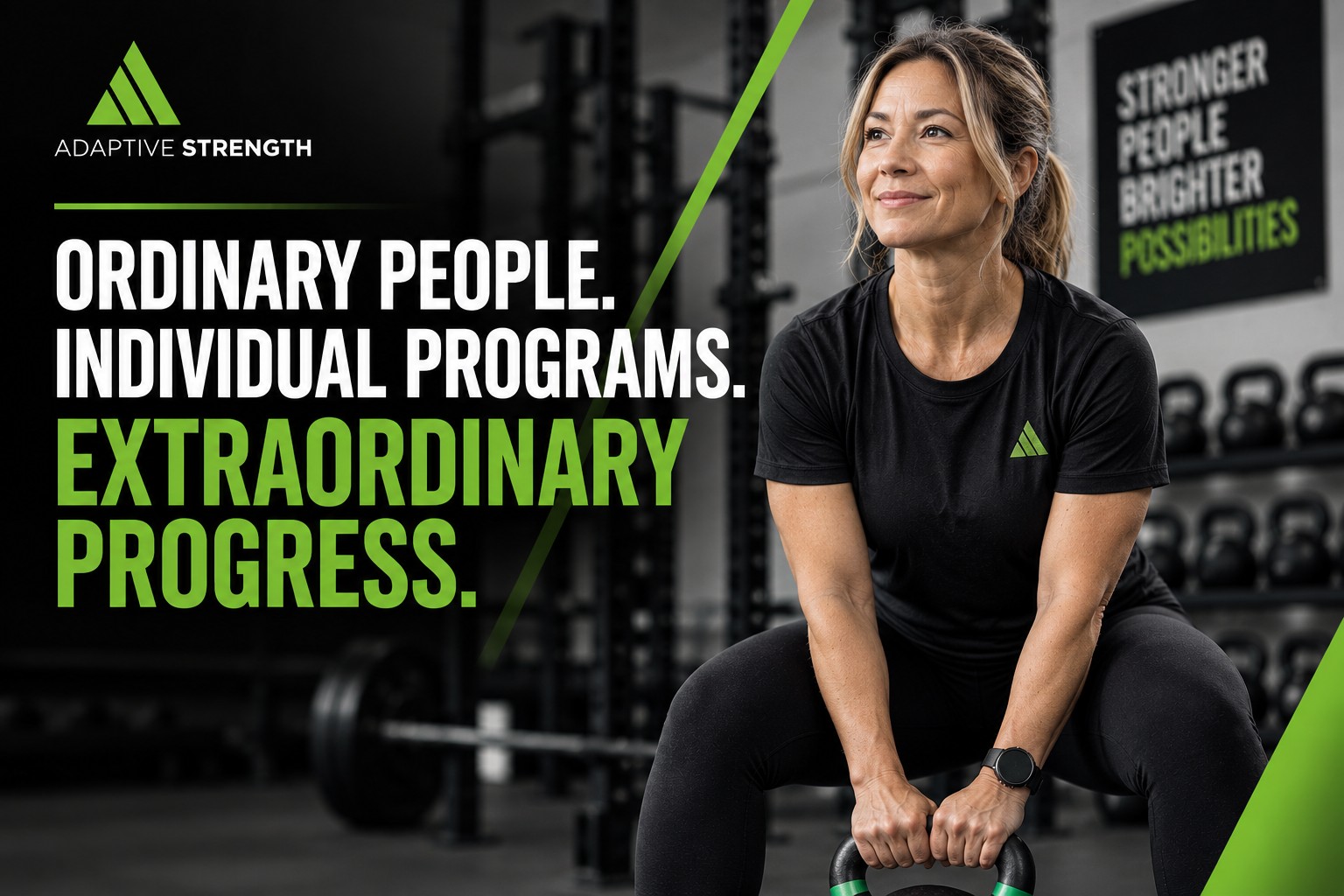
And they're a big part of why ordinary people are achieving extraordinary results at Adaptive Strength.
Individualised Programming
The Program Is Built Around You
Individualised programming is pretty self-explanatory.
It means it doesn't matter where you are right now in your health and fitness journey.
At Adaptive Strength, we create a training program around your individual needs, goals and starting point.
Someone recovering from knee surgery should not have the same program as somebody training for tennis.
A 65-year-old who hasn't strength trained before should not necessarily start in the same place as a 35-year-old who has trained for ten years.
Someone managing an injury may need certain exercises modified while still being able to train everything else.
That seems obvious to me.
But it isn't how every gym operates.
Universal Scalability
The Movement Can Be Adapted to the Person
The next part — Universal Scalability — takes a little more explaining.
And I think this is one of the things that really sets Adaptive Strength apart.
Much of our training is based around fundamental movement patterns.
At Adaptive, we commonly think about movements such as:
These patterns appear throughout both training and everyday life.
Standing up from a chair involves a squat pattern.
Picking something up from the ground involves a hinge.
Walking involves gait.
Carrying the shopping is a carry.
Pushing something away from you is a push.
Pulling yourself up or bringing something towards you is a pull.
The exercises we use in the gym might become more advanced — kettlebell swings, Turkish get-ups, deadlifts, presses and plenty of others — but underneath them are movements we can teach, develop and strengthen.
And this is where scalability becomes so useful.
You Don't Have to Start With the Finished Exercise
Let's use the squat as an example.
That does not mean everybody who walks through our doors immediately gets handed a barbell and told to squat.
The Same Movement — Different Starting Points
One person might comfortably perform a barbell squat.
Another might use a goblet squat.
Someone else may initially squat to a box.
Someone whose hips, knees or legs aren't yet strong enough to squat independently might use their arms for assistance while holding onto a rack or suspension trainer.
They're all training the squat pattern.
You still get to train.
That's Universal Scalability in a nutshell.
Progress It. Regress It. Change It.
Due to strength, mobility, injury, confidence or training experience, a particular exercise may not be appropriate immediately.
That's fine.
Reduce the load.
Change the range of movement.
Provide assistance.
Choose another variation.
Substitute an exercise that trains a similar movement or physical quality.
Then, as you become stronger and more capable, we can progress it again.
That is why two people can be standing ten metres apart inside Adaptive Strength doing completely different-looking exercises — yet both are following programs designed around exactly what they need.
Movement. Strength. Recovery.
This also fits naturally into our broader approach at Adaptive.
Those things aren't identical for everyone.
Which is exactly why the program shouldn't be identical for everyone either.
Yes, Your Grandma Can Strength Train
Just as a side note, I want to throw this out there...
Yes, even though we train with kettlebells and barbells, your grandma could potentially be training with us too.
That doesn't mean I'm going to hand her a 24kg kettlebell on day one.
Maybe she starts with assisted squats.
Maybe she carries a light kettlebell.
Maybe we work on getting up and down from the floor.
And then we build from there.
Give us enough time and she might just become the strongest grandma in her knitting club. 😊
That's the whole point.
We make the training appropriate for where you're starting from — and then help you progress.
The Program Should Fit the Person
This is probably the simplest way I can explain what we do.
We don't take one workout and try to make everybody fit into it.
We look at the person standing in front of us.
And then we build the program from there.
That's Individualised Programming.
Then, when an exercise isn't appropriate yet, we find a version that is.
That's Universal Scalability.
And over time, as your movement improves, your strength increases and your capacity grows, the program grows with you.
Want to Know What This Would Look Like for You?
If you've wondered whether Adaptive Strength would be suitable for you because of your age, fitness level, injury history or health concerns, we can talk through it with you.
At Adaptive Strength in Booragoon, we build individual programs around the person — not the other way around.
If you'd like to know more, you can book a quick call with me, Kurt, Head Coach at Adaptive Strength.
We can have a chat about where you're at now, what you'd like to achieve, and whether Adaptive might be the right fit for you.
Book a Quick Call With Kurt