Strength From the Ground Up: A Full-Body Strength and Conditioning Workout
Strength is not only demonstrated by how much weight you can lift.
It also shows up in your ability to control your body close to the floor, step confidently onto a higher surface, pull your own body weight, rotate with control and maintain effort when you become tired.
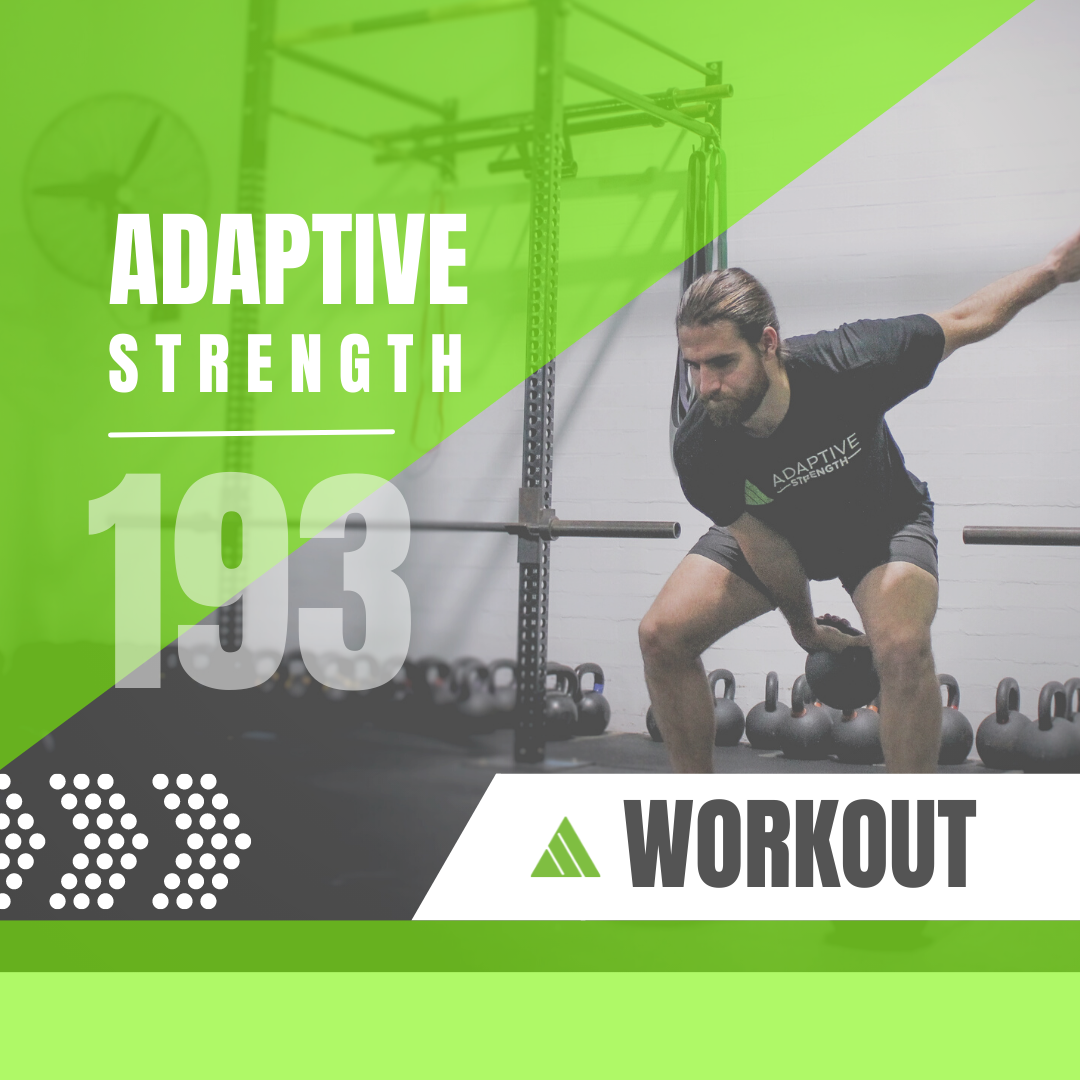
Workout 193 brings these qualities together in one full-body session.
It begins with bear crawling, which challenges coordination, shoulder stability and trunk control. The main strength circuit then combines step-ups, hip raises, chin-ups and wood chops before the workout finishes with three kilometres on the AirBike.
It is a varied session, but the exercises are not random.
Each section has a different purpose:
- The bear crawl asks you to control your body close to the ground.
- The strength circuit trains the hips, legs, upper body and trunk in several directions.
- The AirBike finish develops cardiovascular fitness and whole-body work capacity.
The original version is a substantial workout. You do not need to complete every repetition exactly as written to receive a worthwhile training effect.
The best version is the one that challenges you while still allowing you to move well.
Workout 193 at a Glance
Movement Preparation
Accumulate:
- 5 minutes of bear crawling
This does not necessarily need to be completed continuously. You could divide it into shorter efforts such as five sets of one minute or ten sets of 30 seconds.
Full-Body Strength Circuit
Complete five rounds:
- Step-up: 8 repetitions on each leg
- Hip raise: 8 repetitions
- Chin-up: 5 repetitions
- Wood chop: 8 repetitions on each side
Rest as needed between exercises and rounds.
Conditioning Finish
Complete:
- 3 kilometres on the AirBike
Use a pace you can maintain without your effort falling apart halfway through.
The original workout was designed to be completed in 60 minutes or less.
Block One: Control Close to the Ground
Five Minutes of Bear Crawling
The workout begins with five minutes of bear crawling.
A bear crawl usually involves moving forwards, backwards or laterally while supporting your body through your hands and feet. Your knees remain close to the floor as opposite arms and legs move together.
Although bear crawling may look playful, it can become demanding very quickly.
It challenges:
- Shoulder stability
- Upper-body support strength
- Core and trunk control
- Hip stability
- Coordination
- Awareness of body position
- Contralateral movement
- Cardiovascular fitness
Contralateral movement means coordinating opposite limbs, such as the right hand and left foot. This pattern is also present during walking and running.
The goal is not to crawl as quickly as possible. Try to remain controlled and keep your steps relatively small.
Your hips should stay reasonably steady rather than moving dramatically from side to side.
Why Start the Workout With Bear Crawls?
The bear crawl introduces several qualities that will be used later in the session.
Your shoulders and upper body must support you before the chin-ups.
Your trunk must resist excessive rotation before the wood chops.
Your hips and legs must coordinate as you move before the step-ups and AirBike.
It also raises your body temperature and breathing rate without requiring you to begin with a maximal strength exercise.
However, five minutes is a substantial amount of crawling.
For most people, it will be better to accumulate the time rather than attempting one uninterrupted five-minute effort.
A practical structure could be:
- Crawl for 30 seconds
- Rest for 30 seconds
- Repeat for 10 rounds
Another option is:
- Crawl for one minute
- Rest long enough to recover
- Repeat for five total efforts
Someone new to bear crawling could begin with 10–20-second efforts.
Making the Bear Crawl More Manageable
Possible variations include:
- Holding a stationary bear position
- Taking only a few steps at a time
- Crawling forwards before walking back normally
- Crawling with the hands elevated on a stable box
- Reducing the total time
- Performing a quadruped crawl with the knees on the floor
- Using a bird-dog variation instead
The most appropriate version depends on your wrist, shoulder and trunk strength, as well as your confidence moving near the floor.
Block Two: Strength in Different Directions
After the bear crawl, complete five rounds of step-ups, hip raises, chin-ups and wood chops.
This circuit is effective because the exercises do not all challenge the body in the same way.
The step-up develops single-leg strength.
The hip raise develops strength through hip extension.
The chin-up trains upper-body pulling and grip strength.
The wood chop develops rotational strength and coordination between the lower and upper body.
Together, they ask the body to produce and control force through several different positions.
Step-Ups: Strength for Stairs, Hills and Single-Leg Movement
Complete eight repetitions on each leg.
A step-up involves placing one foot securely onto a box or step and using that leg to raise your body onto the surface.
It develops strength through the:
- Quadriceps
- Glutes
- Hips
- Feet and ankles
It also challenges balance and control because one leg performs most of the work.
This has a clear relationship to everyday activities such as:
- Climbing stairs
- Stepping onto a curb
- Walking uphill
- Hiking
- Carrying an object upstairs
- Getting into a higher vehicle
Single-leg strength is also important during running, jumping, landing and changing direction.
The step height should match your current ability. A higher box is not automatically better.
Use a height that allows you to:
- Place your whole foot on the box
- Keep your knee moving in the same direction as your toes
- Drive through the leg on the box
- Avoid pushing excessively from the lower foot
- Stand tall at the top
- Lower yourself under control
If balance is the main limitation, hold onto a stable support or use a lower box.
Hip Raises: Building Strength Through the Hips
Complete eight repetitions.
The hip raise is commonly performed lying on your back with your knees bent and feet on the floor. You drive through your feet, raise your hips and then lower under control.
It is also commonly called a glute bridge.
The movement develops:
- Glute strength
- Hip extension
- Hamstring contribution
- Trunk and pelvic control
- Awareness of producing force through the hips
Hip extension is used when moving from a bent position towards standing.
It contributes to everyday activities such as:
- Standing from a chair
- Walking uphill
- Climbing stairs
- Lifting from the floor
- Moving out of a low position
It also contributes to athletic movements such as running, sprinting and jumping.
During the hip raise, focus on lifting through the hips rather than creating the movement by excessively arching the lower back.
A short pause at the top can help you maintain control.
The exercise can be made more challenging by:
- Adding a resistance band
- Holding weight across the hips
- Increasing the pause
- Using a single-leg variation
- Progressing to a bench-supported hip thrust
Chin-Ups: Pulling and Grip Strength
Complete five repetitions.
A chin-up is generally performed with the palms facing towards the body. You pull your body towards a fixed bar before lowering under control.
Chin-ups develop:
- Upper-back strength
- Lat strength
- Arm strength
- Grip strength
- Shoulder-blade control
- Trunk stability
- Confidence supporting your body weight
Five chin-ups may be appropriate for an experienced person, but it will not suit everyone.
The aim is not to force your chin over the bar using swinging, kicking or a very shortened range.
Use an alternative that allows you to perform controlled pulling work.
Options include:
- Band-assisted chin-ups
- Assisted chin-up machine
- Eccentric chin-ups
- Isometric holds
- Lat pulldowns
- TRX rows
- Cable rows
An assisted chin-up is not a lesser exercise. It is a way of matching the movement to your current strength.
Over time, assistance can be reduced as your pulling and grip strength improve.
Wood Chops: Producing and Controlling Rotation
Complete eight repetitions on each side.
Wood chops are usually performed with a cable or resistance band. The resistance travels across the body while the hips, trunk and upper body work together.
Depending on the setup, the movement may travel:
- From high to low
- From low to high
- Horizontally across the body
The original workout does not specify the exact direction, so follow the variation demonstrated by your coach.
Wood chops can develop:
- Rotational strength
- Trunk control
- Coordination between the hips and shoulders
- Balance
- Shoulder and upper-back strength
- The ability to transfer force across the body
Rotation is part of many normal activities.
We rotate when moving an object from one side to another, reaching across the body, unloading a vehicle or pulling something from beside us.
Rotational strength may also support sports such as golf, tennis, cricket, hockey and throwing sports.
However, the wood chop does not teach a golf swing or tennis stroke. It develops general strength and coordination that may support those skills.
Focus on moving smoothly and controlling the return.
Do not allow the cable or band to pull you rapidly back to the starting position.
Block Three: Finish With the Engine
Three Kilometres on the AirBike
After the strength circuit, complete three kilometres on the AirBike.
The AirBike uses both the arms and legs. As you pedal, you also push and pull the moving handles.
This makes it a whole-body conditioning exercise.
The AirBike can help develop:
- Cardiovascular fitness
- Leg endurance
- Upper-body pushing and pulling endurance
- Whole-body coordination
- The ability to sustain effort
- General work capacity
Three kilometres is long enough that pacing matters.
Starting at an all-out sprint may feel impressive for the first few hundred metres, but it can cause your speed and technique to fall dramatically later.
A better approach is to begin at a strong but controlled pace.
Try to find a rhythm that allows you to:
- Use both the arms and legs
- Maintain a consistent breathing pattern
- Keep your trunk relatively controlled
- Avoid a major drop in output
- Finish as strongly as—or slightly stronger than—you started
The goal is not necessarily to make the final section easy. It should be challenging.
The goal is to distribute your effort intelligently rather than exhausting yourself in the opening minute.
Coach’s Notes for Workout 193
Accumulate the Bear-Crawl Time
Five minutes of crawling does not need to mean one uninterrupted five-minute set.
Shorter efforts will usually allow better shoulder, hip and trunk control.
Earn the Step Height
Select a box based on your strength and control rather than trying to use the highest option available.
The working leg should do most of the work.
Modify Chin-Ups Before Technique Disappears
Use assistance while you can still control the full movement.
Do not wait until you are swinging, kicking and dropping rapidly from the bar before changing the exercise.
Control Both Directions of the Wood Chop
Moving the cable across the body is only half of the repetition.
Control the return rather than allowing the resistance to pull you back.
Respect the AirBike Distance
Three kilometres is not a ten-second sprint.
Begin strongly but leave enough capacity to maintain your pace throughout the distance.
Three Ways to Make the Workout Yours
Returning to Strength Training
Try:
- Two to three accumulated minutes of bear crawling
- Two to three strength rounds
- A low step or supported step-up
- Bodyweight hip raises
- TRX rows or assisted chin-ups
- Light resistance for the wood chop
- One to 1.5 kilometres on the AirBike
The goal is to become familiar with the movements and finish feeling as though you could have completed a little more.
Training for General Strength and Fitness
Try:
- Three to five accumulated minutes of bear crawling
- Four to five strength rounds
- Moderate resistance for the step-up and wood chop
- An appropriate chin-up or pulldown variation
- Two to three kilometres on the AirBike
Aim for consistent movement from the first round to the last.
Looking for a Greater Challenge
Complete the original workout:
- Five minutes of accumulated bear crawling
- Five strength rounds
- Three kilometres on the AirBike
Increase the challenge by using appropriate resistance or more advanced exercise variations.
You could also aim to maintain a more even AirBike pace or finish the second half slightly faster than the first.
Avoid increasing the load, exercise difficulty and total volume all at the same time.
Where Does This Workout Fit?
Workout 193 provides a broad whole-body session.
It includes:
- Ground-based movement
- Single-leg strength
- Hip extension
- Upper-body pulling
- Rotational strength
- Cardiovascular conditioning
However, it is still one workout rather than a complete training program.
There is relatively little upper-body pressing or heavier bilateral leg work. It also does not include a substantial loaded carry or heavier hip-hinge exercise.
Those qualities could be trained during other sessions.
The appropriate version of Workout 193 would also depend on:
- What you trained earlier in the week
- Your current goals
- Your injury and training history
- Your experience with each exercise
- How well you recover
- Your sport or other physical activities
A good program does not simply provide a collection of challenging workouts.
It determines which physical qualities you need to develop, how much training you can currently manage and how the sessions should progress over time.
Individualised Strength Training in Booragoon
The difficult part is rarely finding another workout online.
It is knowing:
- Which exercises are appropriate for you
- How much work you need
- What weight or variation you should begin with
- How your training should fit around injuries or limitations
- When an exercise should be progressed
- What should change when your goals or circumstances change
At Adaptive Strength in Booragoon, every member follows an individualised program while training in a supervised small-group environment.
You are not expected to complete the same workout as everyone else in the room.
Your program is based on your goals, current ability, training experience, injury history and weekly schedule.
Our strength coaches, physiotherapists and Exercise Physiologist work together to help you train at an appropriate level and progress over time.
One member may complete supported step-ups, hip raises and TRX rows before a short AirBike effort.
Another may use heavier step-ups, unassisted chin-ups and a more challenging conditioning target.
Both can train in the same supportive environment while following programs designed for their individual needs.
The value is not simply being given a list of exercises.
It is having a program designed for you, coached properly and progressed over time.
The first step is an initial consultation and movement assessment.
Book a quick chat with Adaptive Strength to find out whether our approach is right for you.